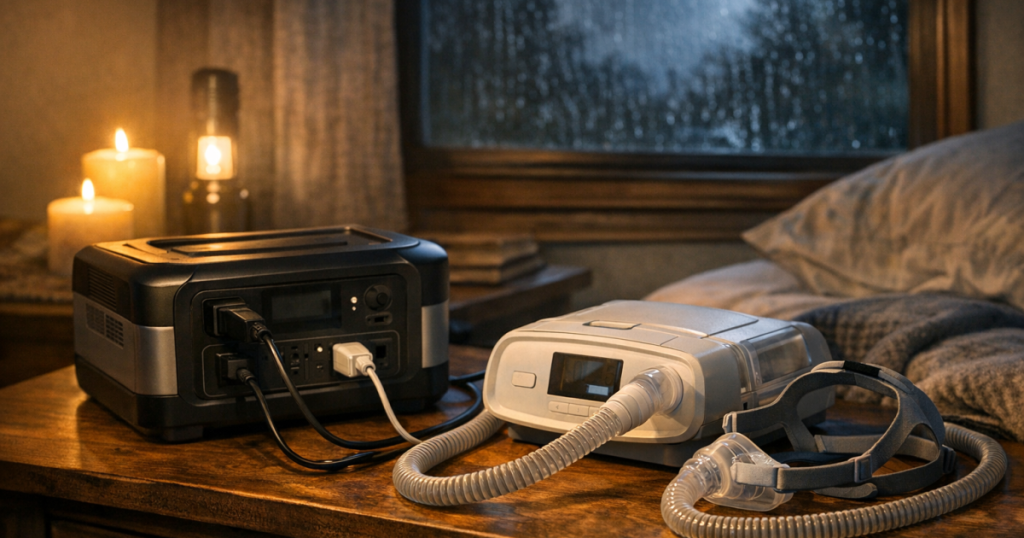
For anyone who depends on sleep therapy, a blackout is not just inconvenient. A CPAP portable power station setup can keep the machine running overnight, but only if you size it around your real machine, settings, humidifier use, and recharge plan.
The goal is simple: know what your CPAP draws, decide how many nights you need, and test the battery before the weather turns bad.
Medical device settings, oxygen use, and changes to prescribed therapy should be handled by your sleep medicine clinician or durable medical equipment provider in line with manufacturer instructions, local regulations, and applicable safety requirements.
The short version
- Most planning starts with watt-hours, not just the size or marketing name of the battery.
- A CPAP usually uses far less power with the heated humidifier and heated tubing turned off, but only change comfort settings in a way that still lets you use therapy properly.
- Measure your actual setup with a plug-in watt meter if your machine uses a standard AC wall plug.
- Plan for inverter losses, battery reserve, cold weather, and battery age instead of assuming the full rated capacity is usable.
- Do a full overnight test at home before you need the setup during a storm, wildfire shutoff, or grid failure.
Step 1: Find the CPAP power information you already have
Start with the label on the CPAP power brick, the machine label, or the user manual. You are looking for input voltage, output voltage, amps, and watts. Some CPAP machines use an external AC power brick. Others may have a DC input option with the right manufacturer-approved cable.
Do not assume two machines from the same brand use the same amount of energy. Pressure setting, mask leak, humidification, heated tubing, altitude compensation, and comfort features can all change real-world draw. A travel CPAP may use less than a full-size bedside unit, but that is not guaranteed for your settings.
If the label says something like 24V and 3.75A, multiply volts by amps to estimate the maximum output of the power supply. That number is not the same as your overnight average, but it tells you the power station must be able to handle the equipment safely. The more useful number is average watts while you actually sleep.
Step 2: Measure your real overnight draw
The most reliable home test is to plug the CPAP into a watt meter, then plug the meter into the wall. A simple meter such as the P3 Kill A Watt P4400 can show watts while the machine is running and total kilowatt-hours used overnight. Use your normal mask, normal pressure settings, and the same humidifier setting you would likely use during an outage.
Run at least one test with the heated humidifier on and one with it off or reduced. Many households discover that heat is the biggest power variable. The blower itself may be manageable for a modest battery, while humidification can shorten runtime sharply. Treat those results as your personal baseline rather than relying on generic runtime claims.
After the test, convert the reading into watt-hours. If the meter shows 0.35 kWh for the night, that is about 350 watt-hours. If it shows 0.70 kWh, that is about 700 watt-hours. This one number helps you decide whether a power station can cover one night, two nights, or only part of a night.
Step 3: Estimate runtime without fooling yourself
Portable power stations are usually rated in watt-hours. A 500 Wh unit does not necessarily deliver 500 Wh to your CPAP through the AC outlet because the battery has to run an inverter, and manufacturers may reserve some capacity to protect the battery. For planning, build in a safety margin.
A plain-English estimate looks like this:
- Start with the power station capacity in watt-hours.
- Subtract a practical margin for inverter loss and reserve.
- Divide the remaining watt-hours by your measured average CPAP watts or overnight watt-hour use.
For example, if your measured CPAP use is about 300 Wh per night, a small 300 Wh station is too close for comfort. A larger unit gives you room for startup draw, colder conditions, age-related capacity loss, and the reality that outages rarely happen at a convenient time. If your machine uses 700 Wh per night with heat and humidity, you either need a much larger battery, reduced heat settings, a recharge plan, or a different medically appropriate backup approach.
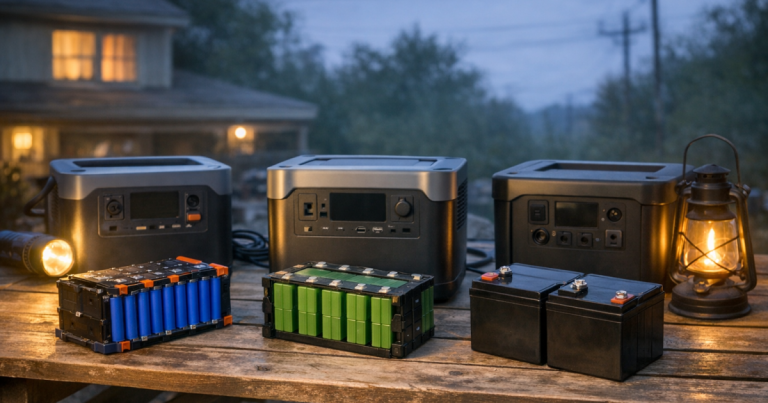
Battery chemistry also matters for long-term outage planning, storage, and cycle life. If you want a deeper plain-English explanation of lithium-ion, lithium iron phosphate, and what those terms mean for backup use, read what matters about battery types in portable power stations.
Step 4: Decide whether to use AC or DC power
Many people plug the CPAP’s normal wall adapter into the AC outlet on the power station. That is convenient, familiar, and easy to test. The downside is that AC output uses an inverter, which can waste some energy compared with a direct DC connection.
Some CPAP machines support DC operation with the correct manufacturer-approved cable or converter. This can improve efficiency in certain setups, but it must be matched to the exact machine voltage and connector. Do not improvise cables, adapters, or polarity. A wrong DC setup can damage equipment or create a safety hazard.
If you use AC power, confirm that the power station’s continuous output rating is higher than the CPAP system’s needs. If you use DC power, confirm the voltage, connector, cable rating, and manufacturer guidance. In either case, do a full sleep-length test before treating it as your blackout plan.
Step 5: Reduce power draw without making therapy unusable
The best runtime improvement usually comes from managing comfort features, not from turning off therapy. Heated humidifiers and heated hoses can draw significantly more power than the blower alone. During a short outage, some users can tolerate lower humidity or no heated tubing for one night. Others cannot sleep comfortably without it, especially in dry winter air.
Practical ways to lower draw include:
- Lowering or turning off heated humidification if you can still use the CPAP comfortably.
- Turning off heated tubing if room conditions allow.
- Using a well-fitting mask to reduce leaks that make the machine work harder.
- Keeping the machine and battery indoors at normal room temperature.
- Avoiding extra loads on the same battery, such as laptops, TVs, or space heaters.
Do not power resistive heating appliances, electric blankets, coffee makers, or space heaters from the same portable station you are counting on for medical sleep equipment. Those loads can drain a battery quickly and may exceed the station’s output rating.
Step 6: Set up the power station safely at bedtime
Place the power station on a stable, dry surface where airflow is not blocked. Keep it away from bedding, water glasses, humidifier spills, and tripping hazards. Use the shortest practical cord arrangement, and do not bury power cords under blankets or rugs.
If the power station has a display, check remaining charge before bed. If it has an auto-shutoff or eco mode, test whether the CPAP draw is high enough to keep the outlet active all night. Some batteries shut down when they think the load is too small. That behavior is manageable only if you discover it during a test, not at 2 a.m. during an outage.
For broader indoor setup precautions, including charging, ventilation, cord routing, and what not to plug in, keep the portable power station indoor safety guide handy as part of your outage plan.
Step 7: Test the full night before you need it
A daytime five-minute test only proves the CPAP turns on. It does not prove the battery will last through a full night, that eco mode will behave, or that your humidifier settings are realistic. The useful test is a normal night at home while grid power is available.
Before bed, charge the power station to the level you expect to have during an outage. Plug in the CPAP the way you plan to use it. In the morning, record the remaining battery percentage and any issues. Repeat with lower humidifier settings if you need more reserve.
Write the result on a note kept with the power station: “CPAP, no heated tube, humidity level 1: used about 40% overnight,” or whatever your setup shows. That note is more useful during a stressful outage than trying to remember numbers from a manual.
Step 8: Plan how you will recharge during a longer outage
One-night backup is easier than three-night backup. For longer outages, decide how the battery will be recharged. Options may include wall charging before a storm, car charging while driving or while the vehicle is safely operated outdoors, solar panels during daylight, or recharging from a generator that is running outside and far from doors, windows, vents, and garages.
Solar can help, but it is weather-dependent and slower than many people expect in cloudy storm conditions. Car charging can help, but it uses fuel and should not be done in an enclosed garage. Generator charging can be useful for households that already have a safe generator plan, but a generator must never be run indoors or in an attached garage.
If CPAP therapy is essential every night, build a layered plan: one battery ready at the bedside, a recharge method, and a backup place to go if the outage outlasts your equipment. That could be a family member’s home with power, a cooling center, a hotel, or another location identified before storm season.
Special cases that need extra attention
CPAP with supplemental oxygen
If you use oxygen with CPAP, your backup plan needs medical and equipment-provider input. Oxygen concentrators, oxygen safety rules, and oxygen storage are separate from standard CPAP battery planning. Do not assume a portable station sized for a CPAP will also run an oxygen concentrator.
BiPAP, APAP, and higher-pressure therapy
BiPAP and APAP machines may have different power behavior than a fixed-pressure CPAP. Higher pressures and large leaks can increase demand. Measure the actual machine in the mode and settings you use.
Apartment and renter setups
Portable stations are often attractive for apartments because they do not burn fuel indoors and do not require a permanent electrical installation. Still, renters should keep cords tidy, avoid balcony generator use that could endanger neighbors, and plan charging around building rules and safe access.
Travel CPAP units
A travel CPAP can be useful as part of a backup plan, but it should not be assumed to be medically interchangeable without checking your prescription, mask compatibility, comfort needs, and manufacturer guidance. Test it the same way you would test your primary machine.
A simple bedside outage checklist
- CPAP machine, mask, hose, and water chamber cleaned and ready.
- Portable power station fully charged and tested overnight.
- Correct AC adapter or manufacturer-approved DC cable stored with the unit.
- Written runtime notes based on your own testing.
- Distilled water if you use humidification and have room to store it.
- Small flashlight or lantern near the bed.
- Phone charged and emergency contacts accessible.
- Recharge plan for outages lasting more than one night.
For lighting near the bed, use a battery lantern or flashlight instead of draining the CPAP battery for room lighting. Keeping medical sleep equipment on its own battery whenever possible makes your runtime estimate cleaner and your plan easier to manage.
Common questions
Can a portable power station run a CPAP all night?
Yes, if the station has enough usable capacity for your machine and settings. The only dependable answer comes from measuring your own CPAP overnight and testing the battery for a full sleep period.
Should I turn off the CPAP humidifier during an outage?
Turning off or lowering heat can greatly extend runtime, but comfort matters. Test lower settings before an outage so you know what you can tolerate without skipping therapy.
Is a UPS the same as a portable power station?
No. A UPS is designed to bridge short power interruptions for electronics, while a portable station is usually intended for longer battery use. Some power stations offer UPS-style features, but verify switchover behavior and medical-device guidance before relying on that mode.
Can I plug a CPAP into a power strip connected to the battery?
It is usually better to plug the CPAP directly into the power station or use only a simple, properly rated cord arrangement if needed. Avoid overloaded strips, damaged cords, and mixing essential medical equipment with nonessential loads.
How much reserve should I plan for?
Plan more capacity than the exact math suggests. A practical reserve helps cover inverter losses, colder rooms, battery aging, pressure changes, and the chance that the outage begins when the battery is not at 100%.
Main lessons
Running a CPAP during a blackout is very doable for many households, but it is not something to size by guesswork. Measure the machine, test the full night, reduce heat only when it still lets you sleep comfortably, and keep the battery dedicated to the job that matters most.
Once your CPAP plan is set, fold it into the rest of your household outage routine: food safety, lighting, phones, pets, medications, and a place to go if the power stays out longer than expected. For a broader household checklist, use the home blackout preparedness planning guide as the next step.