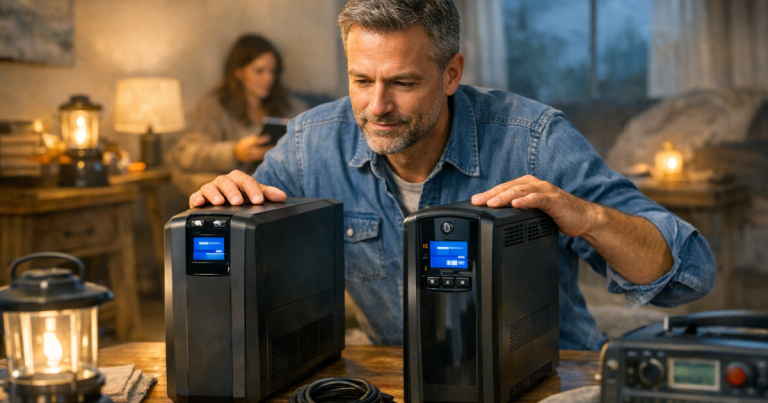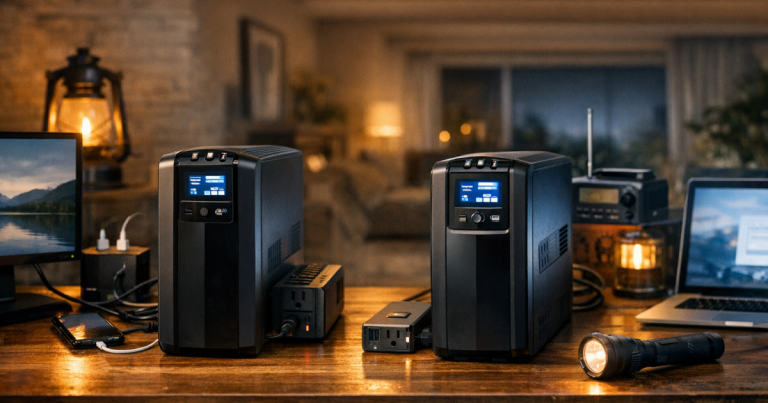
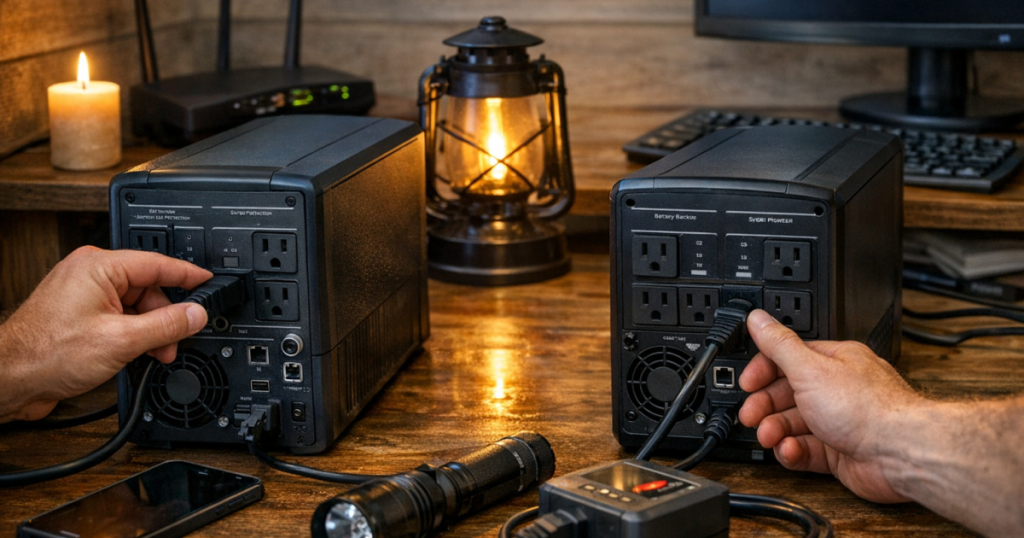
A UPS earns its spot before the lights go out: it buys time for a router, modem, desktop, NAS, or home office setup to ride through a short interruption or shut down cleanly. APC BR1500MS2 vs CyberPower CP1500PFCLCD is a close comparison because both are 1500VA, line-interactive, sine-wave units for US 120V electronics, but their watt ratings, outlet counts, transfer times, and surge ratings do not match.
Quick Buying Links
APC by Schneider Electric APC Back-UPS Pro 1500VA/900W Tower 120V BR1500MS2
Choose it when user-replaceable battery positioning and a clearly named replacement battery matter more than extra watt headroom
CyberPower PFC Sinewave CP1500PFCLCD
Stronger fit for higher connected watt loads, more surge-only outlets, faster stated transfer time, and higher surge suppression
Think of these as electronics stabilizers and short-runtime bridges, not as whole-home backup systems. They belong under a desk, beside networking gear, or near entertainment electronics. For longer outages, a UPS is usually one layer in a larger plan that can also include a portable power station, generator, or solar charging setup.
What to know first
The short answer is simple: CyberPower has the stronger spec sheet where the verified differences are measurable, while APC has a cleaner battery-replacement story on its official page. The better choice depends on whether your priority is extra watt headroom and outlet flexibility, or a familiar APC setup with an emphasized user-replaceable battery path.
- APC Back-UPS Pro BR1500MS2 is a 1500VA, 900W, 120V tower UPS with 10 NEMA 5-15R outlets, including 6 battery-backup-plus-surge outlets and 4 surge-only outlets.
- CyberPower CP1500PFCLCD is a 1500VA, 1000W, 120Vac mini-tower UPS with 12 NEMA 5-15R outlets, including 6 battery-and-surge outlets and 6 surge-only outlets.
- Both are line-interactive UPS units with sine-wave battery output and NEMA 5-15P input plugs for typical US outlets.
- CyberPower lists a 4 ms typical transfer time; APC lists 8 ms typical and 10 ms maximum.
- CyberPower lists 1445 J surge suppression; APC lists a 1080 J surge energy rating.
For a router and modem setup, either model belongs in the same general planning lane as other small electronics backup choices. If your main outage goal is staying online, pair this comparison with our guide to keeping home internet online during a blackout.
Where these two UPS models overlap
The overlap is why this comparison is worth taking seriously. Both models sit in the same familiar 1500VA class, both are line-interactive, and both provide sine-wave output on battery. In plain English, neither one is a tiny strip-style battery meant only for a modem, and neither one is a portable power station meant to run several household essentials for hours and hours.
Manufacturer positioning also points them toward similar household jobs. APC describes the BR1500MS2 as a 120V tower UPS for high-performance computer systems, routers and modems, external storage devices, game consoles, and other home or business electronics. CyberPower describes the CP1500PFCLCD as a 120Vac mini-tower line-interactive UPS for desktop computers, workstations, networking devices, and home entertainment systems.
That makes both models sensible candidates for an outage desk: a modem, router, computer, monitor, external storage, or home entertainment cluster where abrupt shutdowns are inconvenient. The important boundary is that these are plug-in UPS units for electronics. They are not hardwired transfer equipment, whole-home batteries, or generator replacements.
The side-by-side differences that matter
Power rating: 1500VA on both, but not the same watt rating
Both units carry a 1500VA apparent power rating. That number is useful, but it is not enough for blackout planning. The watt rating is the more practical ceiling for the real load you connect.
- APC BR1500MS2: 1500VA and 900W.
- CyberPower CP1500PFCLCD: 1500VA and 1000W.
That 100W difference gives CyberPower the clear edge for households trying to support a larger electronics stack within this UPS class. A desktop tower, networking gear, storage, and a monitor can add up quickly. The answer is not to pack every empty outlet with gear; it is to keep the battery-backed side focused on the devices that need continuity.
Outlets: same number of battery-backed outlets, different total count
The outlet layouts look close at first, but there is a useful difference. Both models provide 6 outlets that are battery-backed and surge protected. Those are the outlets that keep equipment running briefly when utility power drops.
- APC: 10 total NEMA 5-15R outlets, with 6 battery-backup-plus-surge outlets and 4 surge-only outlets.
- CyberPower: 12 total NEMA 5-15R outlets, with 6 battery-and-surge outlets and 6 surge-only outlets.
The practical result: CyberPower gives you 2 more total outlets, but not more battery-backed outlets. This is a good example of why outlet count can be a little sneaky. Surge-only outlets are useful for devices that need protection while grid power is on, but they do not extend runtime during an outage.
Transfer time: CyberPower states the faster typical figure
Transfer time is the small gap between utility power dropping and the UPS switching to battery. For this comparison, the manufacturer-stated figures differ clearly.
- APC: 8 ms typical, 10 ms maximum.
- CyberPower: 4 ms typical.
That gives CyberPower the better stated typical transfer-time figure. For the kind of electronics these units are designed around, the difference is one more point in CyberPower’s favor on measurable specifications. It is not a reason to treat either unit as a substitute for a broader outage plan, but it matters in a close head-to-head.
Surge protection: CyberPower lists the higher joule figure
Both units include surge protection, and both publish a joule rating. The verified numbers are not equal.
- APC: 1080 J surge energy rating.
- CyberPower: 1445 J surge suppression.
CyberPower has the higher published surge figure. For a desk with several electronics plugged in, that adds another practical advantage to the CyberPower side of the ledger. Surge ratings are not the whole story of equipment protection, but in this direct comparison, the larger listed number belongs to CyberPower.
USB charging: similar layout, different stated detail
Both models include two USB charging ports with Type A and Type C represented. APC describes its ports as 2 USB smart charging ports, Type A plus Type C. CyberPower lists 2 USB charge ports, 1 Type A and 1 Type C, with 3.1 A shared.
That makes USB charging a useful convenience on both models rather than the deciding factor. It can keep a phone topped off at the desk, but the main reason to buy either unit is still battery backup and surge protection for AC-powered electronics.
Battery replacement positioning: APC is more direct on the named battery
One APC advantage is how its official page emphasizes user-replaceable battery positioning and names the dedicated replacement battery APCRBC163. CyberPower lists model-dependent replacement battery cartridges for the CP1500PFCLCD.
That does not overturn CyberPower’s measurable wins on watt rating, total outlets, transfer time, and surge rating. It does give APC a real point for readers who value a plainly named replacement-battery path as part of long-term UPS ownership.
Which one fits your outage setup?
Choose APC BR1500MS2 when replacement-battery clarity matters most
The APC Back-UPS Pro, 1500VA/900W, Tower, 120V, BR1500MS2 is the calmer pick for a household that wants a familiar APC tower UPS and values the official emphasis on a user-replaceable battery with a dedicated APCRBC163 replacement battery. It also keeps the important basics: 1500VA rating, 900W rated power, line-interactive topology, sine-wave output, US 120V fit, and six battery-backed outlets.
Its trade-off is that CyberPower has more headroom on rated watts, more total outlets, a faster stated typical transfer time, and a higher listed surge rating. So APC makes the most sense when the 900W rating is enough for the intended electronics load and the battery-replacement positioning carries real weight in your decision.
Choose CyberPower CP1500PFCLCD for the stronger measured spec package
The CyberPower PFC Sinewave CP1500PFCLCD is the more compelling pick on the verified specification differences. It is rated at 1000W instead of 900W, provides 12 total outlets instead of 10, states a 4 ms typical transfer time, and lists 1445 J surge suppression. Its official page also explicitly positions the model for active PFC power-source compatibility.
That combination makes CyberPower the better fit for a denser electronics cluster where the connected watt load still belongs within a plug-in 1500VA UPS plan. The phrase that matters there is connected watt load. Runtime and suitability should be worked from the devices actually plugged into the six battery-backed outlets, not from the VA number alone.
Runtime planning without false confidence
Runtime is where many UPS comparisons get fuzzy. The responsible way to compare these two units is to calculate runtime at the same connected watt load. A router-and-modem load is not the same as a workstation-and-monitor load, and a UPS that feels generous for networking gear can drain much faster when a desktop system is attached.
For longer blackouts, the UPS should usually hand off to something larger rather than carry the whole event by itself. A portable power station can support a different role, especially when you are planning around several hours or multiple days. Our roundup of portable power stations by blackout duration is a better next stop when the outage plan extends beyond short bridging and safe shutdown.
A practical layered setup can look like this: use the UPS to keep networking or computer gear from dropping instantly, then use a larger battery system for extended phone charging, lighting, or selected essentials. The UPS is the seatbelt for sensitive electronics; the larger backup source is the road trip plan.
Mistakes that make either UPS less useful
The biggest mistake is treating every outlet as equal. On both units, only six outlets are battery backed. The remaining surge-only outlets protect equipment while grid power is present, but they do not keep devices running when power fails.
- Reserve battery-backed outlets for the modem, router, desktop, storage, or device that must keep running or shut down safely.
- Use surge-only outlets for gear that benefits from protection but does not need outage runtime.
- Compare connected watts against the official watt rating: 900W for APC and 1000W for CyberPower.
- Keep a UPS in the electronics lane. It is not a whole-home backup system, a transfer switch, or a generator replacement.
- Revisit the setup before storm season so the devices plugged into the battery side still match your actual outage priorities.
A UPS that was tidy when first installed can turn into a cable nest over time. New monitors, chargers, speakers, and hubs have a way of quietly joining the party. A quick seasonal review is boring in the best possible way: it prevents surprises. For a broader routine, use our guide to testing and maintaining backup power before an outage.
Practical takeaway
CyberPower CP1500PFCLCD is the stronger recommendation for most buyers choosing strictly between these two 1500VA UPS models for outage electronics. The reasons are concrete: it has a higher official watt rating at 1000W versus 900W, 12 total outlets versus 10, a 4 ms typical transfer time versus APC’s 8 ms typical and 10 ms maximum, and a higher listed surge suppression figure at 1445 J versus 1080 J.
APC BR1500MS2 still makes sense when its 900W rating fits your connected load and you place extra value on the official user-replaceable battery positioning with the named APCRBC163 replacement battery. That is a sensible, durable reason to choose it, especially for a straightforward router, modem, storage, or desk setup that does not need CyberPower’s extra watt headroom.
The cleanest decision rule is this: choose CyberPower for the better measured spec package, choose APC when replacement-battery clarity is the tie-breaker, and keep either UPS focused on the electronics that genuinely need battery-backed power during the first minutes of an outage.
Quick Buying Links
APC by Schneider Electric APC Back-UPS Pro 1500VA/900W Tower 120V BR1500MS2
Choose it when user-replaceable battery positioning and a clearly named replacement battery matter more than extra watt headroom
CyberPower PFC Sinewave CP1500PFCLCD
Stronger fit for higher connected watt loads, more surge-only outlets, faster stated transfer time, and higher surge suppression