A pocket USB battery can earn its place in an outage drawer when it keeps the boring essentials alive: a phone, earbuds, a small USB light. This Anker PowerCore Solar 20000 review looks at the Anker PowerCore Solar 20000mAh Power Bank as exactly that kind of helper, not as a miniature generator.
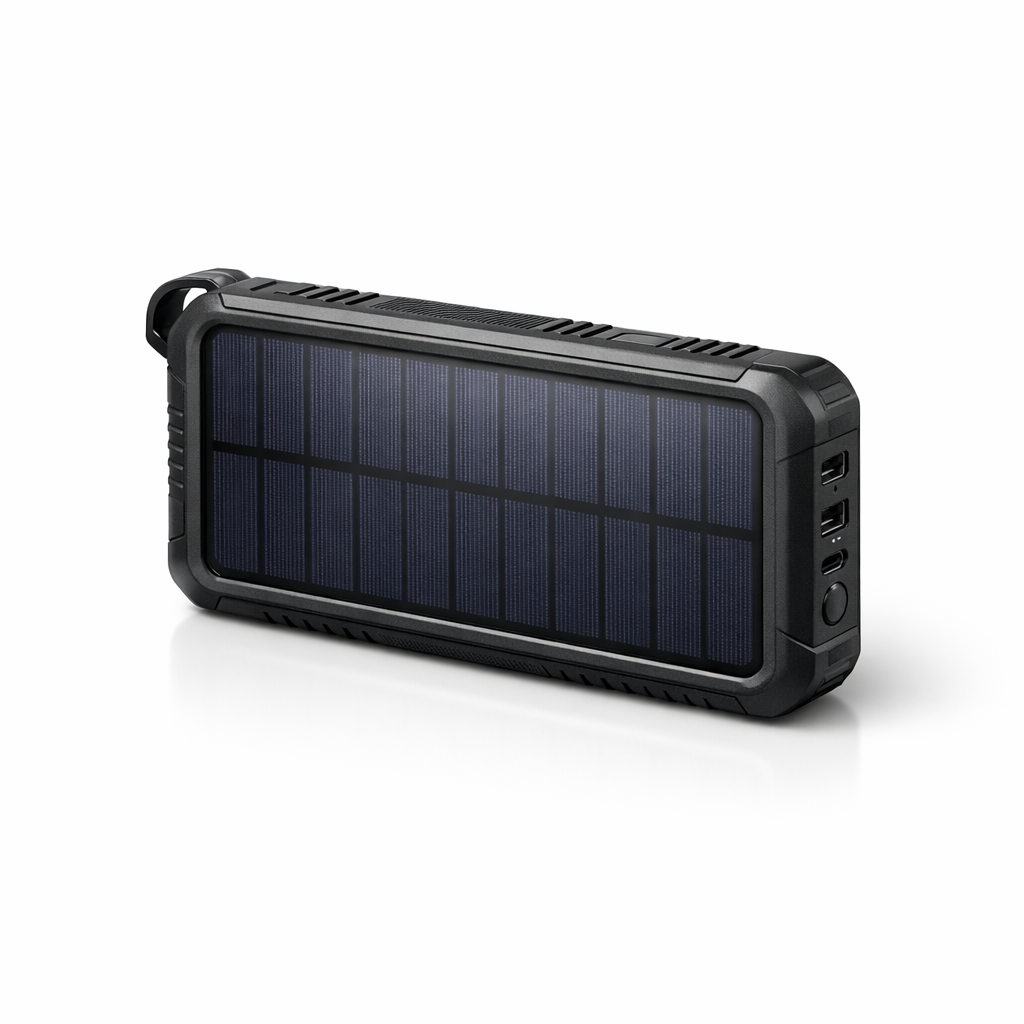
Anker PowerCore Solar 20000mAh Power Bank
Best for owners who want pocketable USB backup, not shoppers building a primary blackout power system
The practical catch is its place in the market. The Anker PowerCore Solar 20000mAh Power Bank is a legacy Anker model, with A1650 manual support, and it is not a current new-customer product on Anker’s US power-bank lineup. That changes the buying lens: it is most relevant if you already own one, inherited one, or are weighing a used or refurbished unit against a newer USB-C power bank.
Product Details
- Product type: solar power bank / external battery for USB-powered small electronics.
- Ports: 1 USB-A output port and 1 USB-C input/output port.
- USB-C input: 5V⎓3A / 9V⎓2A, 18W Max.
- USB-C output: 5V⎓3A / 9V⎓2A, 18W Max.
- USB-A output: 5V⎓2.4A, 12W Max.
- Dimensions: 6.88 x 3.46 x 1.19 inches.
- Weight: 1.03 pounds.
- Required companions: a suitable USB cable for your device and either a USB-C power source or enough sunlight to recharge the power bank.
A small-device backup, not a house-power answer
The best way to understand the Anker PowerCore Solar 20000mAh Power Bank is to keep it in the small USB lane. It is for phones, earbuds, watches, small USB lights, and similar low-power items. In a blackout, that can still be useful. A charged phone can keep weather alerts, family texts, maps, and basic information available when the rest of the house feels frozen in place.
It is not the tool for refrigerators, heaters, home appliances, medical devices, or whole-home backup. It also is not a substitute for a UPS or portable power station if your router, modem, or work setup needs AC power. If you are deciding where a USB power bank ends and a larger backup system begins, our guide to portable power stations, generators, and UPS options for blackouts gives that bigger picture.
That boundary is not a flaw by itself. Small power banks are easy to store, easy to hand to a family member, and simple enough that nobody needs an outage-day tutorial. The issue is whether this older solar-capable design still makes sense when newer USB-C banks are easier to buy new.
Ports and output: useful, but clearly capped
The port setup is straightforward: one USB-A output and one USB-C port that handles both input and output. The USB-A output is rated at 12W Max, while USB-C output is rated at 18W Max. For phones and low-power accessories, that is a practical match. For laptop backup, it is not something to assume. Many laptops need more than an 18W USB-C output to charge reliably, and outage planning gets messy fast when a device only sips power while slowly draining anyway.
The USB-C input is also rated at 18W Max, which makes pre-charging from a USB-C power source the sensible routine before storms, wildfire shutoffs, or travel. The important ownership habit is simple: charge it before you need it. A solar panel on the case does not remove the need for preparation; it just gives you another input when ordinary charging is unavailable.
The single USB-A port also means this is not a family charging hub. You can support more than one type of cable, but you are still working with a compact power bank layout. For an outage drawer, that is fine. For three people trying to refill phones at midnight, it will feel tight.
Solar charging is the fallback, not the plan
The integrated solar panel is the feature that makes this product more interesting than a plain USB battery, but it is also the feature most likely to be overestimated. Solar charging for this kind of compact power bank is slow and variable, and Anker describes it as a process that can take several days. Sun angle, clouds, shade, window glass, and how long the unit is actually in direct sun all affect the result.
For blackout planning, the right mental model is emergency trickle input. It can be helpful when you are away from wall power for a long stretch and want every bit of backup you can get. It should not be your main refill strategy for a household outage. Pre-charge from USB-C, use the stored battery carefully, then treat solar as a bonus input once the power is already out.
This is where the product’s small size cuts both ways. A built-in panel is convenient because there is nothing extra to pack, but the panel area is necessarily limited. It is better to have modest solar help than none at all, but physics remains annoyingly immune to marketing.
Portability and blackout-day handling
At 6.88 x 3.46 x 1.19 inches and 1.03 pounds, the Anker PowerCore Solar 20000mAh Power Bank is pocket-size in the broad sense, though it is not featherweight. It makes more sense in a go bag, glove compartment, bedside drawer, or outage bin than in the pocket of lightweight shorts. The size is still easy to live with for home preparedness, where the main job is being findable, charged, and ready.
The flashlight modes add another small-use advantage. In a real outage, redundancy is helpful: a phone light is useful, but it also burns the device you are trying to preserve for calls and alerts. A dedicated lantern is better for lighting a room, but a power bank with light modes can help with quick tasks like finding cables, walking down a hallway, or checking a breaker panel from a safe distance.
For room lighting, though, a power bank should not be your main plan. A compact lantern is easier to place on a table and less awkward for cooking, cards, or helping kids settle down. Our Streamlight Siege compact lantern review covers that kind of dedicated outage lighting more directly.
The 2026 buying decision
The hardest mark against the Anker PowerCore Solar 20000mAh Power Bank is not its size, port layout, or role. It is availability. Because it is a legacy model rather than a current new Anker US retail product, it is not the cleanest recommendation for someone building a blackout kit from scratch in 2026.
If you already own one, the advice is different: keep it charged and assign it a realistic job. Use it for phones, small lights, earbuds, watches, and other USB devices. Store it with the cables your household actually uses. Label it if that helps. The best emergency gear is not always the fanciest gear; it is the gear someone can find when the Wi-Fi is down and everyone is asking the same three questions.
If you are shopping from zero, a current Anker USB-C power bank is the more sensible small-device route, while an Anker SOLIX portable power station belongs in a different class for AC-powered gear. Those are not direct replacements for this specific product; they simply reflect two cleaner directions: modern pocket charging on one side, larger home backup on the other.
What stands out
The Anker PowerCore Solar 20000mAh Power Bank still has a clear use case as a compact USB backup with a built-in solar fallback. Its strengths are simple: portable size, USB-C input and output, USB-A output, and a role that fits phones and small accessories during short disruptions.
The compromises are just as clear. Solar refill is slow, 18W USB-C output limits what you should expect from larger electronics, and legacy status makes it a poor first-choice new purchase. Used or refurbished units can also carry different replacement or warranty outcomes than buying a current product through normal retail channels.
For a household outage kit, it works best as a secondary layer. Pair it with dedicated lighting, a plan for food safety, and a separate answer for anything that needs AC power. Treat it like a useful drawer tool, not the hero of the blackout.
Verdict
Score: 6.8/10. The Anker PowerCore Solar 20000mAh Power Bank earns credit for doing a narrow job cleanly: portable USB backup for small electronics, with both USB-C and USB-A support in a compact body. The score is held back by the slow, variable solar refill, the 18W USB-C ceiling, and its legacy status in the US market. It is worth keeping and using thoughtfully if you already have one; for a new blackout kit, a current USB-C power bank or a larger backup power product will usually be the cleaner buy.
Anker PowerCore Solar 20000mAh Power Bank
Best for owners who want pocketable USB backup, not shoppers building a primary blackout power system
You might also like: How to Run a CPAP on a Portable Power Station During an Outage.