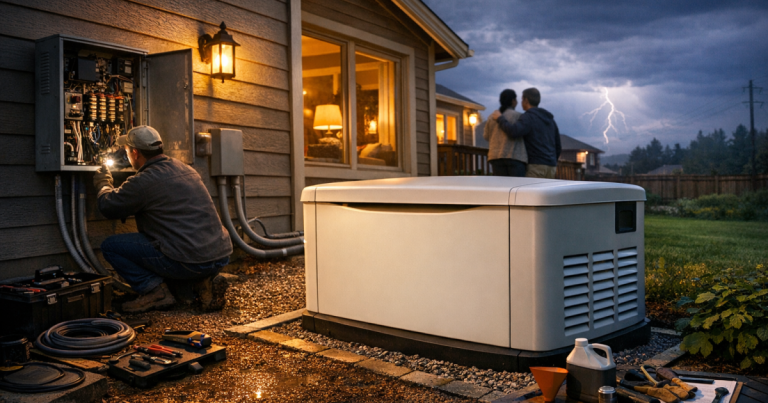
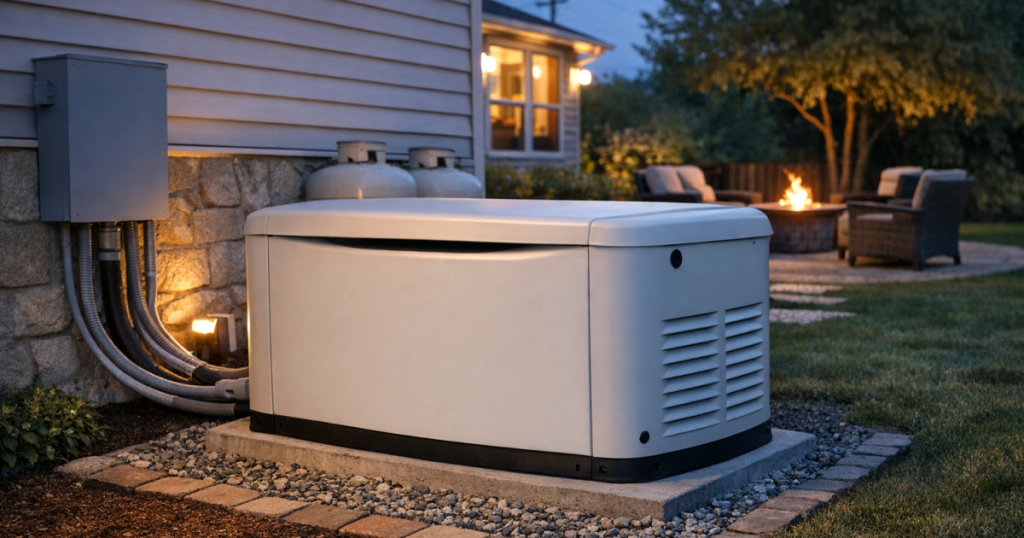
A large standby generator can make an outage feel less like an emergency and more like an interruption you already planned for. This Generac Guardian 26kW Standby Generator review looks at the Wi-Fi enabled Guardian 26 kW residential standby generator, including model G007291-0 with its 200 A whole-house switch package, from the standpoint of a US household deciding whether automatic backup power is worth the installation commitment.
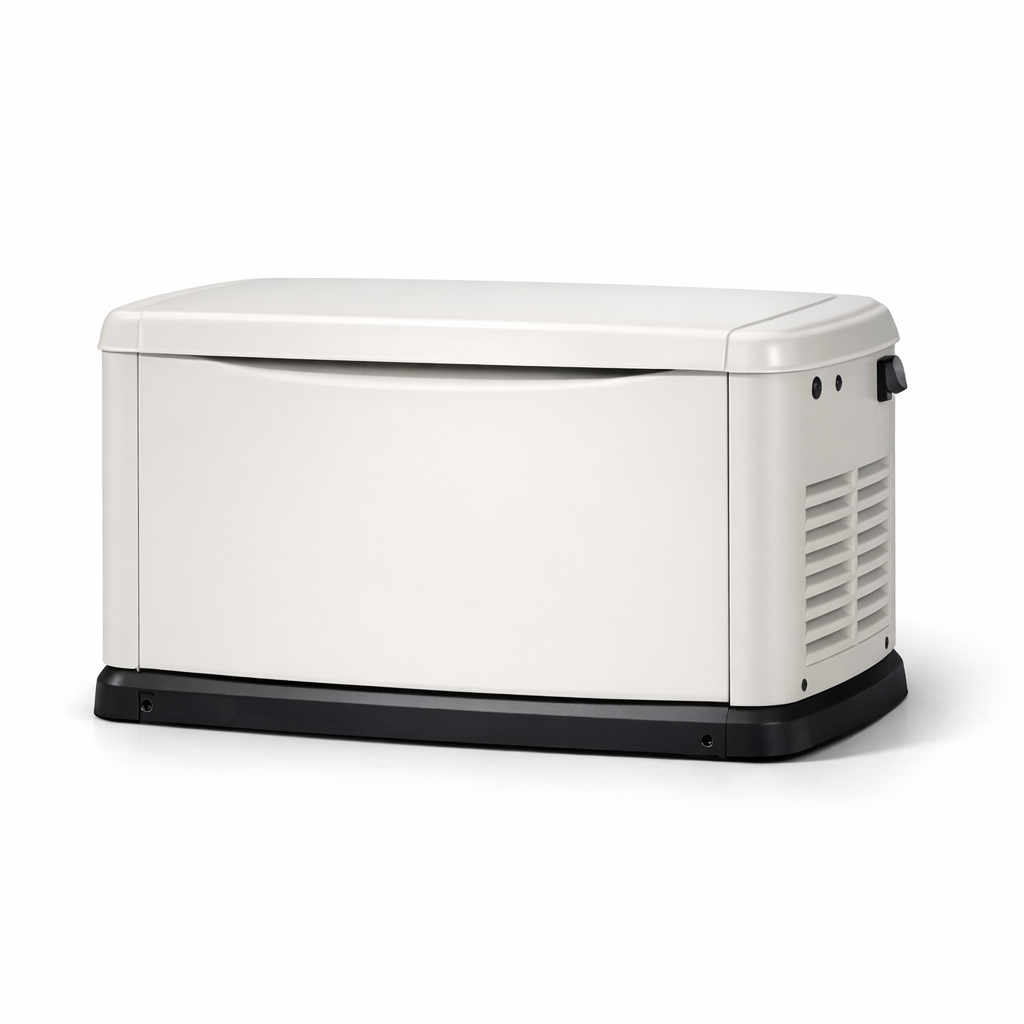
Generac Guardian 26kW Standby Generator
Best for larger homes that want automatic outage backup and can support the fuel and installation requirements
The practical answer: it can be worth it for a larger home that wants automatic backup and has the right natural gas service or liquid propane setup. It is not a plug-in appliance, a portable generator, or a substitute for proper load planning. You are buying a permanently installed outdoor generator system that depends on fuel supply, approved transfer equipment, a compliant installation, and a separate 12 V starting battery.
Electrical wiring, transfer-switch integration, gas or propane fuel connections, and code-related installation work should be carried out by qualified professionals in compliance with local regulations, utility requirements, and applicable safety standards.
Product Details
- Product type: Air-cooled automatic residential standby generator.
- Rated maximum continuous power: 26,000 W on liquid propane and 22,500 W on natural gas.
- Electrical output: 240 V, single phase, 60 Hz, power factor 1.0, with less than 5% total harmonic distortion and a 110 A main line circuit breaker.
- Rated maximum continuous load current: 108.3 A on LP and 93.8 A on natural gas at 240 V.
- Transfer switch package: The G007291-0 package includes a 200 A, 120/240 V, 1-phase, 2-pole, service-rated open-transition automatic transfer switch with a NEMA/UL 3R enclosure.
- Engine: Generac G-Force 1000 Series, 999 cc, 2-cylinder, overhead-valve engine with electronic governor, 3,600 rpm operating speed, and about 1.9 qt oil capacity including filter.
- Size and weight: 48 x 25 x 29 in and 518 lb with aluminum enclosure.
- Battery: Starting battery is not included; Generac specifies a 12 V Group 26R 540 CCA minimum or Group 35 AGM 650 CCA minimum.
- Monitoring and warranty: Includes standard Wi-Fi Mobile Link monitoring and a 5-year limited warranty.
- MSRP: Generac lists the G0072910 variant with MSRP starting at $7,899.00.
Where the 26 kW rating helps, and where it does not
The headline number is strong for a residential air-cooled standby generator: 26,000 W on liquid propane. That gives this Guardian model room for a broader outage plan than a small portable generator or a compact battery system. In a home that needs more than fridge-and-router backup, the extra capacity can matter for central comfort equipment, kitchen circuits, well pumps, sump pumps, lighting, and normal daily routines.
The important detail is that the natural gas rating is lower: 22,500 W. That is still substantial, but it changes the sizing conversation. A home that looks comfortable on the LP rating might need closer load management when running on natural gas. The right question is not “Will 26 kW run my whole house?” It is “Which loads will run together on my fuel type, at my site, through my transfer equipment?”
Generac also states that no overload capability is available for the optional standby rating, and that maximum power decreases with altitude and high ambient temperature. In plain English, this is a generator to size thoughtfully, not a magic box that absorbs every starting surge in the house. Heavy loads starting at the same time still need planning.
The transfer switch package is a major part of the value
The G007291-0 version is meaningful because it includes a 200 A service-rated automatic transfer switch. For many homeowners, that is the part of the system that turns backup power from a manual chore into an automatic outage response. When utility power fails, an automatic standby setup is designed to disconnect from the grid and connect the home to generator power through approved switchgear.
That does not mean every 200 A home gets unlimited power. The generator’s rated output is still the limit, and the transfer switch does not erase the need to decide which loads matter most. In larger homes, installers may use load management to keep high-demand appliances from stacking on top of each other. That is normal, and it is often the difference between a smooth standby system and an oversized bill that still disappoints during a storm.
If you are still early in the project, the most useful pre-work is deciding what must run before any electrical work begins. Our guide on preparing for a generator transfer switch installation walks through the kind of circuit and priority decisions that make the estimate process less vague.
Fuel use is the ownership cost to take seriously
Standby generators do not run on optimism; they run on a properly sized fuel supply. This Guardian runs on natural gas or liquid propane vapor. The required inlet pressure is 3.5 to 7 in water column for natural gas and 10 to 12 in water column for LP.
Generac’s listed fuel consumption is 188 ft3/hr on natural gas at half load and 333 ft3/hr at full load. On liquid propane, the figures are 2.06 gal/hr at half load and 3.63 gal/hr at full load. Those numbers do not tell you exactly what your outage will cost, because real loads change throughout the day. They do tell you that fuel planning is not a footnote.
For natural gas homes, the question is whether the service and piping can support the generator along with other gas appliances under real conditions. For propane homes, the tank size and delivery plan become part of outage readiness. A smaller LP tank can look fine on a sunny installation day and feel limiting during a multi-day winter outage. This is where a whole-home system earns its keep only when the surrounding fuel plan is as deliberate as the generator choice.
Noise, exercise mode, and neighborhood reality
The sound rating is 67 dB(A) at 23 ft at normal load, and 57 dB(A) at 23 ft in Quiet-Test low-speed exercise mode. The exercise time is 5 minutes. Those figures matter because a standby generator is not just used during rare emergencies; it also tests itself, and it lives outside your house year-round.
The 5-minute exercise cycle is a practical plus for routine readiness without making the generator a constant neighborhood character. During an outage, however, the normal-load sound rating is still something to account for when choosing placement. Setbacks, windows, property lines, and local rules all shape where a permanent generator can go. The unit’s 48 x 25 x 29 in footprint and 518 lb weight also make this a site-planned installation, not a weekend repositioning project.
What ownership asks of you
The Guardian 26 kW is built for temporary outage backup, not prime power. It is also not intended for critical life-support applications. That distinction is not a knock against the product; it is the correct lane for a residential standby generator. It can make ordinary blackout life far more manageable, but it should not be treated as the only safety layer for medical dependence or continuous off-grid operation.
Ownership also includes the starting battery decision. Since the battery is not included, the required 12 V Group 26R 540 CCA minimum or Group 35 AGM 650 CCA minimum battery needs to be part of the installation plan. In very cold climates below 0 °F, recommended warming accessories can also become part of the conversation depending on site conditions.
Wi-Fi Mobile Link monitoring is included, which is useful for keeping tabs on the system through Generac’s standard Wi-Fi monitoring path. This model should not be treated as a built-in cellular-monitoring generator. If built-in cellular monitoring, newer controller features, or a higher natural gas rating are priorities, Generac’s newer 26 kW cellular model becomes the more relevant comparison.
Where it fits best in real outage planning
This generator makes the most sense for homeowners who want automatic standby backup for a larger house and can support the fuel, placement, permitting, and installation requirements. It is especially compelling where outages are long enough or frequent enough that rolling out extension cords, managing portable fuel, and manually deciding what to power every time has become a burden.
It is less suitable for renters, apartments, portable-only emergency kits, homes without a practical fuel path, or households looking for inexpensive short-duration backup. If the core goal is keeping a router, phones, a laptop, and a few lights running, a standby generator of this size is usually the wrong scale. If the goal is fridge, freezer, HVAC-related loads, pumps, lighting, and normal household circuits through automatic transfer equipment, the fit becomes much stronger.
Before investing in any whole-home system, it helps to walk the house the way you would during an actual outage: food, medications, heat or cooling, communications, lighting, water, and access. This pre-storm blackout readiness walkthrough is a useful companion exercise because it separates true essentials from nice-to-have loads.
Value depends on the installed system, not the MSRP alone
The listed MSRP starting at $7,899.00 gives a starting point, but it is not the ownership number that matters most. A standby generator project can also involve the pad, fuel line work, electrical labor, permits, transfer equipment details, load management, battery, possible cold-climate accessories, and site-specific constraints.
That is why this model’s value is strongest when the home can actually use its capacity. If your house needs the 200 A service-rated switch package and can benefit from the 22.5 kW natural gas or 26 kW LP capability, the Guardian becomes a serious, coherent standby choice. If your essentials are modest, the same money may be better directed toward a smaller generator, a portable power station strategy, or a narrower circuit plan.
Verdict
Score: 8.8/10. The Generac Guardian 26 kW is worth considering for larger homes that want automatic outage backup and have a realistic path for fuel supply, transfer-switch installation, and load planning. Its strongest points are the substantial continuous power rating, the 200 A service-rated automatic transfer switch package on the G007291-0 version, and the practical fit for whole-home standby planning.
The main trade-offs are equally important: natural gas output is lower than the LP rating, fuel consumption must be planned honestly, the starting battery is separate, and total installed cost can move well beyond MSRP. For the right house, this is a confident standby option. For a smaller essentials-only plan, it is more generator than the job requires.
Generac Guardian 26kW Standby Generator
Best for larger homes that want automatic outage backup and can support the fuel and installation requirements
You might also like: Best Compact Power Stations for Apartment Fridge and Wi-Fi in 2026.