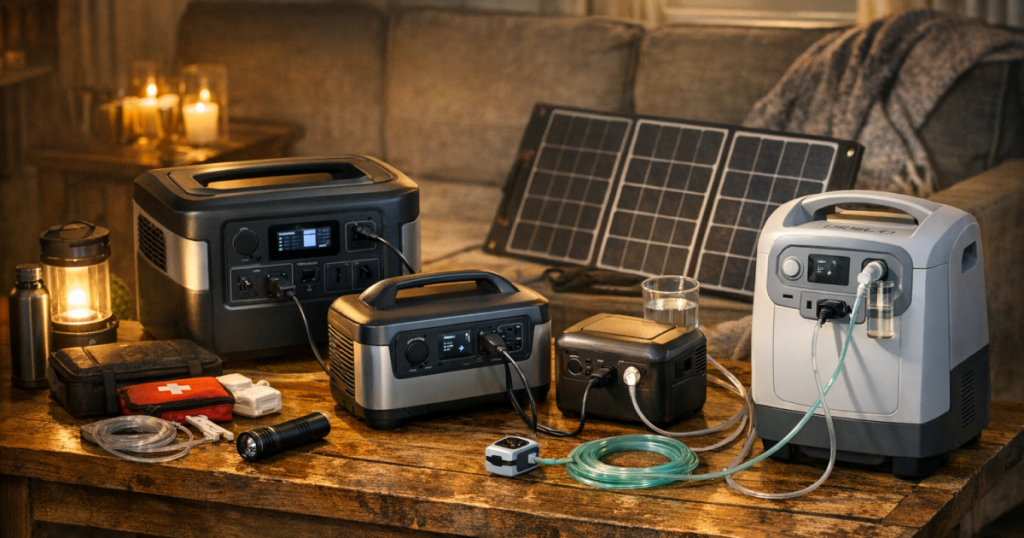
When a blackout affects someone who depends on oxygen, backup power becomes part of the care plan, not a convenience. The best portable power stations for oxygen concentrators are the ones that match the concentrator’s actual watt draw, provide an AC outlet that meets the device’s requirements, are simple to recharge, and fit the home’s outage routine.
Oxygen-flow settings and emergency oxygen planning are health-related decisions that should be handled by the prescribing clinician or durable medical equipment provider. Any permanent electrical wiring, transfer-switch work, or home circuit connection should be carried out by a qualified electrician in compliance with local codes and safety standards.
The short answer for oxygen backup
For most households, the right power station is not simply the largest one on the shelf. It is the unit that can safely run the specific oxygen concentrator for the needed number of hours, with a realistic plan to recharge before the battery is empty. Stationary concentrators, portable pulse-dose concentrators, humidifiers, heated tubing, and other accessories can draw very different amounts of power, so the label on the equipment is more useful than any glossy runtime chart.
No consumer power station should be treated as a replacement for medical planning. A sound outage setup usually includes three layers: the concentrator’s own battery if it has one, a portable power station sized for the expected outage window, and a non-electric backup plan arranged through the medical equipment provider when appropriate.
Start with the concentrator, not the battery
Before choosing anything, write down the concentrator’s power requirement. Look for watts on the machine label or power adapter. If the label lists volts and amps instead, multiply volts by amps to estimate watts. For example, a device drawing 120 volts at 3 amps would be roughly 360 watts. That estimate is not a runtime guarantee, but it gives you a practical sizing number.
Then decide how many hours of operation you need before you can recharge. A four-hour bridge through an evening outage is a different job from an overnight wildfire shutoff or a multi-day storm. Runtime is roughly the station’s usable watt-hours divided by the device’s watt draw, but real results vary because inverters, startup behavior, device settings, temperature, battery age, and reserve settings all affect usable power.
If the oxygen setup is part of a wider essentials plan, it is worth reading how to choose a portable power station for essential circuits so the medical load does not get crowded out by less important items.
Three strong power-station directions to consider
The following picks are practical examples for home oxygen planning, not medical-device endorsements. Always verify the current manufacturer specifications, outlet type, continuous output rating, pass-through behavior, and compatibility with the concentrator before relying on any station during an outage.
Best straightforward 1kWh-style option: Jackery Explorer 1000 v2 Portable Power Station
The Jackery Explorer 1000 v2 Portable Power Station is a useful reference point for households that want a lightweight 1kWh-class backup rather than a heavy whole-home system. That size category can be a sensible match for lower-draw devices, shorter outages, or a rotation plan where the concentrator runs on wall power when the grid is available and switches to the station only when needed.
The practical appeal is simplicity: a dedicated battery that can be staged near the concentrator, kept charged, and moved without turning the home into a wiring project. The caution is equally simple. A stationary oxygen concentrator with a higher draw can drain a 1kWh-style unit faster than people expect, so do the watt-hour math before counting on overnight runtime.
Best for recharge windows: EcoFlow DELTA 3 Plus Portable Power Station
The EcoFlow DELTA 3 Plus Portable Power Station is a strong example when the household’s plan depends on quick recharge opportunities. If outages in your area tend to flicker on and off, or if you expect to recharge from a safe generator setup during the day, fast charging can matter as much as battery size.
Its UPS-capable positioning also makes it worth investigating for people who want the station in the power path before an outage starts. That said, do not assume every concentrator tolerates every transfer behavior. Confirm with the concentrator manufacturer or equipment provider whether the device can be used with a consumer battery backup in that arrangement, and test the setup during normal conditions before storm season.
Best for solar-assisted daytime plans: BLUETTI Elite 100 V2 Portable Power Station
The BLUETTI Elite 100 V2 Portable Power Station fits households that want a compact station with a solar-recharge strategy. Solar does not make blackout power unlimited, but it can extend a plan when the weather, panel placement, and daylight cooperate.
This direction is most useful when the caregiver can manage panels safely, the home has a good sunny location, and the oxygen user is not depending on unproven solar input overnight. Treat solar as a way to slow battery depletion or recover during daylight, not as the only lifeline.
How to size the setup step by step
- Find the real load. Use the concentrator label, power adapter, or manufacturer documentation. Include required accessories that must run at the same time.
- Choose a planning window. Decide whether you are covering 4 hours, 8 hours, overnight, or longer. Longer plans usually require either more battery capacity, a recharge method, or backup oxygen arranged through the care team.
- Leave a reserve. Do not plan to use every last watt-hour. Batteries lose usable capacity over time, and stressful outages are the wrong moment to run at the edge.
- Test while the grid is on. Run the concentrator from the station under normal supervision long enough to confirm there are no alarms, overloads, unexpected shutoffs, or heat issues.
- Write down the process. A caregiver should be able to see which outlet to use, which cords are approved, when to recharge, and who to call if the plan fails.
Checks that matter more than marketing claims
For oxygen use, the most important checks are compatibility, runtime, recharging, and ease of operation. A quiet display, a comfortable carry handle, or app controls can be convenient, but they are secondary to whether the concentrator stays powered safely for the planned window.
- Continuous output rating: The station must support the concentrator’s running draw with room to spare. Avoid relying on surge numbers for steady medical use.
- Outlet match: Confirm whether the concentrator requires standard AC power, a DC adapter, or manufacturer-approved accessories.
- Alarms and behavior: Check whether the concentrator sounds an alarm, restarts properly, or changes behavior when power switches.
- Recharge plan: Wall charging is easiest when the grid returns. Solar and generator charging require more planning, safe placement, and weather or fuel considerations.
- Caregiver usability: Labels, cable management, and a simple written routine reduce mistakes when everyone is tired.
Apartment households have different constraints than houses with garages, yards, and generator space. If indoor-only backup is your main path, use an apartment-friendly portable power station plan that accounts for storage, noise, ventilation, and recharge access without assuming outdoor equipment is available.
What not to do during an oxygen-related outage
- Do not run a fuel-burning generator indoors, in a garage, on a balcony, or near open windows. Carbon monoxide can be deadly, and medical urgency does not make unsafe placement safe.
- Do not daisy-chain extension cords or power strips. Use only cords and connections that match the equipment requirements and the power station instructions.
- Do not change prescribed oxygen settings to save battery. That is a medical decision for the prescribing clinician.
- Do not wait for the first outage to test the setup. A calm afternoon test is much better than troubleshooting during a storm.
- Do not assume a power station is a certified medical UPS. Unless the device maker and care team approve the arrangement, treat it as household backup power, not life-support infrastructure.
Planning for the rest of the room
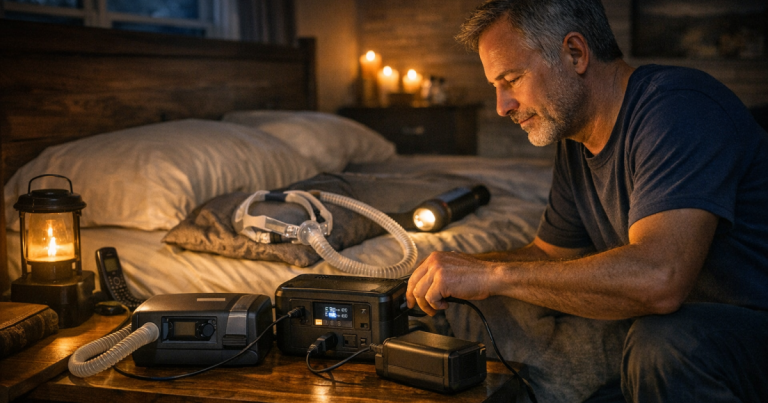
An oxygen backup station should have one job first: keep the prescribed equipment powered. Phones, lights, routers, fans, and radios are important, but they can quietly steal runtime from the device that matters most. If another medical device also needs backup, size it separately rather than guessing. For example, households with sleep therapy equipment can use this guide to power a CPAP machine during an outage and then decide whether one shared station is enough or two dedicated backups make more sense.
Keep the station where it is easy to reach, not buried in a closet behind holiday bins. Tape a short instruction card nearby: concentrator plug location, expected runtime estimate, recharge priority, equipment provider phone number, and the point at which you switch to the medical backup plan.
Questions worth answering before the next storm
Can one portable power station run an oxygen concentrator all night?
Sometimes, but only if the station’s usable capacity and output match the concentrator’s actual draw for the full number of hours needed. A lower-draw portable concentrator is a very different load from a larger stationary unit. Do the math, leave reserve, and test the arrangement before relying on it.
Is solar enough for an oxygen concentrator?
Solar can help recharge a station during the day, but it is not dependable enough by itself for overnight medical power. Cloud cover, shade, panel angle, season, and available daylight all affect charging. Use it as part of a layered plan, not the whole plan.
Should the concentrator stay plugged into the station all the time?
Only if the station and concentrator manufacturer both support that use case and the setup has been reviewed with the care team. Some stations are designed for pass-through or UPS-style use, while others are better kept charged and connected manually when needed.
What to remember
The best oxygen backup plan is measured, labeled, and rehearsed. Start with the concentrator’s watt draw, choose a station that can cover the required hours with reserve, and build a recharge plan that still works when the weather is bad and the household is tired. A well-sized portable power station can be an excellent part of the plan, but it should sit alongside medical guidance, backup oxygen arrangements, and a clear caregiver routine.