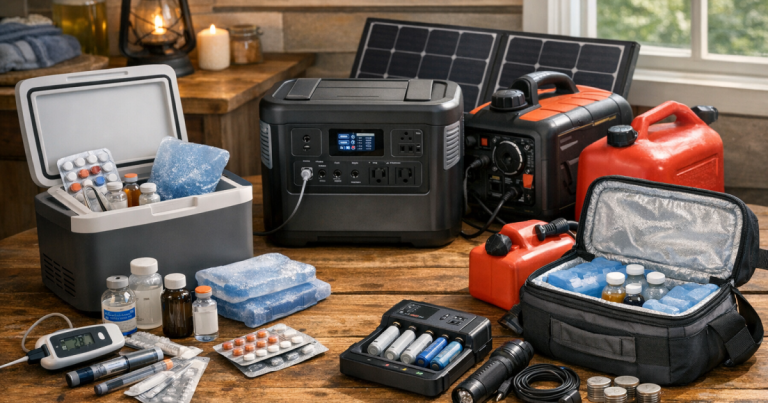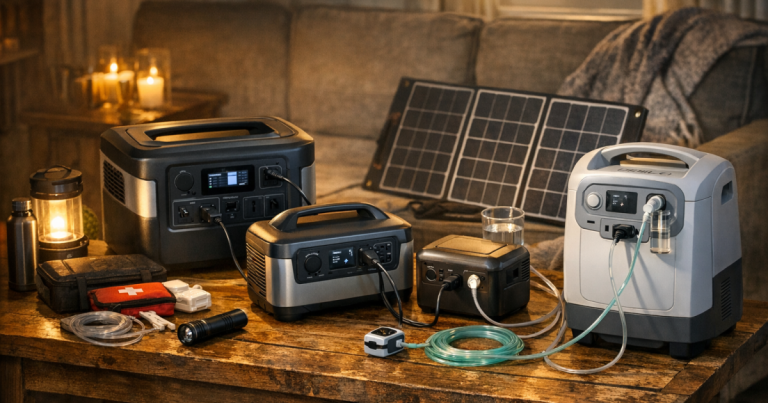
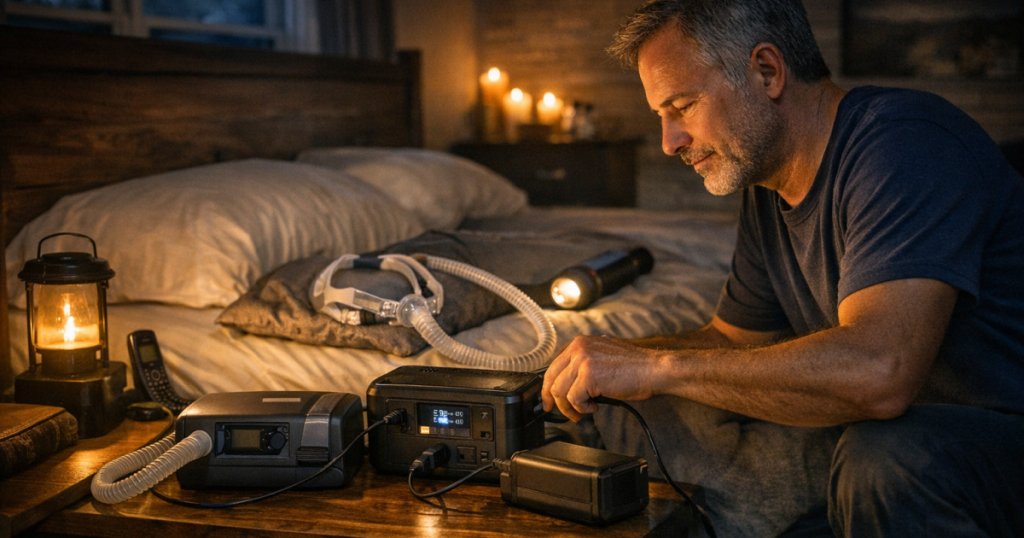
A CPAP machine is not the largest load in a blackout plan, but it is one of the least optional. The goal is simple: power a CPAP during an outage without guessing, overloading a battery, or changing your therapy routine in the dark. A reliable plan starts with your exact machine, your nightly runtime, and a backup source you have already tested.
Changes to CPAP therapy, oxygen use, pressure settings, or medically necessary equipment should be handled by a qualified healthcare professional so your plan stays aligned with your prescription, device requirements, and applicable safety standards. Hardwired generator connections, transfer switches, and home electrical work should be carried out by a qualified electrician in compliance with local codes and safety requirements.
What to know first
For most households, the safest and simplest CPAP outage plan is a dedicated battery or portable power station kept indoors, charged, and reserved for the machine. A generator can recharge batteries or support a wider home plan, but it must run outdoors and away from doors, windows, vents, and attached spaces.
- Start with the CPAP label and manual. Confirm the machine’s input requirements, plug type, and whether the manufacturer supports DC power accessories.
- Decide how many nights you need. One night, two nights, and a multi-day storm plan lead to different battery and recharging needs.
- Account for comfort features. Heated humidification and heated tubing can shorten runtime, sometimes dramatically.
- Test before the outage. A quiet bedroom at 11 p.m. is a poor time to discover you grabbed the wrong cable.
Step 1: Identify what your CPAP actually needs
Do not size backup power from a generic CPAP estimate alone. Look at the power brick, machine label, or manufacturer documentation for your model. You are looking for input voltage, output voltage, amperage, and any notes about approved DC cables or battery operation.
If your machine has a removable humidifier, heated hose, cellular modem, or additional accessories, treat those as part of the load. Some users can safely turn off heat and humidification during an outage; others may not tolerate that well. Make that decision with your clinician if comfort settings affect your ability to use therapy consistently.
A plug-in power meter can help you see what your setup uses during a normal night. Measure the machine the way you actually sleep: same mask, pressure range, ramp setting, humidifier level, and tubing. One hour of testing is better than guessing; a full-night test is better still.
Step 2: Choose the right backup source for the job
A CPAP can usually be supported by one of three backup approaches: a dedicated CPAP battery, a portable power station, or a larger generator-supported plan. The right one depends on your living situation, how long outages usually last, and whether other medical or household loads also matter.
Dedicated CPAP battery
A dedicated CPAP battery is tidy and travel-friendly when it is compatible with your exact machine. The advantage is simplicity: fewer outlets, fewer cords, and less temptation to run nonessential devices from the same battery. The limitation is capacity. It may be a one-machine solution, not a household backup plan.
Portable power station
A portable power station gives you more flexibility. It can usually run a CPAP through an AC outlet and may also support phones, a lamp, or a router if capacity allows. The trade-off is discipline: every extra device reduces the runtime available for the CPAP. If the machine is medically necessary, give it priority and let the tablet fend for itself.
For a deeper CPAP-specific walkthrough, see our guide to running a CPAP on a portable power station.
UPS battery backup
A desktop UPS is useful for brief interruptions, power flickers, and keeping electronics from shutting off abruptly. It is not automatically the best overnight CPAP solution. Runtime depends on the UPS capacity, the CPAP load, and how efficiently it handles small overnight loads. If you plan to use one, test it for the full sleep window you need.
Generator-supported plan
A generator is better thought of as a recharging and whole-house support tool, not something to place beside a bedroom. Gasoline, propane, and dual-fuel generators produce carbon monoxide and must never run indoors, in garages, on enclosed porches, or near open windows. If you are deciding between a battery, UPS, and generator role, this plain-English breakdown of portable power stations, generators, and UPS units for blackouts can help you separate the jobs.
Step 3: Estimate runtime without pretending it is guaranteed
Runtime is an estimate, not a promise. The basic idea is simple: battery capacity is measured in watt-hours, and the CPAP consumes watts while running. Divide usable battery energy by your real CPAP draw, then reduce expectations for inverter losses, battery reserve, cold conditions, and comfort features.
Use this planning sequence:
- Measure or confirm your average load. Your own setup matters more than a broad category estimate.
- Check usable capacity. Not every watt-hour printed on a battery becomes usable AC power at the outlet.
- Plan with margin. Do not aim for a battery that barely reaches your usual sleep time on paper.
- Test overnight. Charge the backup, run the CPAP from it for a normal night, then note the remaining battery percentage or indicators.
If you need two or three nights of therapy, plan for recharging. That might mean solar in daylight, a vehicle outlet where appropriate, or a generator run during safe daytime hours. Each method has limits, and weather has a vote.
Step 4: Set up the machine for outage night
Keep the setup boring. Boring is excellent during a blackout.
- Charge the battery or power station before storm season and after every use.
- Store the CPAP cord, approved DC adapter if used, mask, hose, distilled water if needed, and backup source in one known place.
- Use the fewest adapters possible, and use only accessories compatible with your machine.
- Place the battery where it has ventilation and will not be covered by bedding.
- Keep a small flashlight or lantern nearby so you are not assembling medical gear by phone light.
- Label the battery outlet reserved for the CPAP if other family members may use the backup station.
If your CPAP has an alarm, modem, heated hose, or humidifier setting that behaves differently on backup power, learn that now. The annoying discovery should happen on a calm weekend, not during a thunderstorm.
Step 5: Make a recharging plan before you need it
A CPAP battery plan fails when it assumes the outage ends by morning every time. For a one-night outage, a charged battery may be enough. For a longer event, write down how the backup gets charged again and what else is allowed to share it.
In an apartment, the answer may be a larger power station and conservative use. In a suburban home, it may be a power station indoors with a generator outdoors for daytime charging. In a rural area, the plan may include more fuel storage, a manual transfer setup, or multiple batteries. The common thread is the same: keep the CPAP load protected first.
Review safe placement, cords, carbon monoxide precautions, and transfer-switch limits before you rely on any backup setup. Our home backup power safety basics page covers the rules that matter most when medical equipment is part of the plan.
Special notes for oxygen and other medical devices
If you use supplemental oxygen, a concentrator, a ventilator, or more than one medical device, do not treat the CPAP as a standalone planning problem. Oxygen concentrators and ventilators can change the power requirement and the clinical risk. Your healthcare provider, durable medical equipment supplier, and local utility medical needs program may all be relevant parts of the plan.
Also consider a written outage card with device names, power needs, emergency contacts, and medication requirements. Keep it with the equipment. A stressed household should not have to decode tiny label print while the neighborhood is dark.
Key questions answered
Can I run a CPAP from a portable power station?
Yes, many CPAP users can run a machine from a portable power station, but compatibility and runtime depend on the exact CPAP, the battery capacity, the output method, and whether heated humidification is used. Test your complete setup for a full night before relying on it.
Should I turn off the humidifier during an outage?
Turning off heated humidification can extend runtime for many setups, but comfort and therapy adherence matter. If dry air makes it hard for you to use the CPAP, discuss an outage setting plan with your clinician.
Is it safe to use a generator for CPAP power?
A generator can support CPAP power indirectly by recharging batteries or feeding properly connected circuits, but it must run outdoors and away from openings because of carbon monoxide risk. Never run a generator in a bedroom, garage, basement, or enclosed porch.
Main lessons
To power a CPAP during an outage, build the plan around your actual machine, not a rough guess. Confirm the power requirements, choose a compatible battery or power station, test a full night with your normal settings, and decide how you will recharge if the outage lasts longer than expected. The best setup is the one you can operate calmly at bedtime, half awake, without turning the blackout into a wiring project.