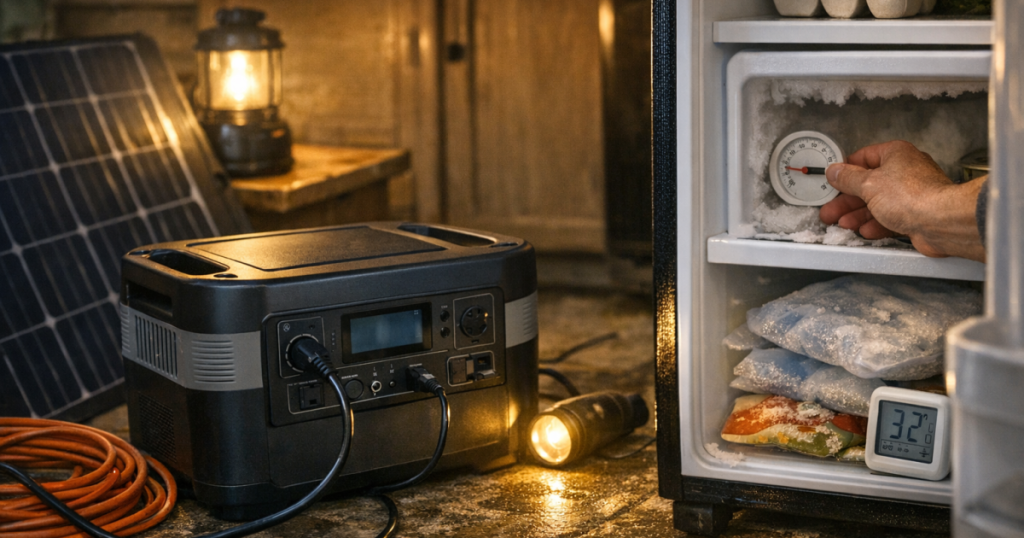
A refrigerator is one of the few loads in a blackout that can save real money and hassle if you keep it running. The best portable power stations for refrigerator backup are not automatically the biggest units on the shelf; they are the ones with enough watt-hours, surge headroom, recharge options, and simple controls for your home’s outage pattern.
Electrical panel connections, transfer switches, and generator inlet work should be carried out by a qualified electrician to comply with local electrical codes and safety standards. A portable power station can usually power a refrigerator by cord, but it should not be used to backfeed a home circuit.
The short answer for 2026
For most US households, a refrigerator backup power station should start around the 1,000Wh class for short outages and move toward 2,000Wh or more if you want a better chance of covering an overnight or full-day outage. A fridge cycles on and off, so runtime depends on the appliance, room temperature, how often the door opens, and how much battery capacity is actually usable after inverter losses.
These are sensible 2026 shortlist options to compare for refrigerator use, based on manufacturer-listed capacity, AC output, battery type, and practical outage fit:
- Anker SOLIX C1000: a compact LiFePO4 option listed at 1,056Wh with 1,800W AC output, making it a strong small-home or apartment candidate when storage space is limited.
- BLUETTI AC180: a midsize LiFePO4 unit listed at 1,152Wh and 1,800W AC output, useful for shoppers comparing value, portability, and basic refrigerator runtime.
- EcoFlow DELTA 2 Max: a larger LiFePO4 choice listed at 2,048Wh and 2,400W AC output, better suited to longer outages or a fridge-plus-small-load plan.
- Jackery Explorer 2000 Plus: an expandable LiFePO4 system listed around the 2kWh class with high AC output, worth comparing if you want room to grow beyond one refrigerator.
Pricing changes often in the US market, so it is more useful to compare current cost per usable watt-hour, included cables, expansion-battery pricing, warranty terms, and return policy than to rely on a stale sale price. Owner reviews can help too, but read them for refrigerator-start behavior, fan noise, charging reliability, and support experiences rather than one-off runtime claims.
Step 1: Estimate what your refrigerator actually needs
Start with the yellow EnergyGuide label or the appliance nameplate. The EnergyGuide label usually gives annual energy use in kilowatt-hours. Divide that number by 365 to estimate daily use, then remember that a power station will lose some energy through its inverter. A simple planning shortcut is to assume only about 80% to 90% of the listed battery capacity will be available to the refrigerator.
Example: if a refrigerator uses about 1.2kWh per day, that is roughly 1,200Wh in 24 hours under normal conditions. A 1,056Wh power station may help through a shorter outage, but it should not be assumed to cover a full day without recharge. A 2,048Wh unit gives more margin, though real runtime still changes with kitchen temperature, door openings, compressor cycles, and appliance age.
For food-specific outage routines, thermometer use, and when to keep the door closed, pair your battery plan with our guide to powering a refrigerator safely during an outage.
Step 2: Check surge output, not just battery size
Refrigerators need steady running power, but the compressor can demand a brief startup surge. That is why the AC inverter rating matters. A power station with a comfortable continuous AC rating and suitable surge capability is a better choice than a high-capacity unit with a weaker inverter.
- Continuous AC output: This is the normal wattage the station can supply. For refrigerator planning, leave generous headroom instead of running near the limit.
- Surge rating: This covers short compressor startup loads. Manufacturer ratings vary, so verify the unit’s AC surge specification before buying.
- Pure sine wave output: Most quality portable power stations advertise pure sine wave AC output, which is the preferred type for motor-driven appliances and electronics.
- Battery chemistry: LiFePO4 batteries are common in current models and are valued for long cycle life. That does not make every model equal, but it is a useful comparison point.
- Recharge speed: Fast wall charging is handy before a storm, while solar input can help during multi-day outages if sunlight and panel placement cooperate.
Step 3: Match the station to your blackout pattern
The best choice changes depending on whether your outages are usually two hours, overnight, or long enough that you start rationing door openings and ice packs. A refrigerator is not a laptop; it is heavy, cyclical, and unforgiving if you undersize the plan.
For short neighborhood outages
A 1,000Wh-class station such as the Anker SOLIX C1000 or BLUETTI AC180 is a realistic place to start if your main goal is bridging brief utility interruptions. This size is easier to store, easier to move, and less painful to keep charged. It is also a good fit for renters who cannot store fuel or run a generator.
If you live in an apartment and need compact backup beyond the refrigerator question, the storage and noise constraints are different; our guide to portable power stations for apartment blackouts and limited storage covers that smaller-space angle.
For overnight or uncertain outages
Around 2,000Wh is the more comfortable class for a full-size refrigerator when you do not know whether power will be back before bed. The EcoFlow DELTA 2 Max and Jackery Explorer 2000 Plus sit in this larger range and give more margin for inverter losses, warmer rooms, and an occasional phone or light recharge. The trade-off is cost, weight, and storage space.
For multi-day storm planning
A power station alone is rarely a complete multi-day refrigerator plan unless you can recharge it. Solar panels may help, but cloudy weather, shade, winter sun angle, and limited balcony or yard space can sharply reduce production. Some households pair a larger battery with a generator used outdoors for periodic recharging, but generator use brings fuel storage, noise, maintenance, and carbon monoxide risks.
If you are deciding whether a battery, generator, or UPS belongs in the plan, the differences are laid out in Portable Power Station vs Generator vs UPS for Blackouts.
Step 4: Look past the headline capacity
Two units with similar watt-hours can feel very different during an outage. Before buying, check the details that affect the kitchen at 2 a.m., not just the spec sheet glamour.
- Display clarity: A clear percentage, input wattage, and output wattage readout makes it easier to know whether the fridge is cycling normally.
- Physical weight: A larger battery is useful only if you can move it safely to the refrigerator and back to its charging spot.
- Outlet placement: Make sure the AC outlets are easy to access when the unit is on the floor near the appliance.
- Extension cord limits: Use a properly rated, grounded cord only when needed, and avoid coiling excess cord under load.
- Noise: Cooling fans can turn on while powering a refrigerator. Owner reviews are useful for spotting whether fan noise is acceptable in small homes.
- Expansion path: Some larger systems allow add-on batteries. That can be helpful, but confirm what is included versus sold separately.
Step 5: Set it up before the outage
Do a low-stress test on a normal day. Charge the station, plug in the refrigerator, and watch the display when the compressor starts. You are looking for stable operation, reasonable output readings, and no overload shutdowns. Do not wait for a storm night to learn where the cord reaches.
- Keep the power station indoors, dry, and away from heat sources.
- Do not plug a refrigerator into a small UPS meant for a desktop computer unless the UPS is specifically sized and rated for that load.
- Do not run gasoline, propane, or dual-fuel generators indoors, in garages, on porches, or near open windows.
- If recharging a power station from a generator, place the generator outdoors according to the manufacturer’s safety instructions.
- Use refrigerator and freezer thermometers so you are making food decisions from temperature, not guesswork.
Helpful questions
Can a 1,000Wh power station run a refrigerator overnight?
Often it can help through an overnight interruption, but it is not guaranteed. A modern efficient refrigerator in a cool kitchen may cycle lightly, while an older appliance in a warm room can drain the battery much faster. Use the EnergyGuide label and a test run for a better estimate.
Should I buy the biggest power station I can afford?
Not automatically. Bigger units give more runtime, but they cost more, weigh more, and take up more storage space. A mid-size station that you keep charged and can move easily may serve you better than an oversized unit that is awkward to use.
Is solar charging enough for refrigerator backup?
Solar can extend runtime, but it is not a promise of continuous refrigerator power. Panel size, sunlight, shade, weather, and placement all affect charging. Treat solar as a useful recharge path, not the only food-safety plan.
Main lessons
The best portable power stations for refrigerator backup in 2026 are the ones that match your appliance, outage length, storage space, and recharge plan. For short interruptions, a 1,000Wh-class LiFePO4 unit with strong AC output may be enough. For overnight or longer outages, a 2,000Wh-class station gives more breathing room. For multi-day events, plan how you will recharge, monitor food temperature, and reduce door openings. A refrigerator backup plan does not need to be dramatic; it just needs to be sized honestly before the lights go out.