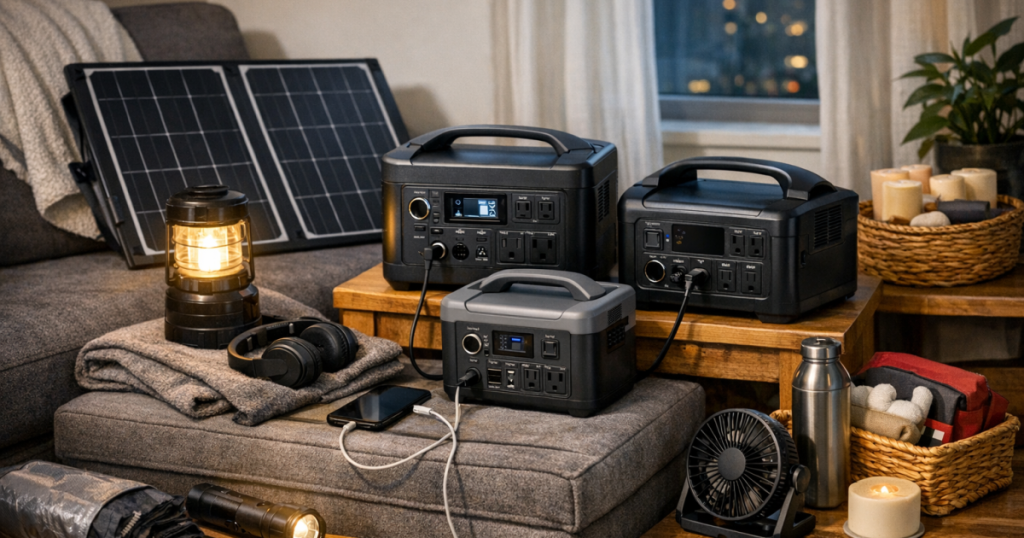
Apartment blackout planning is a small-space puzzle: you need quiet power for phones, a router, maybe a laptop or CPAP, but you do not have a garage for fuel cans or a closet the size of a hardware aisle. The best portable power stations for apartments are battery units that store safely indoors, recharge from a wall outlet, and cover essentials without taking over your floor.
Any connection that ties backup power into apartment wiring, breaker panels, inlets, or transfer equipment should be carried out by a qualified electrician and must comply with local electrical code, building rules, and lease requirements.
At a glance
- For most apartments: a compact power station in the roughly 700Wh to 1,200Wh class is the most balanced starting point for phones, router gear, laptops, lights, and careful overnight use.
- For tight closets: prioritize a clean rectangular shape, manageable weight, simple cable storage, and a unit you can lift without turning outage prep into a deadlift session.
- For medical equipment: size the station around the device’s actual power draw and runtime needs, not the marketing capacity printed on the box.
- For refrigerators: portable stations can work in some setups, but startup surge, total load, and cord routing need closer attention.
- For apartment safety: battery power stations are far more apartment-friendly than fuel-burning generators because they produce no exhaust during operation, but they still need ventilation, dry placement, and sensible charging habits.
Start with the loads you actually need
The first step is not picking a brand. It is writing down what you would plug in during a real outage. Apartment backup power should be boringly practical: phone charging, internet if service is still active, a laptop for work, a lamp, and possibly medical or comfort equipment.
Think in groups:
- Communication: phones, hotspot, weather radio, tablet, and router or modem.
- Work and school: laptop, monitor only if needed, and chargers.
- Health and comfort: CPAP, small fan, rechargeable lanterns, and basic lighting.
- Food safety: refrigerator or small freezer only after checking startup requirements and the station’s output limits.
Do not plan to run everything at once. A smaller power station used with discipline often serves an apartment better than a larger unit that is awkward to store, heavy to move, and rarely kept charged.
Three apartment-friendly picks to use as reference points
For many renters, the best portable power stations for apartments fall into a middle range: large enough to be useful during a long evening or overnight outage, but compact enough to live in a closet, under a desk, or near an entry shelf. These three models are useful reference points because they represent different apartment priorities.
EcoFlow DELTA 3 Plus: for fast recharge and electronics backup
EcoFlow DELTA 3 Plus Portable Power Station is a strong apartment reference if your priority is recharging quickly before storm weather arrives and keeping electronics supported with a UPS-capable design. That makes it worth considering for renters who work from home, rely on internet equipment, or want a battery that can sit near a desk instead of in a storage bin.
The practical check is simple: confirm the output rating, outlet layout, noise behavior during charging, and UPS behavior in the current manufacturer documentation. “UPS-capable” does not automatically mean it replaces a dedicated computer UPS for every setup, especially if you have sensitive desktop gear or a complex home office.
BLUETTI Elite 100 V2: for compact storage and solar flexibility
BLUETTI Elite 100 V2 Portable Power Station is a sensible reference for apartments where storage space is the limiting factor and solar recharging may be part of the plan. Its appeal is not about pretending your balcony is a power plant. It is about having a compact battery system that can be topped up from the wall and, where practical, paired with portable solar gear during longer disruptions.
Apartment solar is often constrained by sun exposure, building rules, balcony access, and weather. Treat solar input as a useful backup charging method, not a guaranteed daily refill unless your actual space supports it.
Jackery Explorer 1000 v2: for a lightweight 1kWh-class setup
Jackery Explorer 1000 v2 Portable Power Station is a useful benchmark for a lightweight 1kWh-style apartment battery. That capacity class is often enough for a realistic essentials plan: phones, router gear, a laptop, lights, and selective use of small devices.
This type of station makes the most sense when you want one unit you can move easily from closet to living room, rather than a heavier system that stays parked in one place. Before relying on it for a specific appliance, check both continuous wattage and surge support against the appliance label and the manufacturer’s guidance.
Pick the right capacity range, not the biggest box
Battery capacity is usually shown in watt-hours, or Wh. Plain English version: a watt-hour is the fuel tank for your battery. A 1,000Wh station is not a promise that a 100-watt device will run for exactly 10 hours, because conversion losses and device behavior reduce real-world runtime. Still, Wh is the right starting number.
- 300Wh to 600Wh: good for phones, tablets, LED lights, radios, and short laptop use. Easy to store, but limited for overnight needs.
- 700Wh to 1,200Wh: the apartment sweet spot for many households. Better for router gear, laptops, lights, and carefully managed medical-device use.
- 1,500Wh and above: useful for longer outages or heavier loads, but bulk, weight, cost, and storage space become more noticeable.
If you are also weighing a UPS or generator, the differences are worth sorting out before you spend money. A broader breakdown of portable power stations, generators, and UPS units for blackouts can help you decide which role each device should play.
Use a simple apartment sizing method
Follow this four-step process before choosing a station:
- List the devices: include only the items you would actually use during the first night of an outage.
- Find the watt draw: check the device label, power adapter, or manufacturer information. For appliances, note that startup surge can be higher than running wattage.
- Estimate hours: decide whether each item needs continuous power or short charging sessions.
- Add a buffer: choose more capacity than the exact math suggests, because batteries are not 100% efficient and outages rarely follow a neat schedule.
For example, a router and modem might need steady power, while phones can charge in batches. A laptop can often be topped up and unplugged. A lamp can be replaced with a rechargeable lantern. That kind of rotation stretches runtime without adding another big battery to the closet.
Apartment safety checks before you plug in
Portable power stations are indoor battery devices, not fuel-burning generators. That is exactly why they fit apartment living. You avoid exhaust, fuel storage, and the obvious problem of trying to run an engine on a balcony, which should not be done.
Still, use them thoughtfully:
- Keep the unit dry and off damp floors.
- Leave open space around vents while charging or discharging.
- Use cords rated for the load and avoid daisy-chaining power strips.
- Do not cover the unit with blankets, boxes, or laundry.
- Charge it on a stable surface where heat can dissipate.
- Follow manufacturer instructions for storage charge level and long-term maintenance.
For a wider safety refresher, especially if your household also owns a generator or high-load equipment, keep home backup power safety basics in your planning folder.
Where a portable station is not enough
A power station is excellent for small essentials, but it is not a magic wall outlet. Electric heaters, large air conditioners, ovens, and high-draw kitchen appliances can drain or overload portable batteries quickly. In an apartment, heat and cooling plans often need non-electric layers: blankets, room-darkening curtains, battery fans, hydration, and a plan to leave if indoor temperatures become unsafe.
Refrigerators are a gray area. Some portable stations can handle some fridges, but you need to verify startup surge, running watts, cord length, and whether the station’s inverter is appropriate for the appliance. If food safety is your main concern, add a refrigerator thermometer and plan cooler space before assuming the battery will handle the job.
Special note for CPAP users
If you use a CPAP, build the plan around the machine, not around a generic runtime claim. Humidifiers and heated tubing can increase power use, and different settings change the math. For a more detailed medical-device setup, read the step-by-step guide to running a CPAP on a portable power station during an outage.
Test your setup on a normal night before storm season. A calm practice run is much better than discovering at 2 a.m. that the cord is too short, the station is not charged, or the machine draws more than expected.
Small-space storage routine
The best apartment backup setup is the one you can maintain without rearranging your life. Put the station somewhere accessible, not buried behind winter coats and a box of mystery cables. Keep its charging cable, a short heavy-duty extension cord, and your device adapters together in one bag or bin.
- Check charge level monthly.
- Recharge before forecast storms, wildfire shutoffs, or extreme heat events.
- Label the station with the devices it is meant to support.
- Keep a small lantern separate from the power station so you can find things in the dark.
- Do one short practice outage: router, lamp, phone, and laptop, all in the same room.
This is where compact gear earns its keep. If setup takes five minutes and does not require moving furniture, you are more likely to use it correctly when the power fails.
Things readers ask
Can I use a portable power station inside an apartment?
Yes, battery-based portable power stations are designed for indoor use when operated according to the manufacturer’s instructions. They do not burn fuel while running, but they still need dry placement, ventilation, and proper charging practices.
Is a portable power station better than a generator for an apartment?
For most apartment dwellers, yes. A fuel-burning generator creates exhaust and cannot be safely operated indoors or on typical apartment balconies. A battery power station is quieter, cleaner, and easier to store, though it has less total energy than a refuelable generator.
How much capacity should an apartment renter start with?
Many renters should start by looking at the 700Wh to 1,200Wh range, then adjust up or down based on actual devices. Smaller units are easier to store; larger units give more runtime but add weight, cost, and storage friction.
Key takeaways
For apartment blackouts, choose quiet battery backup around your real essentials: communication, light, work, and health needs. The strongest setup is usually not the largest one. It is the station you can store, keep charged, move easily, and use without bending lease rules or safety basics.
Start with your device list, choose a sensible capacity class, verify output against any appliance or medical equipment, and practice once before you need it. That is the difference between owning backup power and actually being ready to use it.