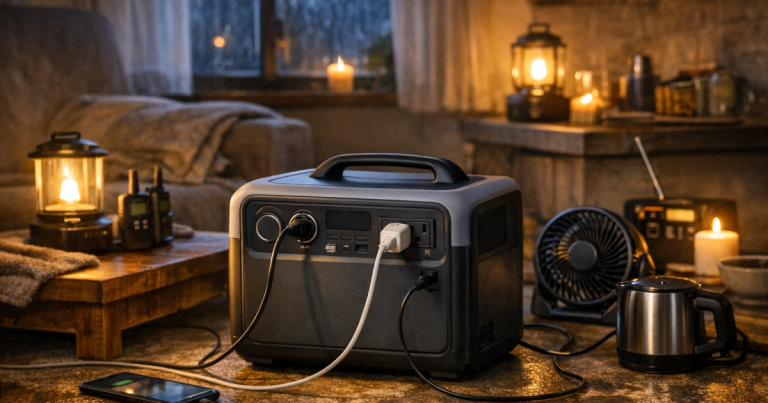
A good blackout battery is not a magic wall outlet. It is a limited tank of stored energy, and this Jackery Portable Power Station Explorer 1000 v2 review starts there: useful capacity, quiet indoor power, and a clear ceiling on what it should be asked to do.
Jackery Portable Power Station Explorer 1000 v2
Best considered for quiet essential-load backup when you can plan watts carefully and avoid safety-critical power needs
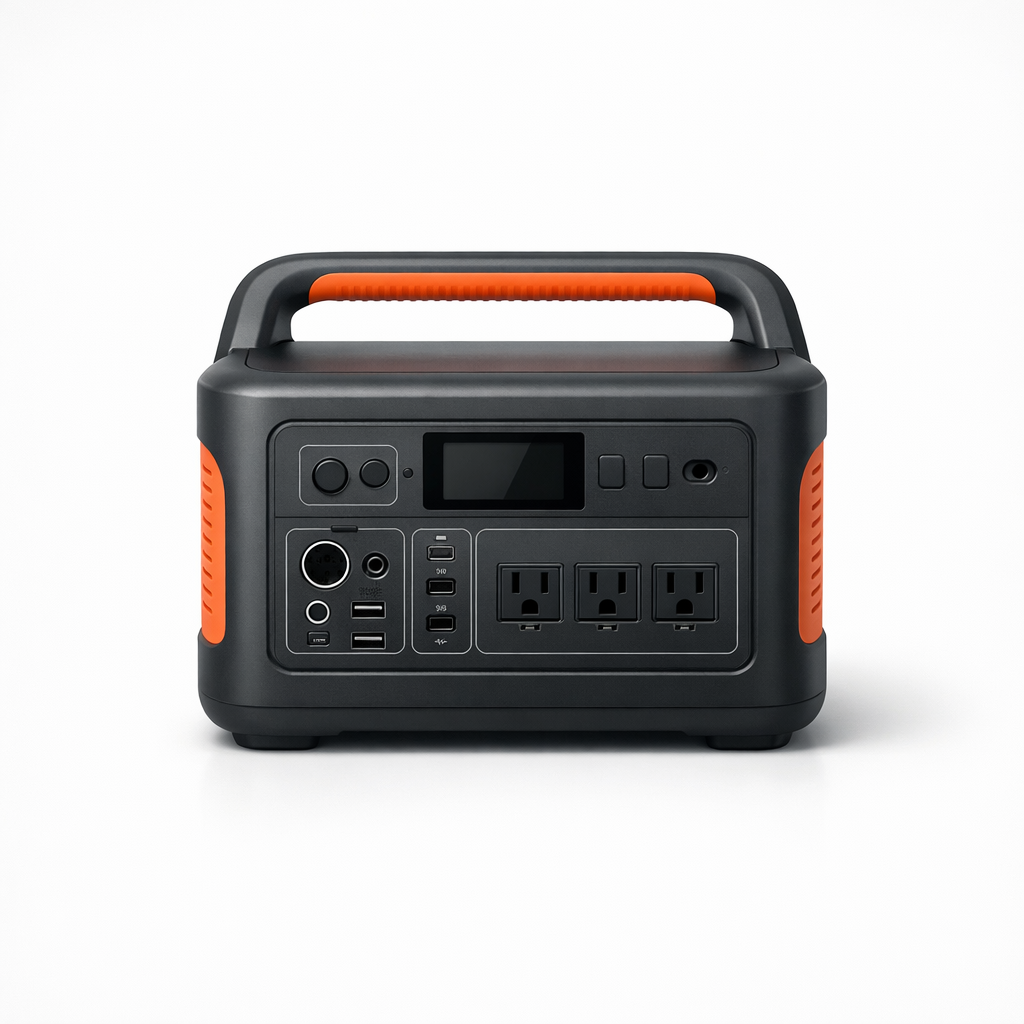
The Jackery Portable Power Station Explorer 1000 v2 is a 1070Wh LiFePO4 portable power station with 120V AC outlets, USB ports, and a 12V DC car port. The practical read is simple: it is a strong fit for essentials, not a substitute for a whole-home system.
Hardwired electrical connections, transfer switches, inlet wiring, and any work tying backup power into household circuits should be handled by a qualified electrician in compliance with local codes and safety requirements.
Product Details
- Battery capacity: 30.4Ah/35.2V DC, 1070Wh.
- Battery chemistry: LiFePO4 cells rated for 4000 cycles to 70%+ capacity.
- AC output: three AC outlets, 120V 60Hz, 1500W rated total output, 3000W surge peak.
- USB output: one USB-C 30W max port, one USB-C 100W max port, and one USB-A 18W max port.
- 12V output: 12V DC car port rated at 10A.
- Charging input: AC charging at 100-120V 60Hz, 15A max.
- Solar/DC input: two DC 8mm ports, with up to 400W max when doubled.
- Listed charging times: AC adapter 1.58 hours, 12V car adapter 12 hours, and solar charging 7.5 hours.
- Size and weight: 12.87 x 8.82 x 9.72 in; around 23.8 lb.
- Operating ranges: charging from 32-113°F and discharging from 14-113°F.
Where the 1070Wh capacity makes sense
The 1070Wh rating puts the Jackery Portable Power Station Explorer 1000 v2 in the lightweight 1kWh class. For a household blackout plan, that is most useful when the job list is controlled: phones, a router, a laptop, LED lighting, a fan, and carefully managed appliance runs. It is not the right mental model for “run everything until the grid comes back.” That way lies disappointment, tripped outputs, or both.
The important number is not just watt-hours on the label. Actual runtime depends on the device load, startup surge, inverter losses, temperature, and how many outputs are active. A refrigerator, for example, does not draw one steady amount of power all day; it cycles and can have a startup surge. A router may be predictable, while a small appliance can drain capacity quickly. Treat 1070Wh as the upper boundary of the stored battery, then build a plan around measured or nameplate watts.
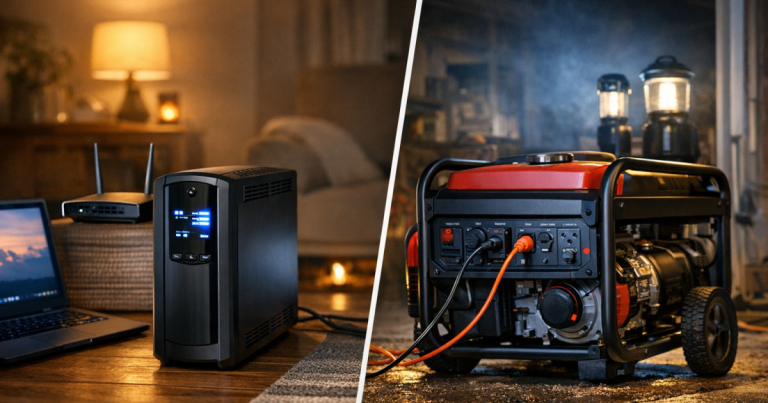
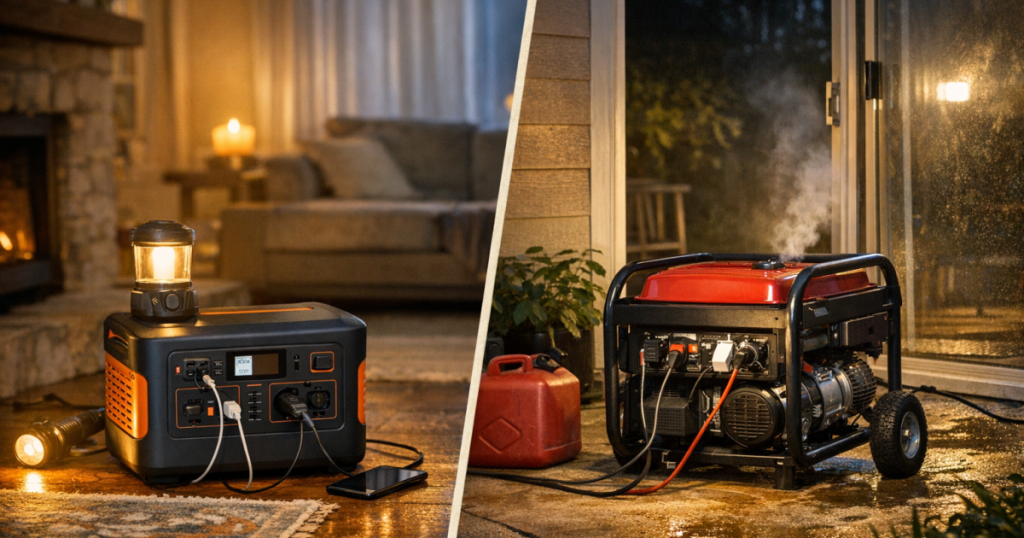
If you are still deciding between battery storage, a fuel generator, and a UPS for electronics, the site’s portable power station, generator, and UPS comparison is a better first step. This Jackery makes the most sense after you already know you want quiet, indoor-friendly battery power for selected loads.
The AC output is useful, but it sets the rules
The three AC outlets are rated for 120V 60Hz with 1500W total output and a 3000W surge peak. That is a helpful amount of output for a 1kWh portable station, but the word “total” is doing real work. Three outlets do not mean three high-draw appliances at once. The combined load still has to stay within the station’s output limits.
For blackout use, that rating points toward practical essentials: a refrigerator run in managed intervals, a modem and router, a laptop, rechargeable lights, small kitchen appliances used briefly, or similar 120V devices. It does not point toward central HVAC, 240V loads, hardwired circuits, or an attempt to backfeed a house. The unit’s strength is selective power, not brute-force home takeover. Quiet is good; quiet and overloaded is just a very polite shutdown waiting to happen.
The bypass mode rating is 100-120V 60Hz at 1500W. That can be useful in a desktop-style setup where the station sits between wall power and connected loads, but it should not be mistaken for a professional UPS system. Jackery’s EPS function is not a 0ms transfer design, and the stated 20ms switching limit means sensitive electronics should be treated cautiously. Jackery also says not to connect equipment with high uninterruptible power requirements, including data servers and workstations.
USB and 12V ports help keep the essentials tidy
The port mix is one of the more practical parts of the Jackery Portable Power Station Explorer 1000 v2. The USB-C 100W max port is useful for many modern laptops and higher-demand USB-C gear, while the USB-C 30W and USB-A 18W ports cover phones, tablets, and smaller accessories. Using USB directly can reduce the need for wall chargers scattered around the room, which is a small but welcome improvement when the house is dark and everyone wants a charging cable.
The 12V DC car port is rated at 10A. That gives the unit another output path for compatible 12V devices, though the same planning rule applies: the device has to fit the port’s rating, and the total energy still comes out of the same 1070Wh battery. Ports add flexibility; they do not add extra stored power.
Charging speed is a real advantage, with solar caveats
Jackery lists a 1.58-hour AC adapter charging time, which is fast enough to change how you use the station before a storm. If a watch or warning gives you a short preparation window, topping up from a wall outlet is a realistic pre-outage move. The 12V car adapter figure is much slower at 12 hours, so it is better viewed as a fallback, not the primary way to recover capacity during a multi-day outage.
Solar charging is listed at 7.5 hours, with DC input through two 8mm ports and up to 400W max when doubled. That is useful for daytime recovery, but the base standalone package includes the Explorer 1000 v2 and one AC charging cable. Solar panels and solar charging cables are bundle or accessory items, so the solar story depends on buying the right companion gear and having sun, placement, and time on your side.
Temperature limits also deserve a spot in the plan. Charging is specified from 32-113°F, while discharging is specified from 14-113°F. In a cold garage or hot vehicle, those ranges can become more than fine print. Store and operate the station where the battery can stay inside its working window.
Limits that should shape the buying decision
The Jackery Portable Power Station Explorer 1000 v2 is not recommended by Jackery for medical devices, life-support equipment, critical public infrastructure, business-critical equipment, or other safety-critical loads. That is not a minor footnote for households with health-related power needs. If a device is tied to health, sleep therapy, refrigeration for medication, or data loss, the backup plan needs more care than simply plugging it into a convenient battery box.
Energy Saving Mode can automatically turn outputs off after 12 hours under low or no-load conditions. That can be helpful for avoiding needless drain, but it can also be the wrong behavior for a tiny always-on load. In a real outage setup, low-draw devices are exactly the ones people hope will quietly keep running. Plan the setup around that behavior rather than discovering it at 3 a.m.
For broader safety habits around extension cords, indoor power stations, generators, refueling, and household loads, keep the site’s home backup power safety basics close to your planning process. The safest backup setup is usually the one with the fewest surprises.
Best fit in a real blackout plan
The strongest case for the Jackery Portable Power Station Explorer 1000 v2 is a household that wants quiet, portable, rechargeable backup for a defined essentials list. Renters, apartment dwellers, remote workers, and homeowners who do not want to run a fuel generator for every short outage are the natural audience. Around 23.8 lb, it is portable enough to move between rooms without treating it like gym equipment, while still offering enough capacity to be more than a phone-charging brick.
It is also a good companion to a larger plan. A generator can handle heavier loads outdoors when conditions and safety allow; a portable power station can sit inside with the router, phones, and lights. That division keeps the noisy, fuel-burning work outside and the everyday living essentials inside. The Jackery’s role is calmer and narrower, which is not a weakness as long as you buy it for the right job.
Verdict
Score: 8.6/10. The Jackery Portable Power Station Explorer 1000 v2 earns a strong recommendation as a quiet 1kWh blackout battery for essentials because its 1070Wh capacity, 1500W rated AC output, useful USB mix, and LiFePO4 cycle rating line up well with realistic home outage needs. Its limits are equally important: it is not a whole-home system, not a professional UPS, not intended for safety-critical medical or business loads, and not a shortcut around proper electrical work. Buy it for phones, routers, laptops, lights, carefully managed refrigerator use, and short appliance runs; choose a different backup approach if your plan depends on uninterrupted transfer, hardwired circuits, or multi-day heavy loads.
Jackery Portable Power Station Explorer 1000 v2
Best considered for quiet essential-load backup when you can plan watts carefully and avoid safety-critical power needs
You might also like: How to Run a CPAP on a Portable Power Station During an Outage.