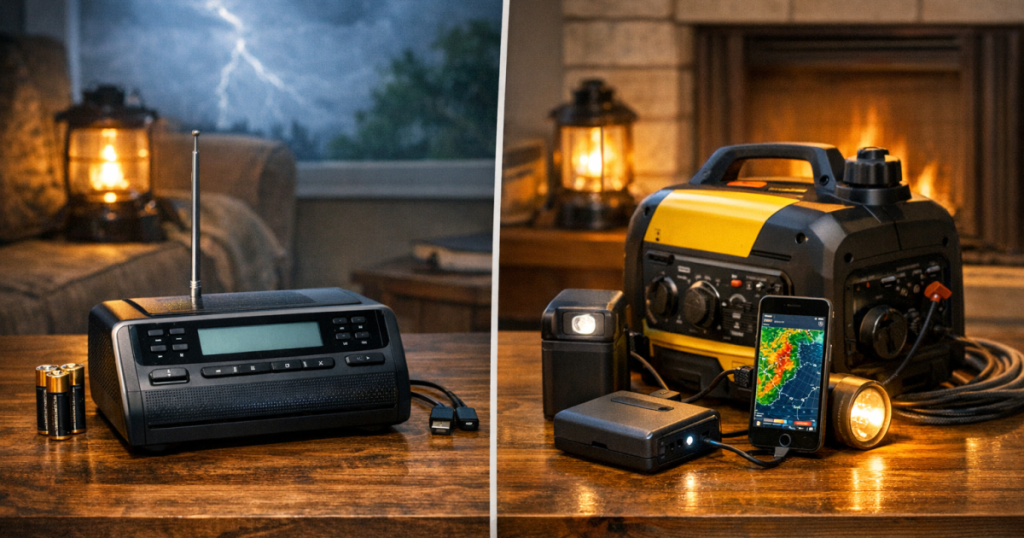
A blackout plan is easier to trust when the warning side is settled before the weather turns ugly. This Midland WR400 Deluxe NOAA Weather Alert Radio review looks at a tabletop NOAA receiver built for a specific job: staying plugged in at home, listening for local emergency alerts, and falling back on AA batteries when the power drops.
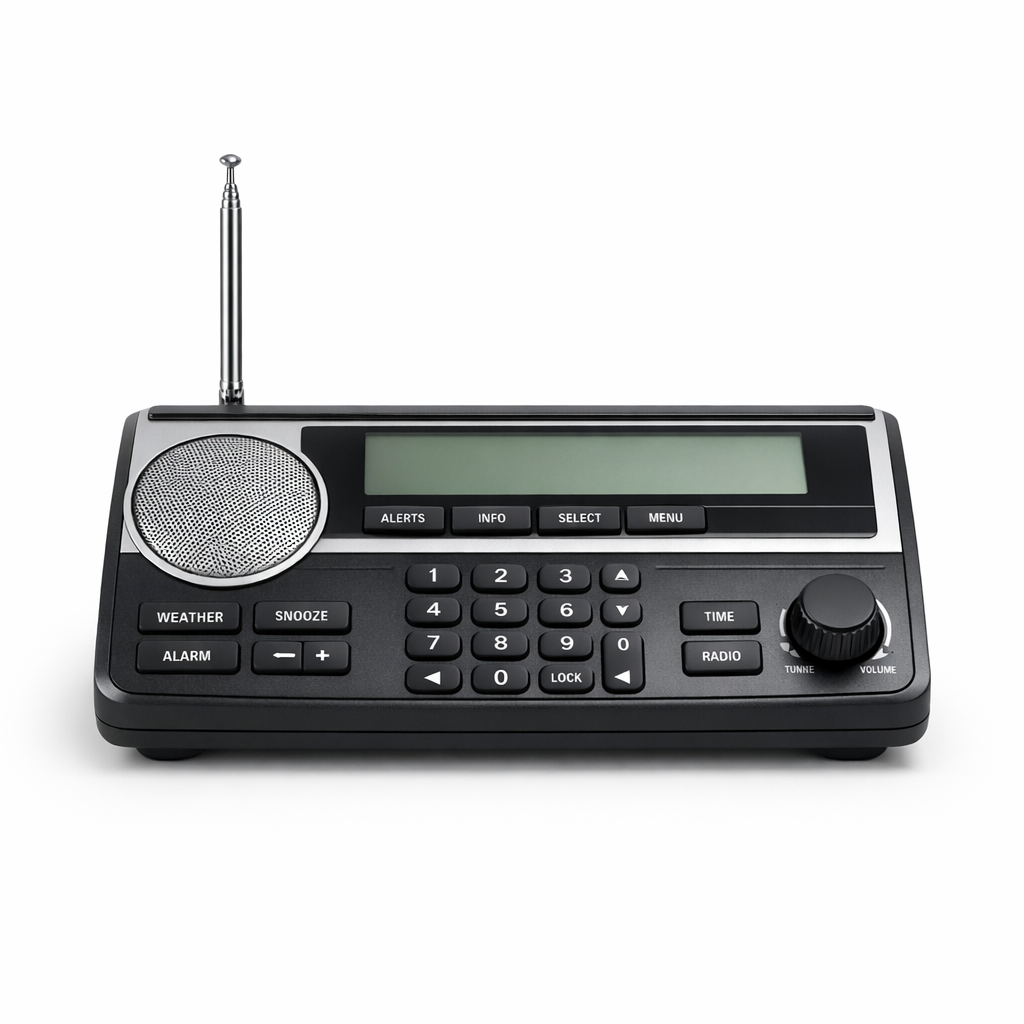
Midland WR400 Deluxe NOAA Weather Alert Radio
A sensible tabletop alert radio for homes that want localized NOAA warnings without adding another complicated blackout device
The WR400 is not trying to be a hand-crank camping radio or a pocket-size power bank. It is a home or office alert radio with S.A.M.E. localized alerting, AM/FM radio, clock alarms, USB charging while on wall power, and backup operation from 4 AA alkaline batteries. That makes it most interesting for households that want one steady alert device on a nightstand, kitchen counter, home office shelf, or storm-prep corner.
Product Details
- Product: Midland WR400 Deluxe NOAA Weather Alert Radio
- Official model: WR400
- Official US price: $109.99
- In the box: WR400 Emergency Alert Weather Radio, AC Power Adapter, Owner’s Manual
- Power: 120V AC adapter with 4 AA alkaline battery backup
- S.A.M.E. locations: Programmable for up to 25 different counties/provinces
- NOAA Weather Band coverage: 162.400 to 162.550 MHz
- AM/FM coverage: AM 520 to 1710 kHz; FM 87.5 to 108.1 MHz
- USB output: 5V, 1A, and USB charging works only when connected to wall power
- Selectable alert types: Voice, Display, Tone, Siren
- US limited warranty: Three years for weather radio receivers purchased by the original consumer from Midland or an authorized reseller
The strongest reason to choose the WR400
The WR400 earns attention because it keeps the alerting job separate from your phone, router, and backup power setup. During a storm outage, a phone may be busy, low on charge, muted, or struggling with cell service. A tabletop NOAA alert radio gives your household another path for emergency information, provided there is a NOAA Weather Radio signal in your area and the radio is programmed and placed for good reception.
The S.A.M.E. feature is the practical centerpiece. Being able to program up to 25 different counties/provinces means the WR400 can be tailored around the places your household actually cares about. For many families, that may mean your home county plus nearby counties where storms typically approach from, or counties where relatives, a workplace, or a school are located. The point is not to receive every possible broadcast; it is to reduce noise and make the alerts more relevant.
That local focus pairs well with broader outage planning. A weather alert radio does not replace batteries, lighting, food, or a way to keep devices charged, but it helps you make decisions earlier. If you are building out the rest of your setup, our home blackout preparedness planning guide is a useful next step because it puts communication, lighting, refrigeration, and backup power into one household plan.
Power design: simple, but with one important limit
For normal use, the WR400 runs from a 120V AC adapter. For outage backup, it requires 4 AA alkaline batteries. Those batteries are not included, so they should be part of the purchase plan rather than an afterthought tossed into a drawer someday. The ownership rhythm is straightforward: keep it plugged in, install fresh AA batteries for backup, and include the radio in your household battery rotation.
The most important limitation is the USB port. The WR400 has a 5V, 1A USB output, but USB charging works only when the radio is connected to wall power. In plain English, it should not be treated as an outage phone charger. When the grid is down and the radio is on AA backup, its job is alert continuity, not refilling your phone.
That is not a flaw so much as a boundary. The WR400 is better viewed as a fixed alert receiver with battery backup, not a portable energy source. If your blackout plan needs phone, router, CPAP, or laptop power, size that separately rather than leaning on this radio. For a broader explanation of where radios, UPS units, generators, and battery power stations fit, see our guide to portable power stations, generators, and UPS options for blackouts.
Alerts and everyday radio features
Midland lists four selectable alert types for the WR400: Voice, Display, Tone, and Siren. That flexibility is useful because alert fatigue is real. A radio that screams for every event in the wrong location becomes easy to ignore; a radio that is programmed carefully and set to a mode your household will notice is more likely to be respected when conditions worsen.
The WR400 also covers AM and FM radio, which gives it a second role during outages and severe weather. Local broadcast radio can be helpful for road closures, school updates, utility restoration news, and regional storm coverage. It is not as targeted as S.A.M.E. weather alerting, but it adds another information channel without adding another device to the counter.
For households with hearing-related needs, the WR400’s accessory path is worth noting carefully. External antenna, strobe light, pillow shaker, and alert cable accessories are optional and are not listed as included in the box. That makes the radio potentially more adaptable than a basic audible-only alert setup, but those accessories should be treated as separate purchases, not bundled features.
Setup and reception are part of the ownership experience
A weather alert radio is only as useful as its setup. The WR400 depends on three things coming together: a NOAA Weather Radio signal in your area, the clearest NOAA channel for your location, and correct S.A.M.E. programming. None of that is complicated, but it does reward a little care before storm season rather than during one.
Placement deserves a few minutes. A tabletop radio that lives in a basement corner or behind electronics may not receive as well as one placed higher or closer to a window. For homes with weak reception, Midland’s optional external antenna support gives the WR400 a sensible path to improve placement without replacing the entire radio.
The radio’s operating temperature range is 32°F to 122°F, which suits normal indoor home use. It should not be treated like a rugged outdoor jobsite radio or tossed into a damp emergency bin in the garage. Keep it where the household can hear or see it, where the AC adapter can stay connected, and where AA backup batteries are easy to replace.
Where it fits best in a home blackout kit
The WR400 is a good fit for households that want reliable alert awareness without turning emergency prep into a pile of gadgets. It belongs in the same practical category as a working flashlight, a labeled battery box, and a written contact list: not glamorous, but very useful when the routine breaks.
It is especially sensible for people who live in storm-prone areas, households with sleeping children, remote workers who may be focused on a laptop during weather events, and anyone who wants an alert device that is not dependent on app notifications. The tabletop format also makes sense for older adults who prefer a dedicated radio over managing yet another mobile notification setting.
It is less suited to evacuation bags, camping kits, or anyone mainly shopping for a hand-crank emergency radio. Midland’s ER-series portable crank weather radios are the more relevant comparison for mobile use. The WR400 is better when it can sit in one place, stay plugged in, and act like a quiet sentry until conditions change.
Value and trade-offs
At an official US price of $109.99, the WR400 sits in the buy-it-on-purpose category rather than the impulse-bin category. The value case comes from localized S.A.M.E. programming, AC-first tabletop operation, AA backup, AM/FM coverage, multiple alert modes, and a three-year US limited warranty for eligible original-consumer purchases from Midland or an authorized reseller.
The trade-offs are clear. You need to supply the 4 AA alkaline batteries. USB charging is not available on battery power. Optional accessibility or reception accessories are not included. And like any NOAA Weather Radio receiver, its usefulness depends on signal coverage, proper channel selection, and accurate programming.
Those limits do not undermine the WR400; they define it. This is a focused home alert radio, and it is strongest when judged against that role rather than against crank radios, phone chargers, or full emergency power stations.
Verdict
Score: 8.5/10. The Midland WR400 Deluxe NOAA Weather Alert Radio is a strong choice for households that want localized NOAA alerts in a fixed home location without adding a complicated device to the blackout kit. The score is driven mainly by its S.A.M.E. programming for up to 25 counties/provinces, its clear AC-plus-AA backup power model, and its practical alert options. Its main compromises are equally important: backup batteries are not included, USB charging does not work from battery power, and reception depends on proper placement and a usable NOAA signal. If you want a tabletop home alert radio, it is easy to recommend. If you want a crank radio, a portable power bank, or an evacuation-bag device, choose a different style of emergency radio.
Midland WR400 Deluxe NOAA Weather Alert Radio
A sensible tabletop alert radio for homes that want localized NOAA warnings without adding another complicated blackout device
You might also like: How to Run a CPAP on a Portable Power Station During an Outage.