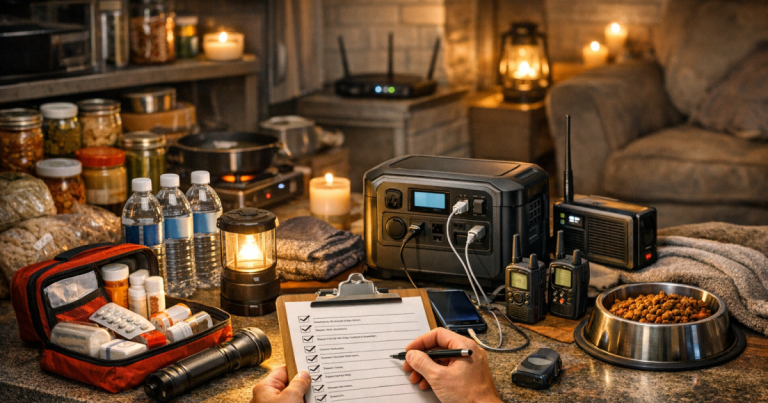
Three days without power is long enough for small gaps to become real problems: a warm fridge, a dead router, low phone batteries, and a flashlight you thought had fresh batteries. A 72-hour power outage checklist gives you a simple way to plan for meals, lights, medications, communications, and backup power before weather or grid trouble arrives.
Generator connections to household wiring, transfer switches, interlocks, and essential-circuit panels should be installed by a qualified electrician to comply with local electrical codes, utility rules, and safety requirements.
Main points
A good 72-hour plan is not a bunker inventory. It is a short, usable household routine for staying safe, fed, informed, and reasonably comfortable until utility power returns or you can relocate.
- Plan for 1 gallon of water per person per day, plus extra for pets, basic washing, and formula or medical needs.
- Keep food simple: shelf-stable meals, manual-open packaging, snacks, and a way to protect refrigerated food.
- Use layered lighting: headlamps, lanterns, flashlights, and spare batteries or rechargeable backups.
- Prioritize communication: phones, a NOAA weather radio, printed contacts, and a plan for limited internet.
- Decide what truly needs power: medical devices, phones, a router, refrigeration, a few lights, or a fan.
- Write down the plan so another adult can follow it without guessing in the dark.
Step 1: Decide what your home must support for 72 hours
Start with people, not gear. Count every adult, child, older relative, overnight guest pattern, and pet that could be in the home during an outage. Then list needs that cannot wait: medications, mobility equipment, baby supplies, medical devices, refrigeration for essential items, and a way to receive local alerts.
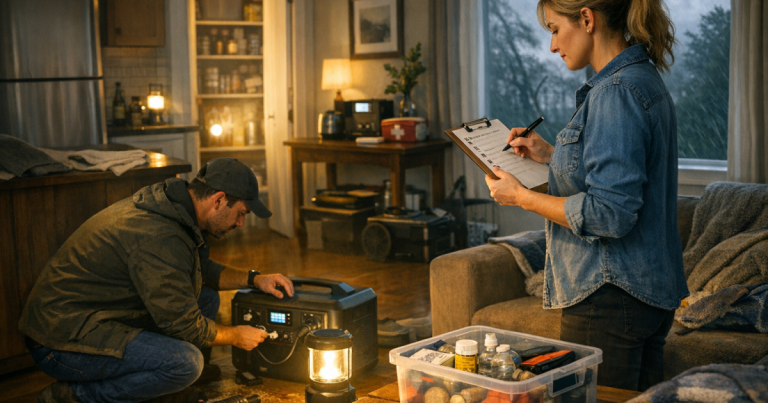
Next, choose the rooms you will actually use. Many homes do better by consolidating into one or two spaces instead of trying to keep the whole house operating. A living room with lanterns, blankets, device chargers, and food supplies is easier to manage than a half-lit house where every drawer hides one missing cable.
Write three assumptions at the top of your checklist: the season, the likely outage length, and whether you can safely leave home. A winter ice storm plan looks different from a summer wildfire shutoff. Heat, cold, smoke, and road closures all change the priorities.
Step 2: Store water and food you can use without much cooking
Water is the first supply to size because it disappears quietly. A basic target is 1 gallon per person per day for drinking and minimal hygiene. For 72 hours, that means 3 gallons per person before pets, infants, medical needs, or hot weather are added.
Food should be boring in the best possible way. Choose items your household will actually eat: canned beans, tuna or chicken pouches, peanut butter, crackers, shelf-stable milk, instant oatmeal, dried fruit, nuts, ready-to-eat soups, and electrolyte packets. Include comfort foods if they help kids or stressed adults settle down. Outage dinner does not need to be impressive; it needs to be edible at 8 p.m. by flashlight.
- Keep a manual can opener with the food, not somewhere “obvious” in a kitchen drawer.
- Group one day of meals in a bin or shelf section so you do not burn through snacks on night one.
- Use coolers and appliance thermometers to help manage fridge and freezer decisions.
- Keep refrigerator and freezer doors closed as much as possible, and do not taste questionable food to decide whether it is safe.
- Plan a no-cook meal for the first night, because that is when everyone is most distracted.
Step 3: Build a lighting, information, and communication layer
Lighting is a safety tool, not just a comfort item. Each person should have a personal light, ideally a headlamp or small flashlight, and the shared space should have lanterns. Avoid relying on candles as a primary lighting plan; they add fire risk at the exact moment people are tired, moving around, and charging devices in odd places.
Your communication layer should include charged phones, power banks, a car charger, written contact numbers, and a NOAA weather radio. If your household depends on online work, school alerts, security cameras, or Wi-Fi calling, decide ahead of time whether you will power the modem, router, and any fiber or cable equipment. For a deeper setup, see how to keep home internet running during an outage.
Print the basics: utility outage number, local emergency management page, pharmacy number, doctor or caregiver contacts, school contacts, pet microchip information, and the address of a nearby friend or family member where you could recharge, cool down, or warm up.
Step 4: Plan essential power instead of pretending everything can run
The most useful question is not “How do I power my house?” It is “Which loads are worth spending limited energy on?” For most households, the priority list starts with phones, medical equipment, lights, refrigeration, internet gear, and one comfort item such as a fan. Large electric heat, central air conditioning, electric ovens, dryers, and well pumps can require far more planning than a small emergency kit can provide.
For small electronics, a charged power bank or UPS can buy time. For longer outages, a portable power station, solar recharging setup, or outdoor generator may be appropriate depending on where you live and what you need to run. Keep your expectations grounded: runtime depends on battery capacity, appliance draw, temperature, age of equipment, and how often loads cycle on and off.
If you use a generator, place it outdoors, away from doors, windows, vents, garages, and enclosed spaces. Never run a generator indoors, and never plug one into a wall outlet. Backfeeding can endanger utility crews and damage equipment. If a generator is part of your plan, read how to connect a generator without backfeeding your home before you buy cords, transfer equipment, or inlet hardware.
- Label the devices that get priority power.
- Store charging cables with the backup battery or power station.
- Recharge battery packs on the first of each month or before forecast storms.
- Keep generator fuel safely stored and rotated according to the container and fuel guidance.
- Use outdoor-rated extension cords where appropriate, matched to the load and conditions.
Step 5: Cover medical needs and temperature-sensitive items
Medical planning deserves its own pass because small mistakes can become urgent. List all prescription medications, oxygen or CPAP equipment, refrigerated medicines, mobility devices, hearing aid batteries, and caregiver routines. Note what needs electricity, what needs refrigeration, and what has a backup method.
For refrigerated medication, ask the prescribing pharmacy or clinician how it should be handled during a power loss. Do not rely on guesswork, and do not assume every medication has the same temperature tolerance. Keep a small cooler, cold packs, and a thermometer available if temperature control is part of your plan.
If someone in the home depends on powered medical equipment, keep emergency contacts printed and decide when you would leave for a safer location. The checklist should say who makes that call, where you go, and what supplies leave with the person. A plan that lives only in one person’s head is fragile.
Step 6: Map the first 72 hours by time block
First 6 hours
- Confirm the outage is not limited to your breaker panel.
- Report the outage if your utility allows it and check estimated restoration updates.
- Unplug sensitive electronics if you are concerned about surges when power returns.
- Put flashlights or lanterns in the rooms people are using.
- Keep refrigerator and freezer doors closed while you decide the food plan.
6 to 24 hours
- Start conserving phone battery and power banks.
- Move everyone into the planned room or zone.
- Use shelf-stable food before opening the fridge repeatedly.
- Check on neighbors, especially older adults or anyone with medical needs.
- Set up backup power only in a safe, ventilated, weather-appropriate location.
24 to 48 hours
- Review food safety and move priority items to a cooler if that is part of your plan.
- Reassess heat, cold, smoke, or flooding risks rather than focusing only on electricity.
- Rotate device charging so one phone stays available for emergency calls.
- Limit generator run time to planned charging or refrigeration windows if fuel is limited.
- Update family or neighbors on your status and any change in plans.
48 to 72 hours
- Decide whether staying home is still safe and reasonable.
- Use your printed contacts if cell service or internet is unreliable.
- Check medication, water, pet food, and sanitation supplies.
- Document spoiled food or outage-related damage if needed for later records.
- Restock and recharge as soon as the outage ends, while the gaps are fresh in your mind.
Step 7: Walk through the house and close the annoying gaps
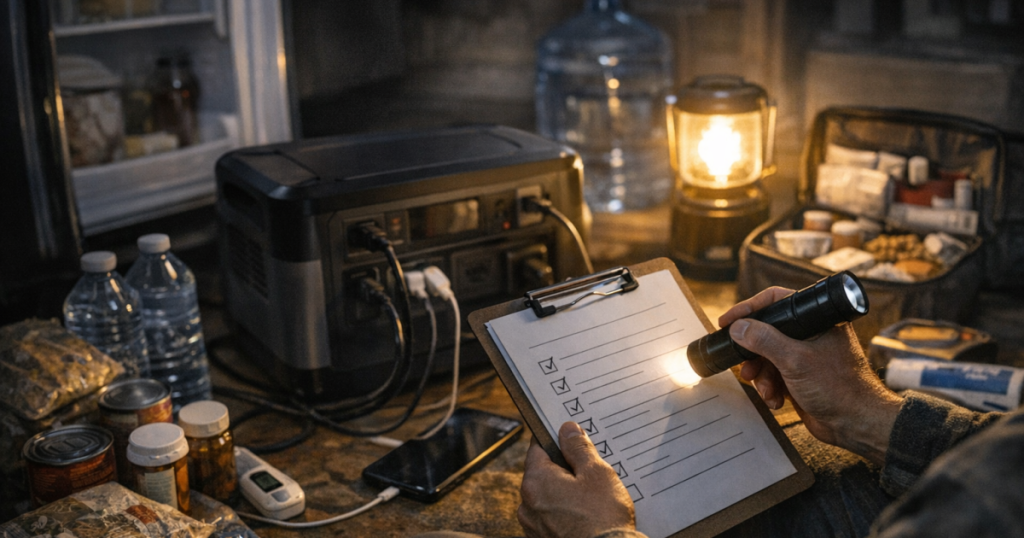
A checklist improves when you walk room by room with a flashlight in your hand. The kitchen exposes missing can openers, coolers, thermometer batteries, and trash bags. Bedrooms reveal whether people can find glasses, medications, warm layers, and chargers in the dark. Bathrooms remind you to plan for hygiene, handwashing, wipes, and toilet needs if water service is affected.
Do this before storm season, not when the lights are already out. If you want a more detailed home audit, use a room-by-room blackout preparedness checklist to catch the dull little details that cause most of the friction.
Copy-ready 72-hour checklist
Use this power outage checklist as a starting point, then mark anything that does not apply to your home. The best version is the one your household can find, understand, and actually follow.
- Water: 3 gallons per person for 72 hours, plus pets and special needs.
- Food: shelf-stable meals, snacks, manual can opener, pet food, baby supplies if needed.
- Lighting: headlamps, flashlights, lanterns, spare batteries, rechargeable lights.
- Communication: charged phones, power banks, car charger, NOAA weather radio, printed contacts.
- Medical: prescriptions, device power plan, refrigerated medication plan, caregiver contacts.
- Backup power: labeled priority devices, charged batteries, safe generator plan if used.
- Food safety: cooler, ice packs, appliance thermometers, trash bags, cleaning supplies.
- Comfort: blankets, warm layers, fans, sunscreen, insect repellent, activities for kids.
- Sanitation: wipes, hand sanitizer, toilet paper, heavy-duty bags, basic cleaning items.
- Documents: insurance details, IDs, utility information, local emergency numbers.
- Pets: leash, carrier, medications, food, water bowl, waste bags, vaccination records.
- After-action note: write down what failed, what ran out, and what you will change.
Key questions answered
How much backup power does a 72-hour plan need?
It depends on the loads you choose. A phone-and-light plan needs far less energy than a plan that includes refrigeration, medical equipment, internet gear, or a well pump. List each device, estimate its wattage from the label or manual, and plan for how many hours it must run. Treat all runtime numbers as estimates, not guarantees.
Should I prepare differently for an apartment?
Yes. Apartments usually rule out fuel-burning generators, and storage space is tighter. Focus on water, shelf-stable food, battery lighting, power banks, a small UPS for internet gear, and a realistic plan for cooling, heating, or relocating if the building becomes unsafe.
What is the easiest item to forget?
The charger or adapter that makes your backup plan work. Keep cables, wall plugs, extension cords, and labels in the same bin as the device they support. A battery without the right cable is just an expensive paperweight with ambition.
How often should I update the checklist?
Review it twice a year and after every outage. Replace expired food, rotate water if your storage method requires it, recharge batteries, test lights, and update phone numbers. The first review is setup; the later reviews are what keep the plan dependable.
What stands out
A strong 72-hour outage plan is specific, modest, and written down. It does not need to run every appliance or solve every scenario. It needs to keep people safe, preserve the supplies you most rely on, and give your household a calm sequence of steps when the power goes out.