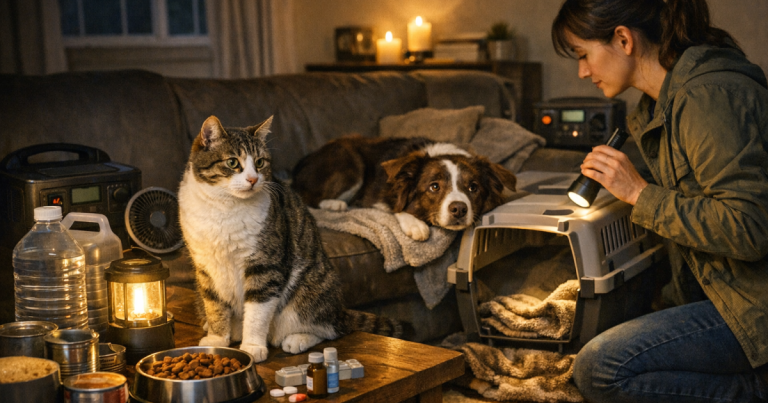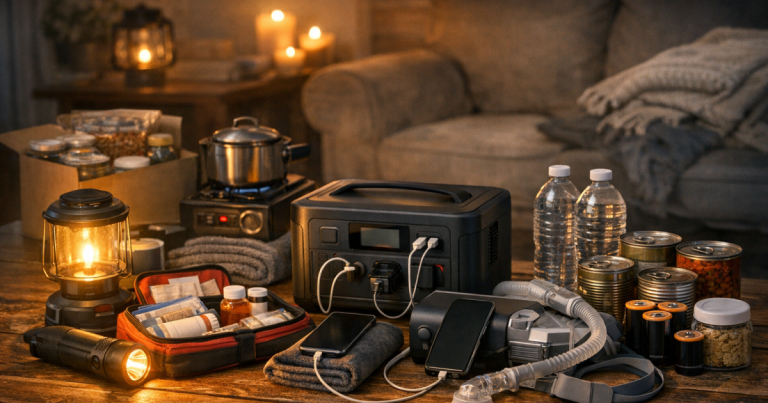
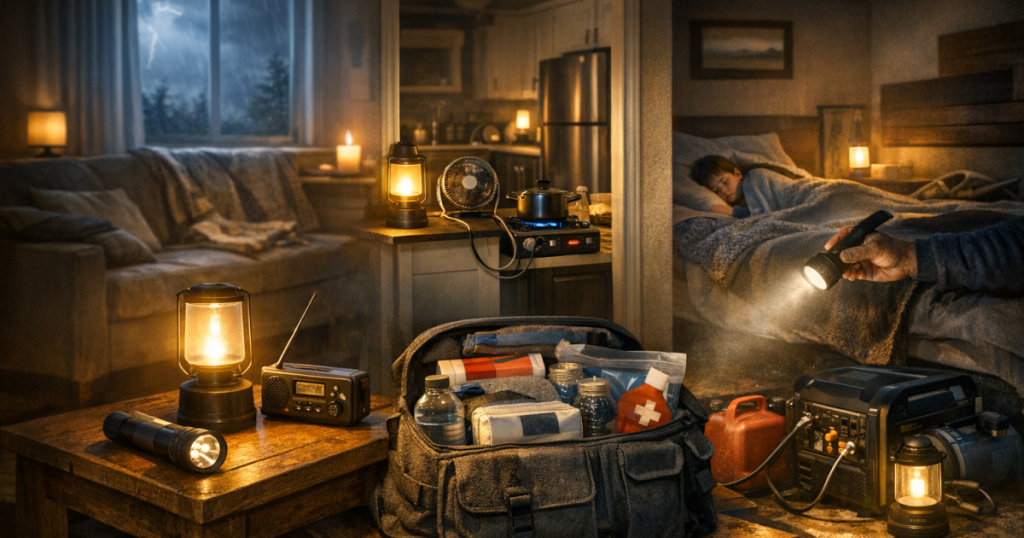
A blackout feels less chaotic when every room already has a job. A room-by-room blackout plan helps you decide where people gather, which loads get power, how food stays cold, and what each person should do before phones start losing charge. The goal is not to run your normal life from batteries or a generator; it is to keep the household safe, connected, and comfortable enough until the grid comes back.
Electrical panel work, transfer switch installation, and generator-to-home connections should be handled by a qualified electrician to meet the National Electrical Code, manufacturer instructions, and local permitting requirements.
The big picture
Start by dividing your home into functions, not square footage. During an outage, the kitchen becomes the food-protection room, one bedroom may become the medical or sleep room, the living room may become the family gathering area, and a hallway may become the safe movement path at night.
This approach is useful because it prevents the common mistake of treating the whole house as one giant problem. You do not need every outlet, lamp, fan, and appliance running. You need the right rooms to support the right tasks at the right time.
- Choose one main gathering room for lighting, device charging, and updates.
- Decide which rooms need backup light immediately and which can wait.
- List any medical, mobility, pet, baby, or work-from-home needs by room.
- Mark food-safety tools and cooling priorities in the kitchen and garage.
- Decide where battery packs, lanterns, radios, cords, and printed instructions live.
Start with the rooms people actually use during an outage
Most households do not spread out during a blackout. People naturally gather in the room with the best light, the most comfortable temperature, and the easiest access to phones, snacks, and updates. Plan around that behavior instead of fighting it.
Living room or family room
This is often the best command center. Keep it simple: two reliable light sources, a place to charge phones, a battery-powered or hand-crank radio, and a printed list of key contacts. If you use a portable power station indoors, this is usually where it makes the most sense because phones, tablets, routers, and small lights can be managed in one place.
Avoid running extension cords through walkways unless you can route them safely along walls. In a dark room, a cord across the floor becomes a trip hazard fast, especially for kids, guests, older adults, or pets.
Kitchen
The kitchen plan is mostly about preserving food and reducing unnecessary fridge openings. Keep an appliance thermometer in the refrigerator and freezer so you are not guessing. As a general food-safety reference, refrigerated food should stay at 40°F or below, and a full freezer holds temperature longer than a half-empty one if the door stays closed.
Write a kitchen outage card that says which door to open, what food to use first, where the cooler is stored, and when to move ice or frozen water bottles. During a short outage, the best action may be doing almost nothing: keep doors closed and check conditions only when needed.
Bedrooms
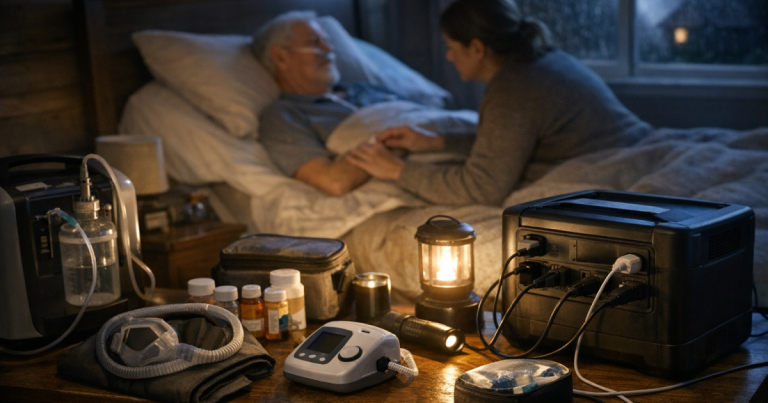
Bedrooms matter most for sleep, warmth, cooling, and medical needs. Put a flashlight or lantern within reach of each sleeping area, not buried in a closet. If someone uses a CPAP machine, oxygen concentrator, powered adjustable bed, refrigerated medication, or mobility device charger, that room needs its own written backup plan.
Do not assume one large backup source will solve every bedroom need. A small dedicated battery for a medical device, a separate phone power bank, and a battery lantern may be more reliable than trying to stretch one shared power source across the house.
Bathrooms and hallways
Bathrooms and hallways are easy to overlook until the first nighttime trip. Use low, stable lighting that will not blind people or create glare on tile. Battery night lights, lanterns placed on counters, or rechargeable lights can make these areas safer without using much energy.
If your home relies on an electric well pump or an electrically controlled water system, include water in the plan. Store drinking water ahead of expected storms, and keep a separate supply for handwashing, toilet flushing, or pets if your setup requires it.
Match rooms to circuits, not just outlets
A room plan becomes much more useful when you know which circuits actually serve each space. Many homes have mixed circuits: a refrigerator may share a circuit with kitchen outlets, a bedroom outlet may be tied to a hallway, or a garage freezer may not be on the circuit you expect.
Before storm season, walk through the home with one person at the electrical panel and another checking lights and outlets. Label what each breaker controls in plain English. For a step-by-step process, use this guide to map essential circuits for backup power before you decide what belongs on your priority list.
Once you understand your circuits, mark them by purpose:
- Critical: refrigerator, freezer, medical equipment, sump pump, well-related equipment, essential heat controls, or communications gear.
- Helpful: router, modem, key lights, phone charging, a fan, or a small cooking appliance if used safely.
- Comfort only: entertainment devices, extra lamps, nonessential rooms, and anything that can wait.
This is also where expectations matter. A portable generator or battery system has limits. Starting watts, running watts, battery capacity, fuel availability, and appliance cycling all affect what can run at the same time. Your plan should say what runs first, what waits, and what never gets connected during an outage.
Build a simple power priority for each room
Instead of writing one big backup-power wish list, give each room a three-tier priority. This makes decisions easier when the outage is longer than expected or fuel and battery charge are limited.
Tier 1: safety and health
These loads protect people, food, or the home itself. Examples include medical devices, refrigerated medication, sump pump needs, a refrigerator or freezer, basic lighting, and a way to receive emergency updates. These are the loads to plan first.
Tier 2: communication and work continuity
This includes phones, a router and modem if internet service is still available, a laptop for essential work, and a radio. If you work remotely, decide which room becomes the outage workspace and what the minimum setup looks like. A laptop plus phone hotspot may be enough for a short disruption; a router, modem, UPS, and battery plan may be better for a household that depends heavily on internet access.
Tier 3: comfort
Comfort is not frivolous. A fan on a hot night, a heated blanket used safely in cold weather, or a familiar lamp for children can keep a household calmer. The key is to treat comfort loads as planned choices, not accidental power drains.
If you are unsure whether your backup setup can support the list you are building, work through how much backup power your outage plan needs before buying more equipment or adding more rooms to the plan.
Plan for light before you plan for everything else
Lighting is the quickest blackout win. It reduces stress, prevents falls, and helps everyone follow the rest of the plan. Every frequently used room should have a known light source that does not depend on wall power.
- Keep one main lantern in the gathering room.
- Place flashlights or small lanterns in bedrooms, not just in a kitchen drawer.
- Use low-level bathroom and hallway lights for nighttime movement.
- Store spare batteries where the lights are used, or standardize rechargeable lights and keep them topped off.
- Avoid candles as a primary lighting plan, especially around pets, children, oxygen equipment, or crowded rooms.
Do a five-minute night drill once or twice a year. Turn off the lights, have everyone find their assigned light source, and walk the route from bedrooms to bathroom to gathering room. It sounds simple because it is, but it reveals missing batteries, blocked drawers, and awkward dark corners quickly.
Give every room a printed instruction card
Printed cards are underrated. During a storm outage, people are tired, phones may be low, and the person who knows the plan may not be home. A room card turns preparation into something the whole household can use.
Keep each card short enough to read by flashlight. A good card includes:
- The room’s job during an outage.
- Where the light source is stored.
- Which outlets or devices are okay to use with backup power.
- What should stay unplugged.
- Any room-specific safety notes, such as keeping fridge doors closed or avoiding cords across walkways.
- Who to call or text if the room supports medical, childcare, pet, or work needs.
Use plain labels. “Router battery backup in office closet” is more useful than “network equipment.” “Garage freezer: keep closed unless moving food to cooler” is more useful than “food safety.”
Think through heat, cold, and air room by room
Temperature is where blackout plans become very household-specific. In hot weather, the safest room may be the shaded downstairs room with cross-ventilation. In cold weather, it may be the smallest room that can be safely kept warm with blankets, layered clothing, and reduced drafts.
Never use a generator, grill, camp stove, or fuel-burning heater indoors, in a garage, on a porch, or near open windows. Carbon monoxide can build up quickly and without warning. If your plan includes a portable generator, it belongs outdoors at a safe distance from openings, with cords and connections arranged to avoid backfeeding, overloads, and trip hazards.
For apartments and condos, the room plan may lean more heavily on portable power stations, UPS units, rechargeable lights, fans, coolers, and communication steps because fuel-powered generators are often not allowed or practical. For suburban and rural homes, the plan may include generator-supported circuits, but the room-by-room priority still matters because fuel and capacity are not unlimited.
Do not leave communication to memory
A blackout plan is partly a power plan and partly a people plan. Decide where household members meet, how you will share updates, and what happens if cell service is weak. The gathering room should have the printed contact list, a radio, charging cables, and any neighborhood or school information you rely on.
For families, roommates, older relatives, and caregivers, it helps to write a short message pattern ahead of time: “Power out, everyone safe, staying home,” or “Power out, relocating to agreed backup location.” For a fuller template, build a household blackout communication plan alongside your room cards.
Test the plan before the next outage
The first real blackout should not be the first time you learn that the freezer is on the wrong circuit or the only working flashlight is in the car. A calm weekend test can be short and still valuable.
- Pick a 30-minute window and avoid opening the refrigerator or freezer.
- Use only the lights assigned in your plan.
- Charge one phone from your backup method.
- Confirm where everyone would gather.
- Walk the hallway and bathroom routes in low light.
- Review what felt confusing, missing, or inconvenient.
After the test, update the room cards. Move gear closer to where it is used. Remove equipment no one understands. Add labels where the plan depends on a specific switch, outlet, battery, or cord.
Main lessons
A good room-by-room blackout plan is not complicated. It gives each room a purpose, puts light where people need it, protects food and medical needs first, and keeps communication simple. The best version is the one your household can actually follow when the weather is loud, the house is dark, and everyone wants clear direction.
Build it in layers: rooms first, circuits second, power priorities third, then testing. That sequence keeps the plan grounded in real life instead of turning it into a wish list of everything you might want to run.
Helpful questions
Which room should be the main blackout room?
Choose the room that is easiest to light, safest to move around in, and closest to key supplies. For many homes, that is the living room, family room, or a downstairs room with good seating and fewer trip hazards.
Should every room have backup power?
No. Every important room should have backup light, but only essential rooms and devices need backup power. Prioritize food safety, medical needs, communication, and basic comfort before powering extra rooms.
How often should I update the plan?
Review it before storm season, after moving furniture or appliances, and whenever household needs change. New medical equipment, a new freezer, a baby, a pet, or remote work can all change the priority list.
What should renters do differently?
Renters should focus on portable, non-installed items such as lanterns, power banks, portable power stations, coolers, thermometers, and printed communication cards. Avoid electrical modifications unless they are approved and handled through the property owner and qualified professionals.
Is it better to plan by appliance or by room?
Use both. Planning by room makes the blackout easier to manage, while planning by appliance helps you understand power limits. Together, they prevent confusion and reduce the chance of overloading backup equipment.