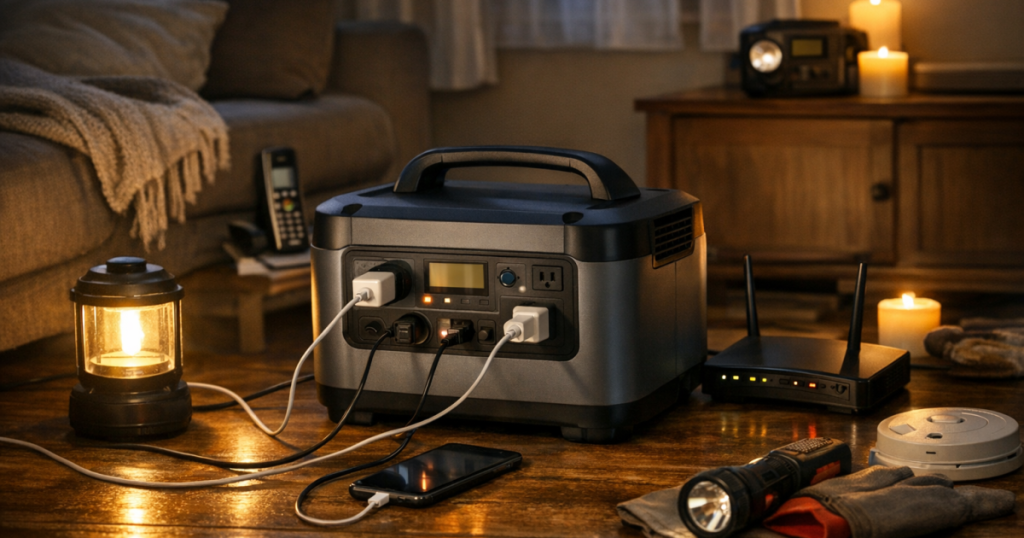
A battery can make a blackout calmer: lights stay on, phones charge, and the router may keep working long enough for updates. But portable power station safety is about more than pressing the power button. Indoors, the right setup keeps heat, cords, charging habits, and appliance loads under control so your backup battery helps without creating a tripping, fire, or equipment-damage risk.
Hardwired connections, transfer equipment, and any setup that ties backup power into home wiring should be carried out by a qualified electrician to comply with the National Electrical Code, local electrical rules, and the equipment manufacturer’s instructions.
The big picture
Portable power stations are usually much safer indoors than fuel-burning generators because they do not run on gasoline, propane, or natural gas and do not produce engine exhaust while operating. That does not make them risk-free. They are high-capacity batteries connected to AC outlets, USB ports, charging electronics, and sometimes solar inputs. Treat them like electrical equipment, not like an oversized phone charger.
The safest indoor outage setup is usually modest and intentional: a battery on a hard floor, a short list of essential loads, cords routed out of walkways, and a charging plan that does not depend on improvising during a storm. Most household problems come from asking the unit to do too much, covering its vents, using weak extension cords, charging in poor conditions, or trying to connect it to circuits it was never meant to supply.
- Use the power station for essentials first: phones, LED lights, router, laptop, small fan, medical devices that are approved for battery use, and similar low-to-moderate loads.
- Avoid high-heat appliances unless the manufacturer clearly supports the load and you have checked the wattage carefully.
- Keep the unit dry, uncovered, upright, and away from bedding, curtains, rugs, and clutter.
- Do not use a portable generator indoors to recharge it. Generators belong outdoors, far from doors, windows, garages, crawlspaces, and vents.
Where indoor battery backup is safer than a generator
The most important safety difference is exhaust. A portable power station can run inside a living room, bedroom, apartment, or home office because it is a battery system, not a combustion engine. That makes it useful for overnight lighting, phone charging, internet equipment, and quiet essential power when neighbors are close by.
Still, do not let that advantage blur the line between a battery and a whole-home power system. Most portable stations are designed to supply selected devices plugged directly into the unit. Some larger systems support more advanced home backup arrangements, but those require the correct equipment and professional installation when home wiring is involved. Never backfeed a wall outlet with a battery, generator, or improvised cord. That can endanger utility workers, damage equipment, and create serious shock and fire risks.
Start with the loads, not the battery
Safe use begins with a simple question: what are you actually trying to keep running? A fridge, Wi-Fi router, phones, LED lamps, CPAP machine, laptop, modem, fan, and medical cooler are very different loads. Some draw steady low power. Others start and stop. Some have brief startup surges. A few, such as heaters and cooking appliances, can drain a battery quickly and push outlet limits.
Before an outage, write down the wattage listed on each device label or power adapter. If the label shows amps instead of watts, multiply volts by amps for a rough estimate. Then compare that number with the continuous output rating and per-outlet limits in your power station manual. Do not rely only on the large watt-hour capacity printed on the case; capacity tells you stored energy, while output limits tell you what it can safely run at one time.
If you want a plain-English refresher on capacity, output, and realistic outage loads, the guide to how portable power stations work during home outages is a helpful next step.
Loads that usually make sense indoors
- Phones, tablets, battery banks, and rechargeable lanterns.
- Modems, routers, and small networking gear when the internet service itself is still active.
- Laptops, monitors with modest power draw, and work-from-home essentials.
- LED lamps and low-watt task lighting.
- CPAP machines and other approved medical devices, after checking the device manual and your clinician or equipment provider’s guidance.
- Small fans, especially for nighttime comfort during a summer outage.
Loads to treat with caution
- Space heaters, hair dryers, kettles, hot plates, toaster ovens, and microwaves can draw very high wattage.
- Full-size refrigerators and freezers may be possible on some stations, but startup surge and runtime vary widely.
- Sump pumps, well pumps, and furnace blowers are not safe to assume without checking startup requirements and connection method.
- Anything with a damaged cord, loose plug, hot adapter, or history of tripping breakers should stay unplugged until repaired or replaced.
Set the station where heat and cords are controlled
Placement matters more than many people expect. During a blackout, a power station often ends up wherever the family gathers: beside a couch, under a table, near a bed, or next to the router. Those spots can work only if the unit has airflow and the cords are managed.
Put the station on a stable, hard surface where it cannot be kicked, tipped, covered, or exposed to spills. Leave open space around vents and fans. Do not tuck it into a cabinet, laundry basket, closet, or pile of blankets to reduce noise. If the cooling fan turns on, that is the unit managing heat; blocking it works against the safety system.
- Keep drinks, pet bowls, buckets, and wet shoes away from the unit and cords.
- Route cords along walls where possible, not across hallways or stairs.
- Use night lights or battery lanterns to mark cords if people may walk through the room in the dark.
- Keep curious children and pets away from ports, buttons, and dangling cables.
- Do not stack other electronics on top of the station while it is charging or discharging.
Use cords and power strips conservatively
A portable power station is not a license to build a web of extension cords across the house. The safest setup keeps devices close to the battery and uses the fewest connections possible. Every added cord, splitter, or power strip creates another point where heat, loose plugs, or overloads can happen.
If you use an extension cord, choose one rated for the load, in good condition, and appropriate for indoor use. Fully insert plugs, avoid crushed or pinched cables, and stop using any cord that feels hot, smells odd, sparks, or has damaged insulation. Do not daisy-chain power strips, cube taps, or multiple adapters.
Power strips can be useful for low-draw electronics, but they do not increase what the power station can safely supply. The battery’s outlet rating still controls the limit. A strip full of phone chargers may be fine; a strip mixing a heater, microwave, and coffee maker is not.
Charge before the outage, recharge carefully during it
The safest battery is the one already charged before the storm arrives. Keep your station at the storage charge level recommended by the manufacturer, then top it up when severe weather, wildfire shutoffs, or grid instability are likely. Avoid waiting until the power is flickering and the household is already stressed.
During a long outage, recharging deserves the same care as running loads. Wall charging is simplest when grid power returns. Solar charging can help if your model supports it, but panel placement, cable routing, weather, shade, and connector compatibility all matter. Do not place the battery outside in rain just because the panel is outside. Keep the station protected indoors or in another dry, manufacturer-approved location, and run compatible cables without pinching them in windows or doors.
If you recharge from a fuel-burning generator, the generator must stay outdoors and away from openings into the home. Never run it in a garage, basement, shed, screened porch, or near an open window. For practical ways to plan battery top-ups over multiple days, see how to recharge a portable power station during a long outage.
Be realistic about medical and essential equipment
Medical equipment changes the stakes. A battery can be a useful part of a blackout plan, but it should not be a guess. CPAP machines, oxygen concentrators, medication refrigerators, feeding pumps, mobility equipment chargers, and other essential devices have different power needs and safety requirements.
Check the medical device manual, confirm whether the device can be powered by an external battery or inverter output, and test the setup before an outage. If a device has a heated humidifier, compressor, or motor, its runtime may be very different from a simple wattage estimate. Keep written notes on settings used during the test, how long the battery lasted, and what charging method worked.
Households that rely on powered medical equipment should also have a plan beyond the battery: backup supplies, transportation options, utility medical baseline programs where available, and a contact list for clinicians, caregivers, and local emergency resources. The medical planning checklist here is a stronger place to build that out: plan for blackouts with home medical equipment.
Warning signs that mean stop using it
Most quality power stations include protection systems, but you should still pay attention. Stop using the unit and move people away from it if you notice swelling, cracking, leaking, smoke, a burning smell, unusual heat, repeated fault codes, arcing, or a cord that becomes hot to the touch. Follow the manufacturer’s instructions for shutdown and service. Do not open the case, puncture the battery, or attempt a home repair.
Keep working smoke alarms in the area where you use and charge the station. If your home has a garage, workshop, or storage room where batteries are charged, alarms and clear exits matter there too. Do not charge large batteries on a bed, couch, pile of clothes, or paper-covered desk.
Storage between outages
Indoor safety is not only about the hours when the lights are out. Storage habits affect whether the station is ready and in good condition next time. Store it in a dry indoor location, away from extreme heat, freezing conditions, direct sun, and flammable clutter. Use the manufacturer’s recommended storage charge range and recharge interval. If the unit has an app, display, or self-test feature, treat it as a convenience rather than a substitute for reading the manual.
Label your charging cables and keep them with the station. Add a small card listing your essential loads, the order you plan to plug them in, and any devices that should never be used on the battery. That one card can prevent a lot of rushed decisions at 2 a.m.
Questions people ask
Can I use a portable power station in a bedroom overnight?
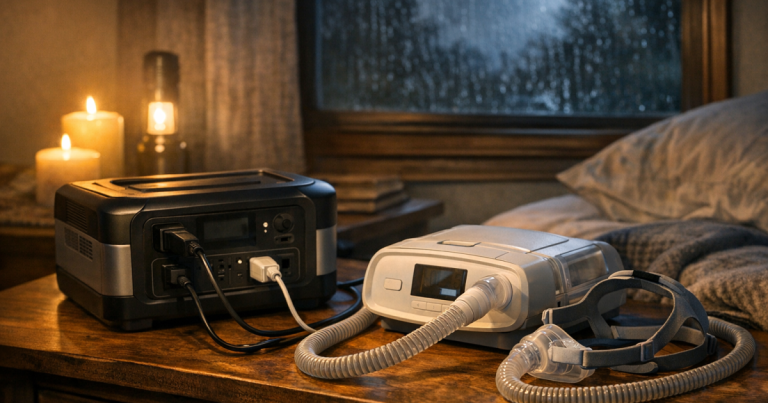
Yes, if the unit is in good condition, placed on a hard surface with airflow, kept away from bedding and liquids, and used within its rated output. Keep cords out of walking paths and do not cover the station to muffle fan noise.
What is the biggest portable power station safety mistake indoors?
The most common mistake is overloading it or treating it like a wall outlet during normal power. High-heat appliances and too many devices on one power strip can exceed limits quickly.
Can I plug a fridge into one?
Sometimes, but verify the fridge’s running watts, startup surge, plug type, and the power station’s output rating. Test it before an outage and remember that runtime estimates vary with cycling, room temperature, and battery size.
Is pass-through charging safe?
Some models support charging while powering devices, and some limit or discourage it. Check the manual for your exact model and do not assume every station works like a UPS.
Can I connect it to my home breaker panel?
Only with equipment designed for that purpose and installed correctly. Transfer switches, inlet boxes, interlocks, and hardwired backup connections are electrician work and must follow code and manufacturer requirements.
Main lessons
A portable power station is one of the more apartment-friendly and indoor-friendly blackout tools, but it works best when you give it a specific job. Keep the loads modest, respect the output limits, protect airflow, use cords carefully, and decide how you will recharge before the outage lasts all night.
Good safety planning is not complicated. It is the difference between a battery sitting in the middle of a dark room with random cords everywhere and a calm, tested setup that keeps the essentials running while everyone knows what not to plug in.