A blackout plan gets much easier when you know what is inside the box you are relying on. Understanding portable power station battery types helps you set realistic expectations for runtime, weight, storage, recharging, and how confidently a unit can sit ready between outages.
Electrical panel connections, transfer switches, and any system that ties backup power into household wiring should be handled by a qualified electrician in compliance with local electrical codes, manufacturer instructions, and applicable safety requirements.
At a glance
- LFP, also called LiFePO4, is widely favored for home outage backup because it is durable, stable, and well suited to frequent charging and standby use.
- NMC and related lithium chemistries can pack more energy into a lighter case, which can matter for camping, apartments, stairs, and grab-and-go use.
- Lead-acid and AGM batteries still appear in some UPS units and older backup systems, but they are usually heavier and less flexible than modern lithium stations.
- Battery chemistry does not tell the whole story. Runtime depends on watt-hours, inverter size, the device load, temperature, battery age, and how the power station is managed.
- For indoor outage use, batteries avoid the carbon monoxide danger of fuel-burning generators, but they still need dry placement, airflow, correct charging, and careful handling.
Why battery chemistry matters during a blackout
Most people notice the big number on the front of a power station first: watt-hours. That number matters, but it is not the full story. The battery chemistry influences how heavy the unit feels, how long it may remain useful over years of outage seasons, how it behaves in storage, and how comfortable you may feel keeping it charged for emergency use.
A family trying to keep phones, LED lamps, a router, and a few small medical or comfort devices running overnight has different needs than someone trying to roll a large power station from the garage to the kitchen for a refrigerator. Chemistry affects those real-life details. A lighter battery is easier to move upstairs. A longer-life chemistry is reassuring when the station spends most of the year waiting for storm season. A safer operating setup matters when the unit is running next to the couch, bed, or home office.
If you are still sorting out how these units fit into an outage plan, start with the basics of how portable power stations work during home outages. Battery chemistry makes more sense once watts, watt-hours, inverter output, and charging limits are clear.
The main battery types you will see
LFP or LiFePO4: the steady home-backup favorite
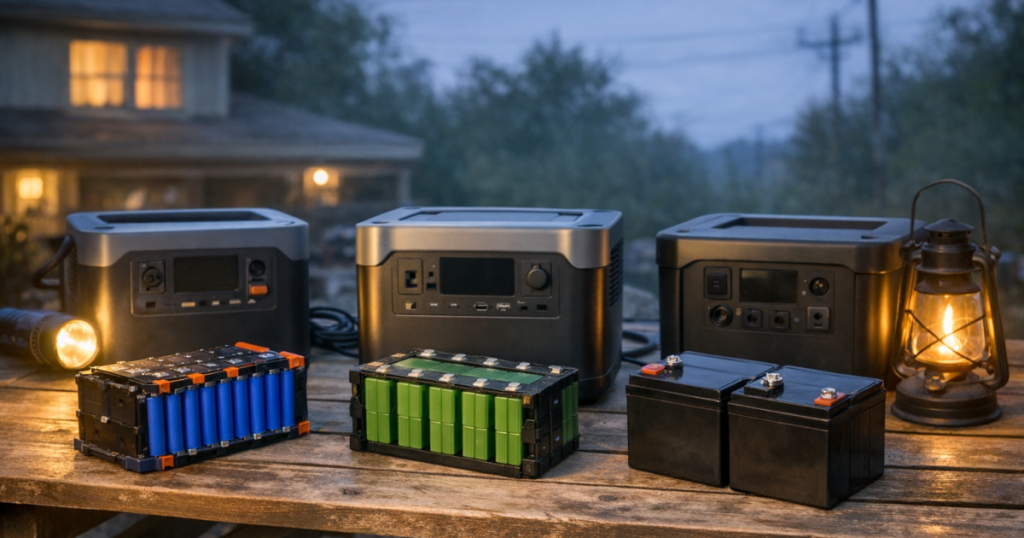
LFP stands for lithium iron phosphate, often written as LiFePO4. In plain English, it is a lithium battery chemistry known for long service life, stable behavior, and good suitability for repeated charging. For home outage backup, those strengths line up well with how people actually use a power station: charge it before storm season, top it off before a forecasted outage, run essential loads, then store it again.
The trade-off is that LFP batteries are often heavier and a bit bulkier than more energy-dense lithium chemistries at the same general capacity. That does not matter much if the unit stays on the main floor or in a closet near the devices it will power. It matters more if you need to carry it up stairs, load it into a car, or move it frequently between rooms.
For outage planning, LFP is usually the chemistry people feel most comfortable assigning to long-term household readiness. It is a strong match for phones, laptops, lights, modems, routers, fans, small appliances within the unit’s output rating, and many medical-device support plans when the equipment requirements are verified.
NMC and related lithium chemistries: lighter for the energy stored
NMC stands for lithium nickel manganese cobalt oxide. You may also see related lithium chemistries used in portable electronics, power tools, electric vehicles, and some power stations. The practical advantage is energy density: these batteries can store a useful amount of energy without as much size or weight.
That can be valuable in a small apartment, a camper, or a household where one person needs to lift and move the unit without help. A lighter station may be the one you actually bring to the bedroom for a CPAP machine, carry to the desk for a laptop and router, or put in the car during an evacuation.
The main planning point is to read the manufacturer’s guidance on storage, operating temperature, charging, and cycle life. NMC can be very useful, but the details vary by product design, battery management system, cooling, and how the unit is treated over time. Do not assume two power stations have the same behavior just because they both use a lithium battery.
Lead-acid and AGM: older, heavier, still present in some backup gear
Lead-acid batteries are familiar from cars, small backup systems, and older emergency-power setups. AGM, or absorbent glass mat, is a sealed lead-acid design often used in UPS units and standby applications. These batteries can be dependable in the right role, but they are heavy for the amount of usable energy they provide.
For modern portable power stations, lead-acid is usually less attractive because it is harder to move and typically offers less convenient usable capacity for a household blackout kit. You may still run into it in older equipment or in a UPS protecting networking gear or a desktop computer. It can make sense for short bridging power, but it is not usually the first choice for a portable station you expect to move room to room.
Sodium-ion and newer chemistries: promising, but verify the product details
Newer battery chemistries continue to appear in consumer backup products. Sodium-ion is one example people may hear about because it uses different raw materials and can offer useful cold-weather characteristics in some designs. For home outage use, the important point is not the buzz around the chemistry. It is what the finished product actually delivers.
Before relying on any newer battery type, verify the rated capacity, output limits, charging methods, storage guidance, warranty terms, operating temperature range, and support availability. Emerging chemistry can be interesting, but a blackout plan should be built around confirmed capabilities rather than assumptions.
How portable power station battery types affect outage planning
Battery chemistry is one layer of the decision, but outage usefulness comes from the complete system. A power station includes the battery cells, battery management system, inverter, outlets, charging hardware, cooling design, and firmware or control logic. A good battery inside a poorly matched unit can still disappoint if the inverter cannot handle the load you connect.
Think in three questions. First, how much energy is stored? That is the watt-hour rating. Second, how much power can it deliver at one time? That is the watt rating and, for some appliances, the surge rating. Third, how well does the battery type fit your pattern of use? That includes weight, storage, charging frequency, and expected long-term durability.
A simple runtime estimate looks like this: usable watt-hours divided by the device’s running watts. Many people use a rough allowance for inverter losses rather than assuming every rated watt-hour reaches the appliance. For example, a 1,000 watt-hour station running a 50-watt combined load will not necessarily run for exactly 20 hours. Real runtime depends on efficiency, temperature, battery condition, and whether the load stays constant.
This is especially important for refrigerators and freezers. A fridge cycles on and off, so its average draw can be much lower than its startup draw, but the startup surge still matters. The only reliable approach is to check the appliance label, use measured household data where available, and confirm the power station can handle both running and startup demands.
Battery type by outage scenario
Short evening outage: phones, lights, router, and comfort
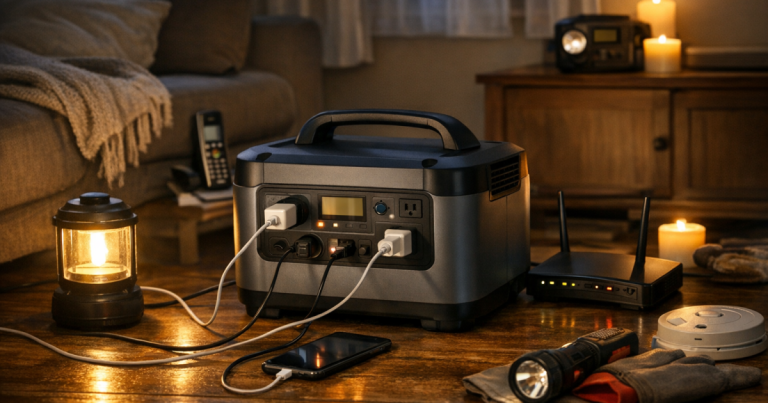
For a 4- to 8-hour outage, chemistry may matter less than having the unit charged and easy to access. Small lithium power stations can keep phones, tablets, LED lamps, a modem/router setup, and a laptop going if the combined load stays within the unit’s limits. LFP gives reassuring durability if you expect to use and recharge the station often. NMC may make sense when portability and compact storage matter more.
Overnight bedroom backup: CPAP, fan, and phone charging
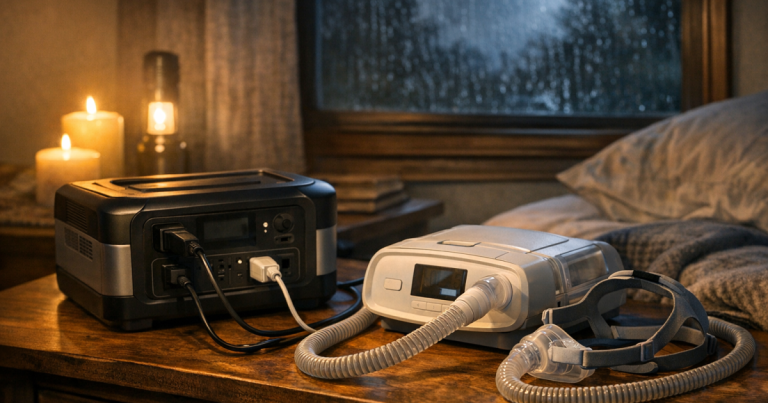
For bedroom use, quiet operation, outlet placement, display dimming, and verified runtime are important. Battery chemistry contributes to confidence, but the medical or comfort device’s actual power draw is the deciding factor. Heated humidifiers on CPAP machines, for example, can change runtime significantly. Anyone depending on powered medical equipment should build a plan around the device’s manual, backup recommendations, and a tested routine, not a guess.
For a deeper planning checklist, use the site’s guide to blackout planning with home medical equipment before relying on any single battery setup.
Kitchen support: refrigerator, freezer, and food safety
For refrigeration, chemistry is only part of the picture. You need enough stored energy, enough inverter output, and a safe cord setup. Larger LFP stations are common in this role because they are well suited to standby use and repeated cycling, but the refrigerator’s surge demand has to be confirmed. Avoid plugging in multiple large loads just because outlets are available. The limit is the power station’s output, not the number of receptacles on the front panel.
Multi-day outage: recharging becomes the real constraint
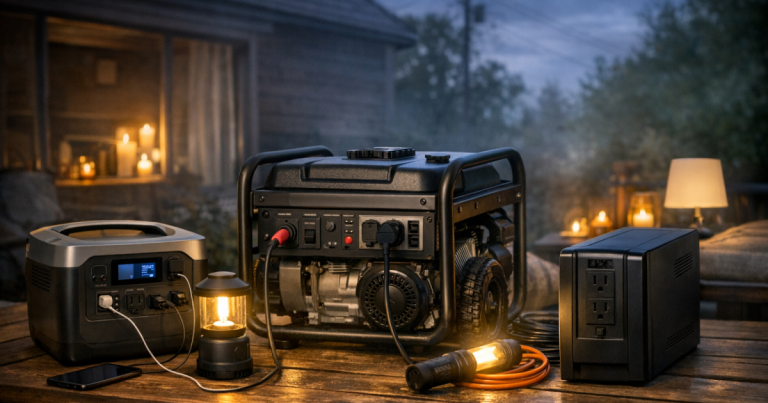
During a long outage, the question shifts from battery type to refill strategy. A high-capacity station is helpful, but once it is drained you need a way to recharge it. Wall charging is fastest when the grid is up. Solar can help when weather, panel placement, and sunlight cooperate. A fuel generator can recharge a power station, but it must stay outdoors and away from windows, doors, vents, garages, and enclosed spaces.
Safety notes for indoor battery backup
Portable power stations are designed for indoor battery use, but that does not make every setup automatically safe. Keep the unit dry, give it breathing room, avoid covering vents, use cords rated for the load, and do not run cords where people will trip over them in the dark. If a unit is swollen, damaged, unusually hot, wet, or giving error warnings, stop using it and follow the manufacturer’s instructions.
Do not connect a power station to household wiring unless the equipment is specifically designed for that use and installed correctly. Backfeeding through a wall outlet is dangerous. For room-by-room backup, it is usually safer to plug essential devices directly into the station or use appropriate extension cords within the manufacturer’s limits.
For a fuller safety walkthrough, including placement and what not to plug in, read the portable power station safety guide for indoor outage use.
Storage habits that help any battery type
A good outage battery can be weakened by poor storage. Heat is hard on batteries, so avoid leaving a power station in a hot car, shed, attic, or sunny window for long periods. Very cold storage can also affect performance, especially when you need immediate output or charging. A dry, room-temperature location is usually the most practical home base.
Follow the manual for storage charge level and top-off intervals. Some units are designed to sit at a high state of charge for emergency readiness, while others may recommend periodic checks or a partial-charge storage range. The right habit is the one specified for your model, not a rule copied from a different battery product.
Label the unit with the date you last charged it, the devices it is assigned to, and any tested runtime notes. During a stressful outage, that small label can save time. For example, “Router plus two phones: tested,” or “Bedroom station: CPAP cable in top drawer.” Practical notes beat memory when the lights are out.
What to verify before relying on a power station
- Battery chemistry: Confirm whether the unit uses LFP, NMC, lead-acid, or another chemistry, and read the storage and charging guidance for that exact model.
- Usable capacity: Watt-hours are a starting point, but real runtime is affected by inverter losses and the load connected.
- Continuous output: Make sure the station can run the total watts you plan to plug in at one time.
- Surge capability: Refrigerators, freezers, pumps, and some appliances may need more power at startup than while running.
- Charging options: Check wall, vehicle, solar, and generator-compatible charging instructions before an outage, not during one.
- Operating temperature: Verify the safe temperature range for use, charging, and storage.
- Cord plan: Use properly rated cords and avoid daisy-chaining power strips or overloading outlets.
- Priority list: Decide in advance whether the battery is for communications, medical equipment, food safety, work, lighting, or comfort.
FAQ
Is LFP always better for outage backup?
No. LFP is a strong fit for many home backup setups because it is durable and well suited to standby use, but weight and size still matter. A lighter NMC-based unit may be more practical if you need to move it often.
Can battery type tell me how long my fridge will run?
Not by itself. Runtime depends on watt-hours, inverter efficiency, fridge cycling, startup surge, room temperature, and how often the door is opened. Test your setup before relying on it for food safety.
Are portable power stations safe indoors?
Battery power stations do not produce carbon monoxide like fuel-burning generators, so they are suitable for indoor use when operated as directed. Keep them dry, ventilated, undamaged, and within the manufacturer’s load and temperature limits.
Should I keep my power station fully charged all year?
Follow the manual for your exact model. Some emergency-ready units are designed for high-charge standby, while others specify periodic charging or a storage range to protect battery health.
Does a bigger battery mean I can run anything I plug in?
No. Capacity and output are different. A large battery may store plenty of energy but still have an inverter limit that prevents it from running high-wattage or high-surge appliances.
Why it matters
The best battery type is the one that fits the way your household actually rides through an outage. For many homes, that means an LFP station kept charged for lights, phones, internet gear, and carefully chosen essentials. For others, a lighter lithium unit is more useful because it can be carried where it is needed. Older lead-acid gear can still fill a short backup role, but it usually needs more realistic expectations around weight and usable energy.
Battery chemistry gives you clues, not guarantees. Pair it with measured loads, safe placement, a charging plan, and a written priority list. That combination turns a power station from a hopeful purchase into a dependable part of your blackout routine.