This Goal Zero Boulder 100 Briefcase review is really about expectations: the panel is a solar input source for a battery system, not the battery system itself. It does not store energy, it does not provide AC power on its own, and it is not meant to plug directly into small USB devices.
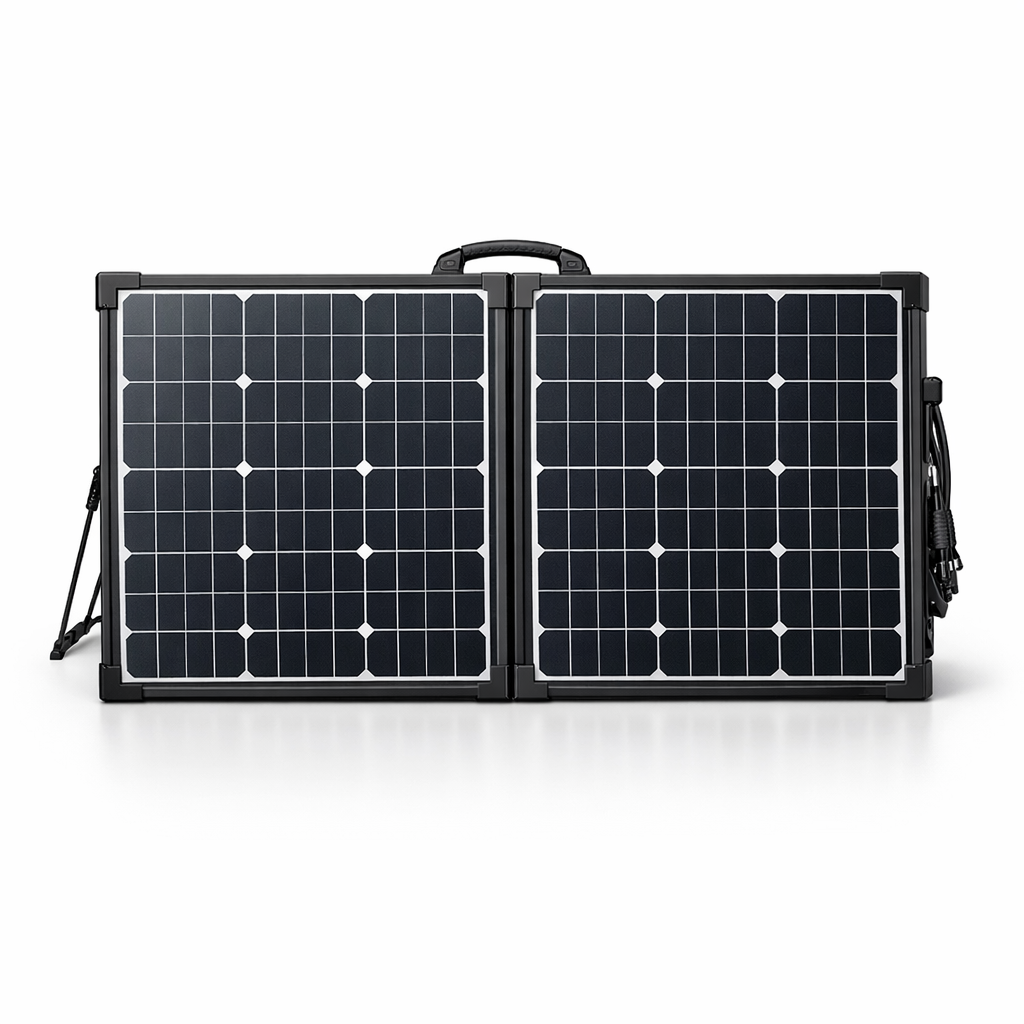
Goal Zero Boulder 100 Briefcase
Best for Goal Zero battery owners who want rugged, deployable solar recharging for modest blackout essentials
Used the right way, though, the Goal Zero Boulder 100 Briefcase has a clear role in home outage planning. It is a rugged folding 100W solar panel designed to recharge compatible Goal Zero Sherpa power banks and Yeti portable power stations. For a household trying to stretch stored battery power through a storm outage or wildfire shutoff, that can be a very useful system component.
Product Details
- Product: Goal Zero Boulder 100 Briefcase
- Product type: Portable folding solar panel
- Rated power: 100W
- Panel layout: Two 50W panels chained together and connected by a hinge
- Solar cell type: Monocrystalline
- Solar port output: Blue 8mm solar port, 14-21.5V, up to 7A, 100W max
- Voltage specs: 21.5V Voc and 17.2V Vmpp
- Weight: 25.9 lb
- Folded size: 26.75 x 21.75 x 3.75 in
- Unfolded size: 26.75 x 43.5 x 1.75 in
- Cable length: 6 ft
- Included items: Boulder 100 Briefcase with cord and built-in kickstand, plus canvas carrying bag
- Warranty: 2 years
- Listed price: $399.95
What the 100W rating means during an outage
A 100W solar panel is best understood as a recharge helper, not a whole-home power answer. In outage terms, the Boulder 100 Briefcase can feed solar input into a compatible Goal Zero Yeti portable power station or Sherpa power bank while the sun is available. The actual stored power you can use later still depends on the connected battery’s capacity, input limits, and output options.
That distinction is important. The panel cannot run a refrigerator, CPAP, router, laptop, or light directly as an AC source. Those jobs belong to the power station. The Boulder’s job is to help refill that station during daylight so your battery setup has a better chance of lasting through a longer outage.
Goal Zero also notes that solar charge times vary with elevation, temperature, time of year, angle, and position to the sun. That is not fine print; it is the everyday reality of portable solar. A single 100W panel can be useful for maintaining smaller loads or adding daytime recovery, but it should not be treated as a guaranteed fast recharge solution for a large battery after a heavy overnight draw.
If you are still deciding whether solar, a battery, a generator, or a UPS belongs in your blackout plan, start with the broader trade-offs in portable power station vs generator vs UPS. The Boulder makes the most sense after you have already decided that a rechargeable battery system fits your home.
The briefcase design is sturdy, but not ultralight
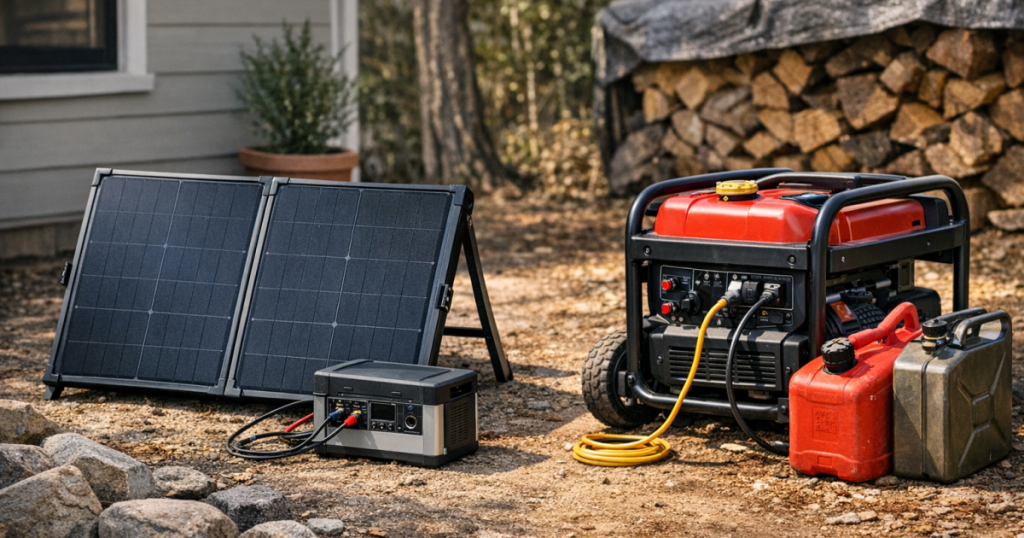
The most appealing part of this panel is the physical format. Two 50W panels fold together on a hinge, and the built-in kickstand makes it easier to aim the panel without building a makeshift support from patio furniture. The canvas carrying bag is also useful because this is not a tiny accessory you toss into a kitchen drawer.
At 25.9 lb, the Boulder 100 Briefcase is portable in the “carry it to the yard, driveway, campsite, or sunny side of the house” sense. It is not ultralight. That weight is a reasonable trade-off for people who want a more rugged glass-and-aluminum style panel, but it is a real consideration for apartment dwellers, older adults, or anyone who would need to move it repeatedly through the day to follow the sun.
The folded size, 26.75 x 21.75 x 3.75 in, is manageable for garage storage, a utility closet, or a vehicle. Unfolded, it spans 26.75 x 43.5 x 1.75 in, so it needs a clear patch of sun where it will not be stepped on, tipped over, or shaded by porch rails and shrubs. In a blackout, the best solar panel is the one you can actually place safely and adjust without turning setup into a project.
Compatibility is the buying decision
The Boulder 100 Briefcase is built around Goal Zero’s ecosystem. Goal Zero states that Boulder panels are designed to charge Sherpa power banks and Goal Zero Yeti portable power stations, not small USB devices directly. For Yeti or Sherpa owners, that makes the product straightforward: it is a matching solar input component for stored blackout power.
For anyone using another brand of portable power station, the connector relationship becomes the central issue. The panel uses a blue 8mm solar port rated 14-21.5V, up to 7A, with a 100W max. That port and voltage range need to make sense for the battery being charged. The panel itself is not a universal AC appliance charger, and its usefulness drops sharply if it does not connect cleanly to the system you already own.
There is also a scaling limit. Chaining Boulder 100 or Boulder 100 Briefcase panels requires Goal Zero’s 4x 8mm to HPP Combiner Cable. That makes expansion possible within the intended system, but it also reinforces the point that the panel is part of a planned setup, not a standalone blackout kit.
Weather, placement, and safe outage habits
Goal Zero gives a waterproof statement for Boulder panels, but the power bank or power station being charged still needs to be protected from dust, rain, and snow. In practice, that means the solar panel can be outside in the sun while the battery stays covered and dry, with cable routing kept neat enough to avoid trip hazards or strain on the ports.
The 6 ft cable gives you some placement flexibility, but it is not endless. If your sunniest spot is far from a sheltered battery location, that short distance shapes the setup. A porch, open garage doorway, covered patio edge, or dry shaded bin arrangement can all be more realistic than leaving a portable power station exposed beside the panel.
This is also not the right panel for permanent roof mounting. Goal Zero says Boulder Briefcases are not designed to be permanently mounted to a fixture. Treat it as a deployable panel: unfold it, point it, use it during daylight, then bring it back in when the charging session is over.
For broader system habits, including where backup gear should and should not be used around the home, keep the basics in home backup power safety basics close at hand. Solar is quieter and cleaner at the point of use than a fuel generator, but cables, weather exposure, and battery placement still deserve care.
Where it fits best in a blackout plan
The Boulder 100 Briefcase is strongest for households that already use, or are planning around, a compatible Goal Zero Yeti or Sherpa battery. It gives that battery system a daytime recovery path without fuel storage, exhaust, or generator noise. That can be especially attractive in neighborhoods, apartments with outdoor access, and homes where the goal is to keep essentials going rather than pretend one panel will cover everything.
I like it most as a durability-first panel for realistic essentials: phones, a router, LED lighting, laptop work sessions, and other modest loads handled through the connected power station. It is also a sensible companion for people who want a repeatable storm routine: battery charged before weather arrives, panel ready near a sunny window route or outdoor spot, and the most important loads prioritized.
It is less compelling for buyers who want the lightest possible solar option, direct USB charging for phones and headlamps, or rapid recovery for a large power station after running heavy appliances. Goal Zero’s Nomad panels are the more natural direction for small-device charging, while larger outage loads may call for multiple panels or a higher-wattage solar setup paired with a battery that can accept the added input.
Blackout questions worth asking before buying
Can it replace a portable power station?
No. The Boulder 100 Briefcase produces solar input when exposed to sunlight, but it does not hold a charge. Stored power, AC outlets, and nighttime use come from the compatible power station or power bank connected to it.
Is one 100W panel enough for a long outage?
It depends on the battery size, the loads you run, and the sunlight you get. One 100W panel is a useful recharge path for modest battery use, but large batteries and appliance-heavy plans can outgrow it quickly.
Is this a good apartment option?
It can be, but only for apartments with a safe, sunny placement area such as a balcony, patio, or accessible outdoor spot. The 25.9 lb weight and unfolded size make placement more important than with smaller panels.
Verdict
Score: 7.9/10.
The Goal Zero Boulder 100 Briefcase earns its recommendation as a rugged solar recharging component, not as a complete blackout power system. The most influential factors are its 100W rated output, sturdy folding two-panel format, and tight fit with compatible Goal Zero Yeti and Sherpa batteries. Its compromises are equally clear: it weighs 25.9 lb, does not charge USB devices directly, is not for permanent mounting, and a single panel may be slow for larger outage batteries. For Goal Zero battery owners who value durability and a simple deployable setup, it is a strong, sensible addition to a home outage kit.
Goal Zero Boulder 100 Briefcase
Best for Goal Zero battery owners who want rugged, deployable solar recharging for modest blackout essentials
You might also like: How to Run a CPAP on a Portable Power Station During an Outage.