When the lights go out, the fridge becomes a clock: every door opening costs you cold air, and every hour changes what is safe to save. The fastest way to keep food safe during power outage conditions is to keep refrigerator and freezer doors closed, track time and temperature, and make discard decisions before anyone gets sick.
Food safety decisions after prolonged warming can affect health; commercial food storage, care facilities, and advice for medically vulnerable people should be guided by qualified food-safety or healthcare professionals in line with local health department requirements.
What to know first
The household rule set is simple enough to remember during a storm. A refrigerator generally keeps food cold for about 4 hours if the door stays closed. A full freezer can usually hold a safe temperature for about 48 hours, while a half-full freezer is closer to 24 hours. These are planning limits, not promises, because room temperature, door seals, appliance condition, food load, and how often the door opens all matter.
Use 40°F as the key refrigerator threshold. Perishable food that has been above 40°F for more than 2 hours should be discarded. For frozen food, look for ice crystals or a temperature at or below 40°F; food that still meets those conditions can usually be refrozen, although quality may drop.
- Keep doors closed unless you are making a planned, quick move.
- Use appliance thermometers in both the fridge and freezer.
- Group food together so cold items help insulate each other.
- Move only what you need into a cooler; do not browse with the door open.
- When in doubt about meat, seafood, dairy, cooked leftovers, or cut produce, throw it out.
Step 1: Stop the cold air from escaping
The best first move is boring, and that is why it works: leave the doors shut. A closed refrigerator is an insulated box. Every snack check, milk check, and “just seeing how bad it is” check lets cold air spill out and warm air move in.
Make one person the fridge manager during the outage. That person decides when the door opens, what comes out, and what gets moved to a cooler. It sounds a little dramatic until you have three people opening the freezer in the first hour. A bit of door discipline can save dinner, breakfast, and the grocery budget.
If you expect a longer outage, write the outage start time on a sticky note and place it on the fridge. Add the time when anyone opens the door for a planned move. This keeps decisions based on the clock instead of guesses.
Step 2: Use thermometers, not hope
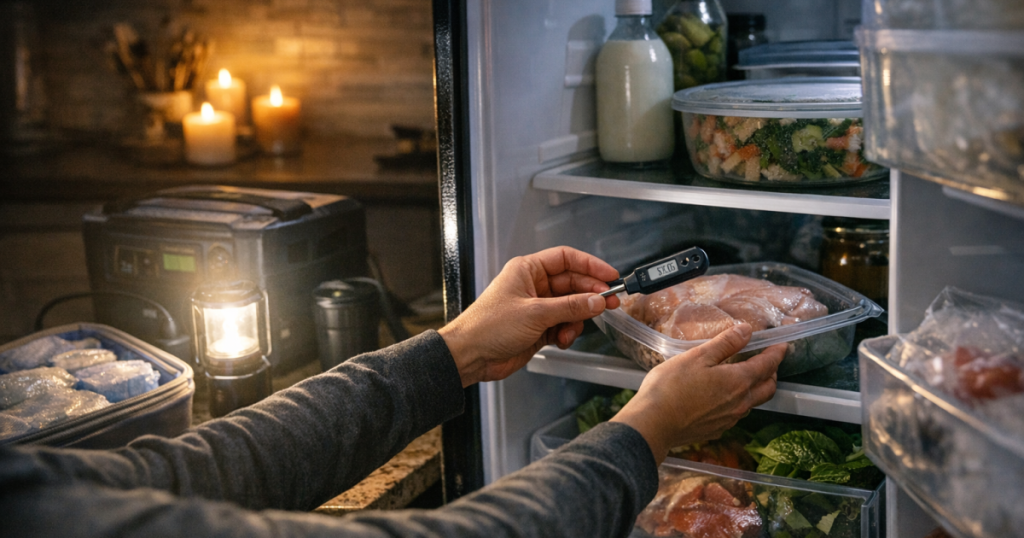
A fridge can feel cool and still be unsafe for some foods. The most useful low-cost tool is an appliance thermometer placed where you can read it quickly. Put one in the main refrigerator compartment and one in the freezer before storm season if you can.
For refrigerator food, the practical target is 40°F or colder. For the freezer, 0°F is normal operating territory, but after an outage the key question is whether frozen food still has ice crystals or has stayed at 40°F or below. If you do not have a thermometer, you have to lean more heavily on time limits, food type, and common sense.
A digital probe thermometer can help check individual foods after power returns, but do not use one reading to rescue everything. A casserole in the center of the fridge, a carton of milk in the door, and raw chicken on a lower shelf can warm at different rates.
Step 3: Know what is risky and what is usually fine
Not all food carries the same risk. The goal is not to throw away every condiment in a panic; it is to be strict with the foods most likely to cause illness after warming.
Foods to discard after unsafe warming
- Raw or cooked meat, poultry, fish, and seafood
- Milk, cream, soft cheeses, yogurt, and opened dairy-based dips
- Cooked rice, pasta, beans, vegetables, casseroles, soups, and leftovers
- Eggs and egg-based dishes
- Cut fruit, cut melon, cooked potatoes, and opened tofu
- Refrigerated dough, opened lunch meat, and prepared salads
Foods that are often less sensitive
- Whole fresh fruits and many whole vegetables
- Hard cheeses, butter, and margarine, depending on condition and time
- Unopened juice, many pickles, mustard, ketchup, soy sauce, and vinegar-based condiments
- Bread, tortillas, nut butters, jams, and many shelf-stable pantry foods
These lists are practical household guidance, not a license to ignore smell, texture, mold, damaged packaging, or long exposure to heat. Also, smell is not a reliable safety test. Food can make someone sick even when it smells normal.
Step 4: Move food only when it helps
A cooler is useful when you have ice, frozen gel packs, or a plan to keep it cold. It is not useful if you move food from a cold sealed fridge into a warm box with no ice. Before opening the refrigerator, decide exactly what you are moving: baby formula, essential medications that require refrigeration, a small amount of milk, or tonight’s meal.
Pack coolers tightly. Put ice or frozen packs on top as well as around the sides, because cold air sinks but coolers lose heat through every surface. Keep the cooler in the coolest practical room, away from sun, pets, and repeated opening. If the outage is short, your fridge may be the better cooler.
If you have advance warning, freeze containers of water. They help fill freezer space, slow warming, and become drinking water as they thaw. A fuller freezer generally holds cold longer than a sparse one, so even a few frozen water jugs can help.
Step 5: Be careful when using backup power
Powering a refrigerator can protect a lot of food, but it needs to be done safely. Refrigerators cycle on and off, and their startup draw can be higher than their running draw, so backup power has to be matched to the appliance and used with safe cords, placement, and ventilation.
If you plan to run the fridge during a blackout, start with the setup basics in how to power a refrigerator safely during an outage. The key point is to avoid improvising with undersized cords, overloaded outlets, or unsafe generator placement.
Portable power stations, inverter generators, and transfer-switch setups can all have a place, but they solve different problems. Battery units are quiet and indoor-friendly when used as directed, while fuel generators must stay outdoors and far from living spaces because of carbon monoxide risk. For fridge-focused battery planning, see portable power stations for refrigerator backup to understand runtime trade-offs before you rely on one.
Any generator, transfer switch, extension cord, or power-station setup should be treated as part of your safety plan, not just your convenience plan. Review home backup power safety basics before storm season so the first setup is not happening in the dark.
Step 6: Check food methodically when power returns
Do not celebrate by immediately restocking the fridge. First, check the appliance thermometer, the outage timeline, and the condition of the food. If the refrigerator stayed at 40°F or below, most refrigerated food can remain. If it rose above 40°F for more than 2 hours, discard perishable items.
For the freezer, sort food into three groups. Food that is still frozen solid is the easiest to keep. Food with ice crystals or a measured temperature of 40°F or below can usually be refrozen or cooked, though texture may suffer. Food that has fully thawed and warmed above 40°F for more than 2 hours should be discarded if it is perishable.
Clean up leaks from thawed meat or seafood carefully. Wash shelves, drawers, and containers with hot, soapy water, then sanitize surfaces as appropriate for your appliance materials. Put a note on your shopping list for the foods you discarded; it is easier to rebuild calmly when you know what actually needs replacing.
Special situations worth planning for
Medications and medical diets
Some medications and medically necessary foods need tighter temperature control than ordinary groceries. Follow the storage instructions from the pharmacy or manufacturer, and ask the pharmacist or healthcare professional what to do after a temperature excursion. Do not guess with refrigerated medication.
Infants, older adults, and immune-compromised people
Households with higher-risk people should use a stricter discard policy. If a food is borderline, treat it as unsafe. The cost of replacing food is frustrating; foodborne illness in a vulnerable household is worse.
Long outages and hot weather
Summer outages are less forgiving. A kitchen that climbs into the 80s°F will warm food faster than a cool house in winter. If heat is building, focus on the highest-value cold storage first: freezer door closed, fridge door closed, coolers packed only when you have ice, and backup power reserved for the refrigerator if your setup supports it safely.
Questions people ask
Can I put food outside in winter?
Usually, this is not the cleanest or most reliable plan. Outdoor temperatures fluctuate, sunlight warms food, animals can get into it, and snow or porch storage is hard to monitor. A cooler with a thermometer is safer than loose bags outside.
Can I refreeze thawed food?
Yes, if the food still contains ice crystals or has stayed at 40°F or below. Quality may decline, especially with fruits, vegetables, bread, and prepared meals, but safety depends on temperature and time more than texture.
Is it safe to taste food to check it?
No. Do not taste questionable food. Smell and taste are poor safety tests because harmful bacteria can be present without obvious warning signs.
What should I buy before storm season?
Keep the list simple: appliance thermometers, a cooler, ice packs or frozen water containers, shelf-stable meals, and a written fridge plan. If backup power is part of your household plan, size it around real loads and safe use rather than assuming any device can run any appliance.
Why it matters
Fridge and freezer safety during an outage is mostly about calm timing. Keep doors closed, measure temperature when you can, protect the highest-risk foods, and do not let sunk cost talk you into eating something questionable.
A little preparation turns a stressful blackout into a sequence of manageable choices. You may still lose some groceries in a long outage, but you will know why, what to save, what to discard, and how to make the next one easier on your household.