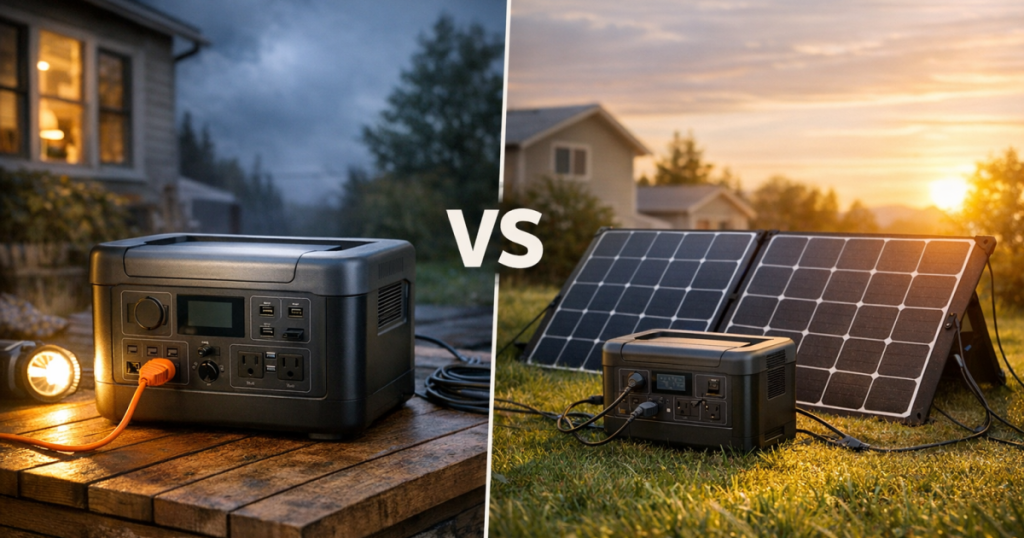
The phrase portable power stations vs solar generators can make the decision sound more complicated than it is. For most home blackout planning, you are choosing between a battery you charge ahead of time and a battery system that also has a realistic way to recharge from solar panels during daylight. Both can help with phones, lights, routers, laptops, medical devices, and small appliances. Neither should be treated as automatic whole-home backup.
Hardwired home electrical connections, transfer switches, interlocks, and circuit-panel work should be carried out by a qualified electrician to meet local code, utility rules, and electrical safety requirements.
In brief
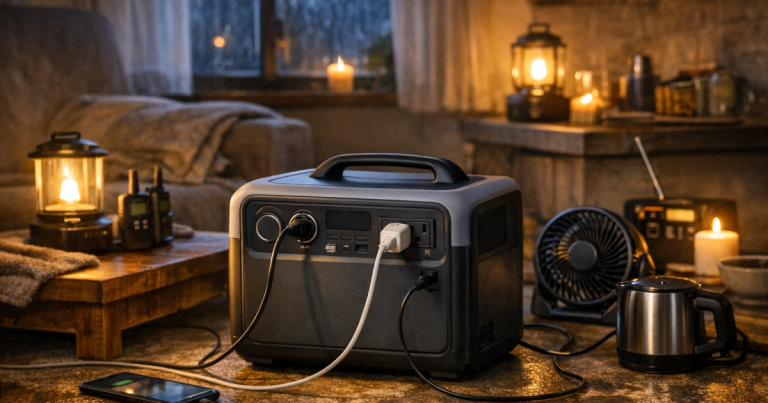
A portable power station is a rechargeable battery with outlets. You charge it from a wall outlet, vehicle outlet, or compatible solar panel, then plug devices directly into it during an outage. It is quiet, indoor-safe when used as directed, and useful for apartments, renters, remote workers, and households that mainly need essential-device backup.
A solar generator is usually not a separate technology. In current home-backup language, it normally means a portable power station packaged with, or designed to work with, solar panels. The battery still does the work at night. The panels simply help refill it when the sun is strong enough and the panel setup matches the power station’s input limits.
The practical answer is simple: if you need backup for a few hours or overnight, a charged portable power station may be enough. If you are planning for a multi-day outage and have a safe sunny place to set up panels, a solar-capable setup gives you more flexibility. Before sizing anything, it helps to understand the basics of watts, watt-hours, runtime, and charging, which are covered in more depth in Home Backup Power Basics: Watts, Runtime, Fuel, and Safety.
What the names actually mean
The term “solar generator” can be misleading because the box itself is usually a battery power station. It does not create electricity in the way a gasoline, propane, or natural gas generator does. Solar panels create electricity when exposed to usable sunlight, and the power station stores that electricity for later use.
That distinction matters during real outages. A battery can run quietly indoors, but it has a fixed amount of stored energy. Solar panels can extend runtime, but only under the right conditions: daylight, clear enough weather, correct panel angle, safe placement, compatible connectors, and enough solar input for the loads you are trying to support.
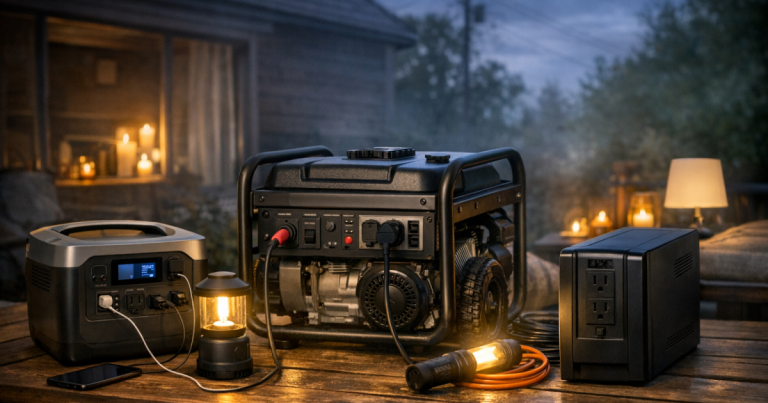
For many homes, the best setup is not one or the other. It is a power station sized for your most important loads, plus a plan for recharging. That recharge plan might include solar, a vehicle, shore power when the grid returns, or a portable generator used outdoors with proper safety precautions.
Where a plain portable power station makes the most sense
A portable power station is strongest when your outage goal is controlled and specific. Think of keeping phones charged, running a modem and router, powering a laptop for remote work, using LED lamps at night, or supporting a small medical device according to its power requirements.
It is also the cleaner fit for renters and apartment dwellers who cannot store fuel, run a generator outside, or modify an electrical panel. Because there is no engine exhaust, a power station can be used indoors according to the manufacturer’s instructions. That is a major advantage in dense neighborhoods, high-rise buildings, and bad weather.
The trade-off is capacity. Once the battery is empty, it has to be recharged. A small unit may be fine for phones and lights but unrealistic for refrigerators, freezers, sump pumps, space heaters, window air conditioners, or other higher-demand loads. Even larger units need careful load planning because appliance startup surges and long runtimes can drain a battery faster than people expect.
When looking at familiar models such as Jackery Explorer 1000 v2 Portable Power Station, EcoFlow DELTA 3 Plus Portable Power Station, or BLUETTI Elite 100 V2 Portable Power Station, do not focus only on the headline capacity. Check the continuous output rating, surge capability, usable battery capacity, outlet types, charging methods, solar input limits, warranty terms, and whether the manufacturer supports the kind of use you have in mind.
Where a solar generator setup earns its keep
A solar generator setup starts to make sense when your blackout plan extends beyond a single evening. If you can recharge some energy each day, you may be able to keep small essentials going much longer than you could with a battery alone.
The value is not that solar makes power unlimited. It does not. The value is that it adds a refill method when the grid is down and fuel is hard to get. That can be especially useful during wildfire shutoffs, storm recovery, rural outages, or multi-day grid failures where you want to preserve battery capacity for nighttime.
Solar is strongest for low-to-moderate loads that can be managed during daylight. Charging phones, running a laptop, topping off the battery for evening lights, or supporting a router for part of the day is a very different job from running a refrigerator around the clock. The larger and more continuous the load, the more battery capacity and panel area you need, and the more weather affects the plan.
Solar also needs space and attention. Panels work best when aimed well, kept out of shade, and protected from wind, theft, foot traffic, and water pooling. A balcony with partial shade, a small patio, or a north-facing window may not deliver what the product photos imply. For realistic planning, read the panel and power station manuals together rather than assuming any panel will recharge any battery quickly.
The practical differences that matter at home
For blackout planning, the useful comparison is not the name on the box. It is how the setup behaves when the lights are out, the weather is inconvenient, and the household is trying to stay safe and functional.
- Stored energy: A portable power station gives you whatever energy is already charged into the battery. A solar generator setup adds a way to refill some of that energy during the day.
- Indoor use: Battery power stations are quiet and do not produce engine exhaust. Gasoline, propane, and natural gas generators are different equipment and must be operated outdoors, far from openings, according to safety instructions.
- Runtime: Runtime depends on battery capacity, the wattage of connected devices, inverter losses, temperature, battery age, and usage habits. Treat any estimate as a planning number, not a guarantee.
- Recharging speed: Wall charging is usually the most predictable when the grid is available. Solar depends on sunlight, panel wattage, input limits, angle, shade, and weather.
- Noise: Battery systems are much quieter than engine generators, although cooling fans may run under heavier loads or during charging.
- Appliance limits: Refrigerators, freezers, pumps, and motor-driven appliances can have startup surges. Always check the appliance label and the power station’s output rating before relying on it.
- Whole-home limits: Most portable battery setups are not designed to run an entire house. They are usually better for selected essentials unless professionally integrated into a suitable system.
If you are still working out what size battery fits your household, the Portable Power Station Capacity Guide for Home Outages is a good next step because it focuses on capacity, loads, and realistic runtime expectations.
Three home outage scenarios
Phones, lights, and internet for one night
For a short outage, a charged portable power station may be the simpler answer. Add LED lanterns, phone cables, and a small UPS for networking equipment if your internet service remains active. This kind of setup is quiet, compact, and easy to test before storm season.
Fridge protection during an uncertain outage
A refrigerator changes the planning. It cycles on and off, may draw more power at startup, and can drain a smaller battery quickly depending on conditions. A larger power station may help, but you should verify the fridge’s running wattage and startup behavior rather than assuming a battery will handle it. Keep the door closed, use fridge and freezer thermometers, and think in terms of preserving food safely rather than running every kitchen appliance.
Multi-day outage with daytime charging
This is where solar becomes more interesting. A solar-capable station can recharge during good daylight while you run only the most important loads. The plan works best when you schedule energy use: recharge devices in the afternoon, reduce loads at night, and save battery for medical equipment, communications, and lighting. For more detail on the charging side of the plan, see How to Recharge a Portable Power Station During a Multi-Day Outage.
Checks before you rely on either setup
A dependable backup plan is built around numbers you have verified, not the most optimistic runtime shown in a product listing. These checks are worth doing before storm season, not during the outage.
- List your essential loads: Write down the devices you truly need: phones, router, lamps, CPAP, medication refrigerator, laptop, fridge, freezer, or other essentials.
- Check wattage: Use the appliance label, manual, or a plug-in power meter for plug-in devices. Pay attention to startup surge for anything with a motor or compressor.
- Estimate runtime conservatively: Divide usable battery capacity by the watts you plan to run, then leave margin for inverter losses and real-world use.
- Test before an outage: Run your intended setup for a few hours while the grid is on. Confirm cords reach safely, fans do not overheat, and the battery drains at a rate you can live with.
- Verify solar compatibility: Match panel voltage, connector type, wattage, and input limits to the power station’s manual. Do not assume panels are interchangeable.
- Plan safe cord routing: Avoid trip hazards, pinched cords, wet locations, overloaded power strips, and daisy-chained extension cords.
- Avoid backfeeding: Do not plug a power station or generator into a wall outlet to power your home wiring. That can endanger utility workers, damage equipment, and violate electrical rules.
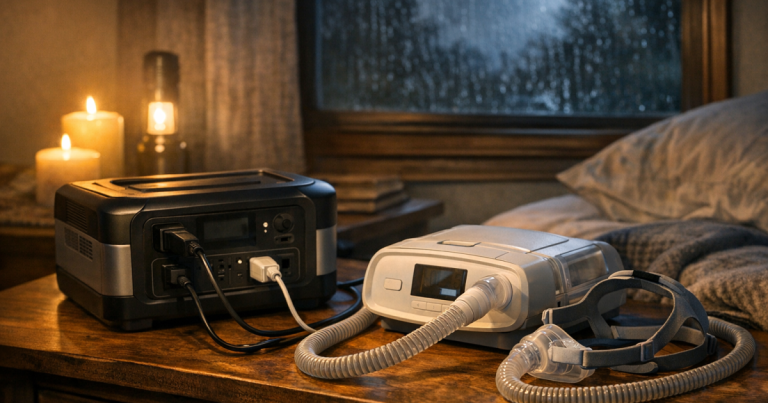
- Protect medical needs first: For medical devices, confirm power requirements with the device documentation and build in extra runtime. Do not rely on a single untested battery for critical care.
So which one should you choose?
Portable power stations vs solar generators is really a question of whether you need stored backup only, or stored backup plus a practical daytime recharge method. For many households, the right first step is a battery that can comfortably cover essential loads for the outage length you are planning around. Solar becomes the next layer if your outages are long enough, sunny enough, and predictable enough to make panel setup worthwhile.
Choose a plain power station approach if your main concerns are overnight outages, apartment-friendly backup, phone and laptop charging, router runtime, and simple indoor use. Choose a solar-capable setup if you are planning for multi-day outages, have safe outdoor space, and are willing to manage panels, weather, and charging windows.
For whole-house expectations, be cautious. A portable battery kit is not the same as a standby generator, a professionally designed home battery system, or a properly connected generator circuit. It can be excellent for targeted essentials, but it should not be sold to yourself as a magic box that runs everything as normal.
Common questions
Is a solar generator just a portable power station?
Usually, yes. In most consumer home-backup use, a solar generator is a portable power station bundled with, or compatible with, solar panels. The battery supplies power; the panels help recharge it.
Can either option run a refrigerator?
Sometimes, but you must verify the refrigerator’s running watts, startup surge, and the battery’s output rating. Runtime can vary widely based on fridge size, room temperature, door openings, and battery capacity.
Can I use a portable power station indoors?
Battery power stations are generally intended for indoor use when operated according to the manufacturer’s instructions. Engine generators are different and must be run outdoors away from windows, doors, vents, and garages.
Do solar panels work during cloudy weather?
They can produce some power in cloudy conditions, but output is often much lower than in direct sun. Plan solar as a helpful recharge method, not a guaranteed full refill every day.
Should I connect a power station to my home panel?
Only equipment designed for that purpose should be connected to home wiring, and the electrical connection should be handled by a qualified electrician under local code and utility requirements.
Main lessons
A portable power station is the simpler, quieter way to cover essential devices for short outages. A solar generator setup adds resilience when outages stretch longer and you have a realistic place to harvest sunlight. The safest plan is not based on a label; it is based on your actual loads, your expected outage length, your recharge options, and a short test run before the next blackout.