A multi-day outage turns a battery backup from a convenience into a schedule you have to manage. A portable power station recharge plan matters because the battery is only as useful as your next safe way to refill it.
The good news: you do not need a complicated setup. You need a realistic power budget, a few safe charging options, and a habit of recharging before the station gets uncomfortably low.
Generator inlet boxes, transfer switches, interlock kits, and any wiring that connects backup power to household circuits should be installed by a qualified electrician in compliance with local electrical codes and safety standards.
The short version
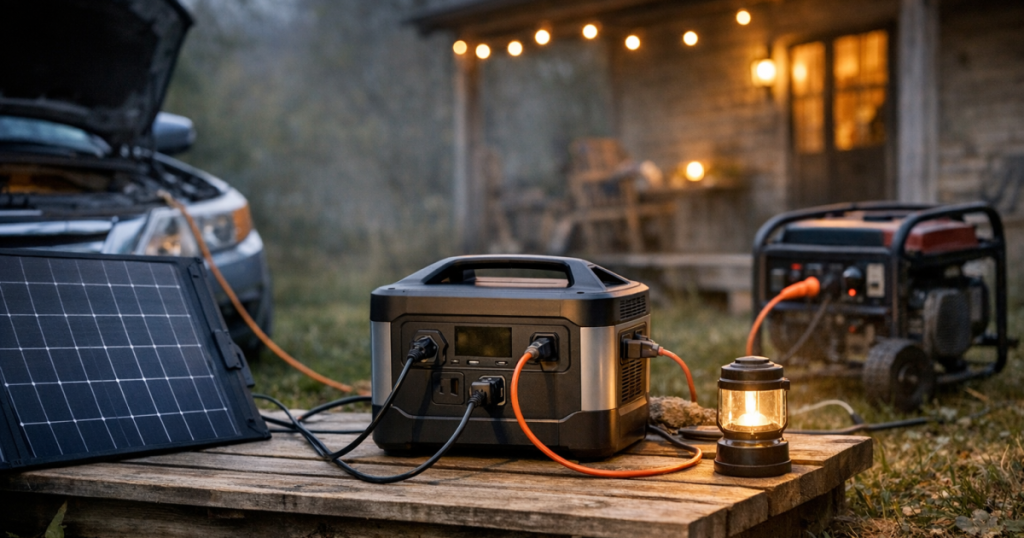
During a long blackout, recharge your power station in layers. Start fully charged before storm season, reduce unnecessary loads, then use the safest available refill method: utility power if it returns briefly, solar during daylight, an outdoor generator during planned run windows, or a vehicle outlet only as a slow fallback.
- Top off before severe weather whenever possible.
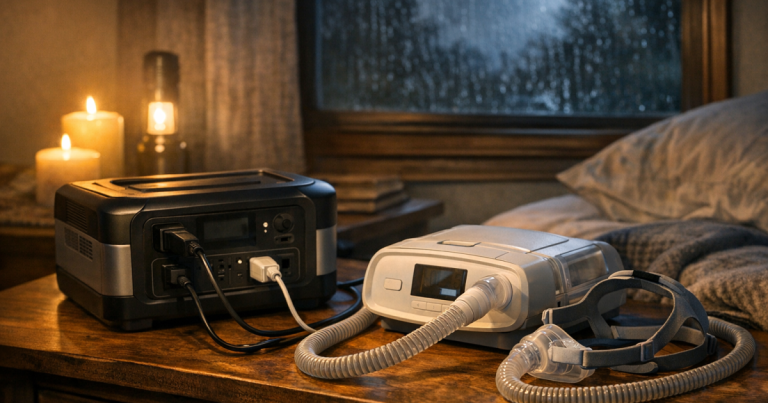
- Run only the loads that matter: phones, lights, router, laptop, CPAP, small medical devices, or fridge support if your unit can handle it.
- Recharge before the battery reaches zero; 20% to 30% remaining is a useful planning point.
- Use solar for daytime stretching, not as a guaranteed whole-outage solution.
- Operate fuel-powered generators outdoors only, far from doors, windows, vents, and garages.
Step 1: Know what you are trying to keep alive
The easiest way to run out of power is to treat the station like a wall outlet. A portable power station has two limits: how much power it can deliver at once, measured in watts, and how much energy it stores, measured in watt-hours.
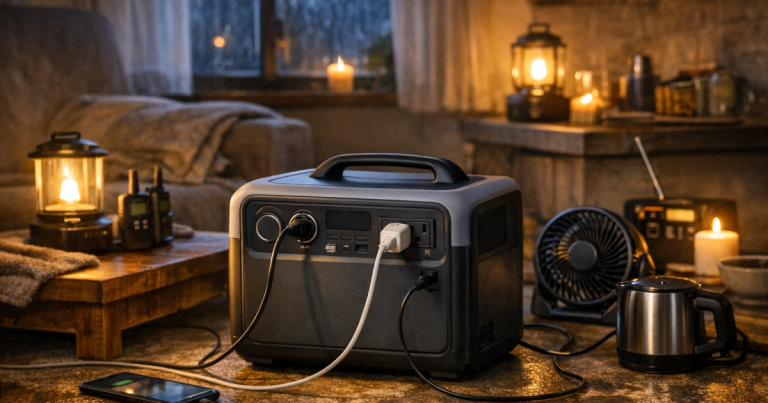
Start by making a short essentials list. For many households, that means phones, a few LED lights, a Wi-Fi router and modem, one or two laptops, rechargeable radios, and medical equipment that is already approved for the user’s setup. A refrigerator, freezer, microwave, sump pump, or furnace blower changes the plan because those loads can draw much more power and may have starting surges.
If you are still working out what your battery can realistically support, use our portable power station capacity guide before building a recharge schedule. It is better to discover a mismatch on a normal weekend than during a storm outage.
Step 2: Stretch the battery before you refill it
Recharging matters, but conservation buys time. Every watt you avoid using is a watt you do not have to replace later.
- Charge phones and laptops in batches instead of leaving everything plugged in all day.
- Use low-power LED lanterns instead of running large AC lights.
- Turn off the station’s AC outlets when you only need USB ports, if your model allows separate controls.
- Let the fridge stay closed as much as possible and power it only in managed cycles if your setup is suitable.
- Move nonessential comfort loads, like fans or entertainment devices, behind medical, communication, food safety, and work needs.
This is where outage planning becomes personal. A remote worker may prioritize a router and laptop. A family with refrigerated medication may prioritize temperature control. A renter in an apartment may care most about quiet lighting, phones, and a battery-powered radio.
Step 3: Use wall power whenever it appears
If grid power flickers back on during a rolling outage or repair window, plug the station in and recharge immediately. Do not wait until bedtime or assume the power will stay on.
Set a household rule: when power returns, the station, phones, rechargeable lanterns, and any UPS units get topped off first. Laundry, entertainment, and other catch-up tasks can wait until the essentials are charged.
Use the charger and cable recommended for your power station. Some models let you adjust AC charging speed; a slower setting may be gentler and quieter, while a faster setting can be useful when the power may disappear again. Verify the manufacturer’s instructions for your exact unit rather than guessing.
Step 4: Recharge from a generator without turning it into an indoor hazard
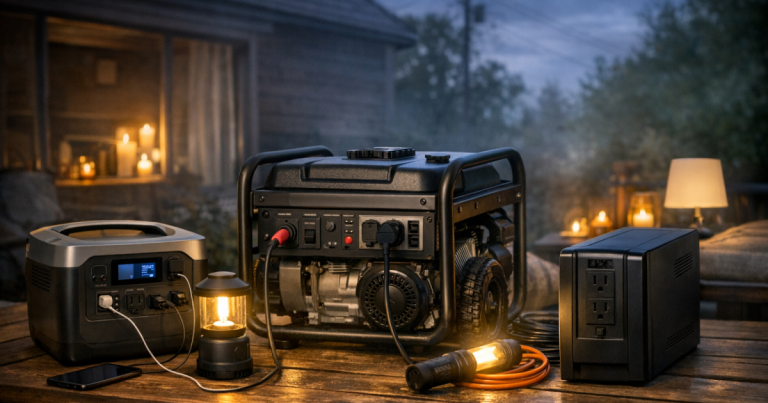
A portable generator can be an effective way to refill a power station during a long outage, but the generator and the battery serve different roles. The generator produces power while fuel is available. The power station stores quiet indoor power for nighttime, electronics, and short no-fuel windows.
Run the generator outdoors only, positioned far from doors, windows, vents, crawlspace openings, and attached garages. Never run it in a garage, basement, enclosed porch, breezeway, or near an open window. Let it cool before refueling, and keep fuel stored safely according to the container and local rules.
A sensible routine is to run the generator for a planned window during the day, recharge the power station, cool down the fridge or freezer if your setup supports it, and charge other small batteries at the same time. Then shut the generator down and use the power station indoors for quiet evening and overnight needs.
Before doing this, check two numbers: the generator’s available outlet capacity and the power station’s maximum AC charging input. The station will only charge as fast as its charger and settings allow. Do not overload the generator with space heaters, large appliances, and battery charging all at once. For a wider safety refresher on watts, fuel, runtime, and limits, see home backup power basics.
Step 5: Treat solar as a daylight extender
Solar panels are useful during multi-day outages because they can add energy without fuel, noise, or fumes. They are also weather-dependent. Clouds, shade, short winter days, smoke, poor panel angle, and incompatible cables can all reduce output.
Before an outage, verify the solar input range for your exact power station. Check the allowed voltage, connector type, maximum input watts, and whether the panel setup needs a specific adapter. Do not connect random panels just because the plug seems to fit.
In use, place panels in full sun, adjust the angle every few hours, and keep cords where nobody will trip over them. Expect solar to support phones, lights, laptops, router time, and gradual battery recovery better than heavy appliance loads. If the forecast shows several cloudy days, plan another recharge method instead of counting on solar alone.
Step 6: Use a vehicle only as a backup charging source
Many power stations can charge from a vehicle outlet, but this is usually slow. It is best viewed as a fallback for topping up, not the main plan for a large battery.
Use the vehicle charging cable intended for your station. Keep the vehicle outdoors, never idling in a garage or enclosed space. Be careful about draining the starter battery, especially if you are charging with the engine off. For long outages, fuel for the vehicle also becomes part of the decision, so do not spend it casually.
A simple three-day recharge rhythm
Here is a practical pattern for a household trying to keep phones, a router, LED lights, and laptop time going through a three-day outage. Adjust it for medical needs, weather, fuel, and your station’s capacity.
- Morning: Check battery percentage, weather, fridge temperature if relevant, and the day’s priorities. Use solar early if sun is available.
- Midday: Run solar at the best angle. Charge phones, power banks, radios, and laptops while the station is already awake.
- Afternoon: If you have a generator, run it outdoors during a planned window to recharge the station and handle any approved high-priority loads.
- Evening: Shut down nonessential outlets. Use the station for lights, router time, device charging, and essential overnight equipment.
- Overnight: Keep loads minimal. Avoid running convenience devices that can wait until daylight.
The goal is not to keep everything normal. The goal is to keep the right things working long enough for the grid to come back or for you to make the next safe decision.
Key checks before the next storm
A recharge plan should be tested before you need it. Pick a weekend afternoon and run through the steps with real devices.
- Confirm how long your station takes to recharge from wall power at its normal setting.
- Test your solar panel connection in full sun and note the typical input you actually see.
- If using a generator, confirm the station charges properly from it while the generator is outdoors and lightly loaded.
- Label the charging cables so nobody has to search for them in the dark.
- Store the station where it stays dry, accessible, and within the manufacturer’s recommended temperature range.
- Keep a written priority list near the station so family members know what gets powered first.
Indoor use also deserves a separate habit check. Place the unit on a stable surface, allow ventilation around it, keep it away from water, and avoid burying it under blankets or gear. Our guide to using a portable power station indoors during an outage covers the practical safety points in more detail.
Common questions
Can I recharge a power station while it is running devices?
Some models support pass-through charging, but limits vary. Check the manual for your unit, watch heat and load levels, and avoid assuming every outlet can be used at full power while charging.
Is solar enough for a multi-day outage?
Sometimes, for small loads. Solar can be excellent for phones, lights, routers, and laptops, but it is unreliable as the only recharge method if you need high loads or face cloudy weather.
How low should I let the battery get?
For outage planning, try not to run it to empty. Recharging around 20% to 30% remaining gives you a cushion if weather changes, fuel runs low, or the next charging window is delayed.
Can I charge a power station from a gas generator indoors if the garage door is open?
No. Fuel-powered generators belong outdoors, well away from openings to the home. An open garage door does not make indoor or attached-garage operation safe.
Should I buy more battery capacity or focus on recharging?
Both matter, but recharging is what makes a multi-day plan work. Extra capacity helps the first night; a safe refill method helps the second and third day.
Why it matters
A portable power station is most valuable when it becomes part of a routine, not a mystery box in the closet. Charge it before bad weather, assign it clear jobs, and know exactly how you will refill it if the outage lasts longer than expected.
That calm, repeatable plan is what keeps a household connected, lit, and organized when the grid is down for more than a few hours.