When the power goes out, the refrigerator quickly becomes one of the most important loads in the house. You can run a refrigerator on a portable power station, but the setup works best when you size the battery for startup surge, reduce door openings, and plan how you will recharge if the outage lasts longer than a day.
A portable power station is usually safer and quieter indoors than a fuel-powered generator because it does not produce exhaust. The trade-off is simple: the battery has a fixed amount of stored energy, so every door opening, warm room, and extra device plugged in cuts into your cold-food window.
Any connection to home wiring, a transfer switch, or an electrical panel should be carried out by a qualified electrician to comply with local electrical codes and safety requirements. For most households, the refrigerator should be plugged directly into the portable power station or into a properly rated grounded extension cord, not backfed through household wiring.
At a glance
- Check two ratings: the refrigerator’s running load and its startup surge requirement.
- Use watt-hours for runtime: battery capacity in watt-hours tells you more than the headline watt rating.
- Expect cycling: refrigerators do not pull full power every minute; the compressor turns on and off.
- Keep it closed: door openings often matter as much as battery size during a short outage.
- Plan the recharge: a one-day outage and a three-day outage need different routines.
Step 1: Find the refrigerator’s real power needs
Start with the label inside the refrigerator, on the back, or in the owner’s manual. You may see watts, amps, volts, or a combination. In the US, most standard refrigerators use a 120-volt household plug. If the label gives amps instead of watts, multiply volts by amps to estimate watts.
For example, a label that lists 120 volts and 3 amps suggests about 360 watts while that load is active. That does not mean the refrigerator uses 360 watts all day. The compressor cycles, the defrost system may run occasionally, and energy use changes with room temperature, door openings, and how full the fridge is.
The number many people miss is startup surge. When the compressor starts, it may briefly need much more power than it uses while running. Your power station’s AC inverter must handle that short surge, or it may shut off even though the refrigerator’s normal running wattage looks manageable.
Step 2: Match the refrigerator to the power station
A power station has two important limits for this job: AC output and battery capacity. AC output is measured in watts and tells you what the unit can run at one time. Battery capacity is measured in watt-hours and tells you roughly how long it can keep supplying energy.
Check the power station’s continuous AC output rating first. Then check its surge or peak rating. The continuous rating should cover the refrigerator while running, and the surge rating should cover the compressor’s startup draw. Do not assume a small station can start a full-size refrigerator just because it has a household-style outlet.
Next, look at watt-hours. A 1,000 watt-hour battery does not usually deliver every listed watt-hour to the appliance because the inverter and electronics use some energy. Heat, age, and operating mode can also affect results. Treat all runtime math as a planning estimate, then test your own setup before storm season.
Step 3: Estimate runtime without overpromising it
The basic formula is simple: usable watt-hours divided by average watts equals estimated hours. The hard part is knowing the refrigerator’s average draw across a full cycle, not just the compressor’s running draw.
If your refrigerator averaged 100 watt-hours per hour during a test, a power station with about 800 usable watt-hours could support it for roughly 8 hours. If the same refrigerator averaged 60 watt-hours per hour in a cool kitchen with the doors closed, the estimate would stretch longer. In a hot garage, or with frequent door openings, it could be shorter.
The best way to improve the estimate is to measure. A plug-in electricity meter can show how much energy the refrigerator uses over several hours. Run the test when the refrigerator is already cold, then repeat it during warmer conditions if your kitchen or garage gets hot. This gives you a household-specific number instead of relying on a broad average.
Step 4: Set up the refrigerator during an outage
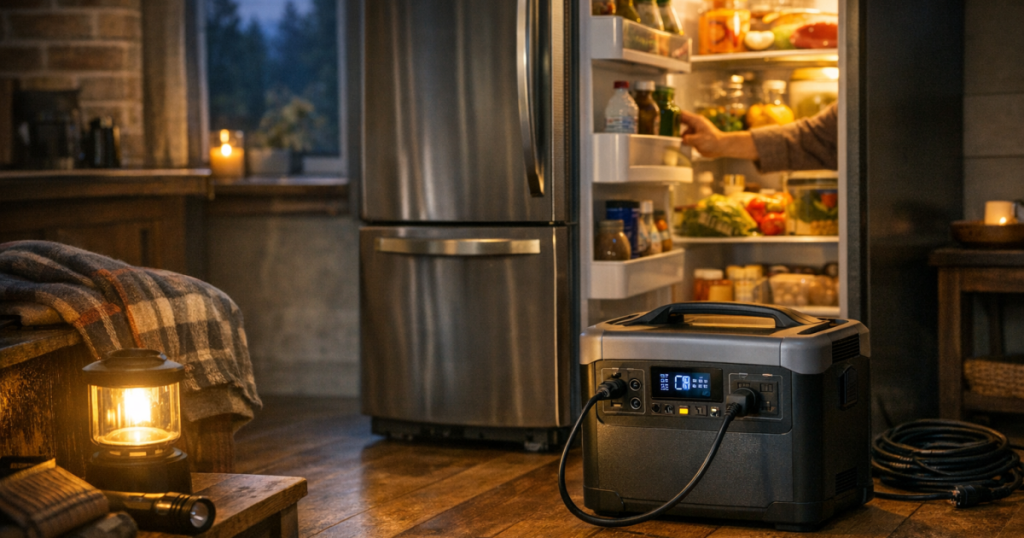
Once the power is out, keep the setup simple and stable. Place the power station where it stays dry, has airflow around its vents, and will not be kicked, tipped, or covered by blankets or boxes. Do not place it in standing water, near a wet entryway, or directly against the warm rear coils of the refrigerator.
- Plug the refrigerator into the AC outlet: use the power station’s AC output, not its USB or DC ports.
- Use the shortest safe cord if needed: choose a grounded, appliance-rated extension cord with the right gauge for the load. Do not daisy-chain cords.
- Start with no extra loads: let the refrigerator compressor start before adding small devices like a phone charger.
- Watch for overload warnings: if the station trips or shuts off when the compressor starts, the surge demand is likely too high.
- Keep vents clear: both the refrigerator and the power station need airflow to work efficiently.
If the power station cannot start the refrigerator, do not keep forcing repeated startup attempts. Unplug the refrigerator, let the power station reset according to its manual, and reassess the load. A smaller fridge, chest freezer, or cooler strategy may be more realistic for that battery.
Step 5: Make the cold last longer
Battery backup works best when the refrigerator has less work to do. Before storm season, keep a refrigerator thermometer inside and aim to keep food at 40°F or below. A freezer should be at 0°F. During an outage, a thermometer gives you better information than guessing by feel.
Keep the doors closed as much as possible. The USDA’s general food-safety guidance is that a refrigerator can keep food cold for about 4 hours if unopened, while a full freezer can hold temperature longer than a half-full one. A power station can extend that window, but it does not remove the need to monitor temperature.
A few habits help:
- Move high-use drinks and snacks to a cooler so the main refrigerator stays closed.
- Freeze containers of water ahead of storm season to add thermal mass.
- Group refrigerated items so you can grab what you need quickly.
- Avoid plugging in coffee makers, space heaters, microwaves, or other heavy loads on the same station.
- Give the refrigerator a powered cooling period, then let it coast closed if you need to conserve battery.
Food safety should guide the plan, not just battery percentage. If the refrigerator rises above 40°F for an extended period, use official food-safety guidance to decide what to keep and what to discard.
Step 6: Decide what else gets power
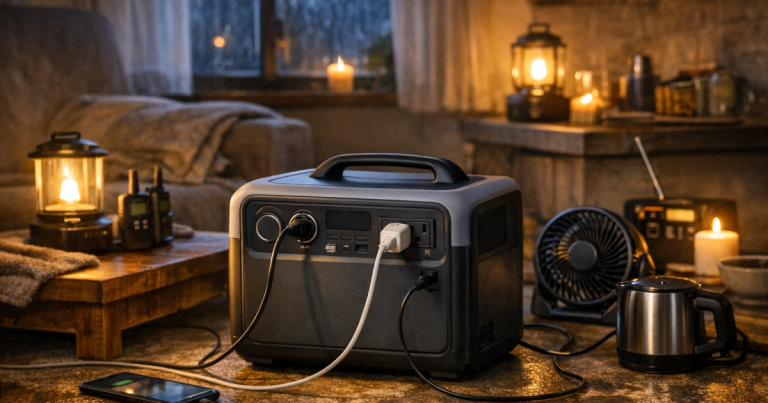
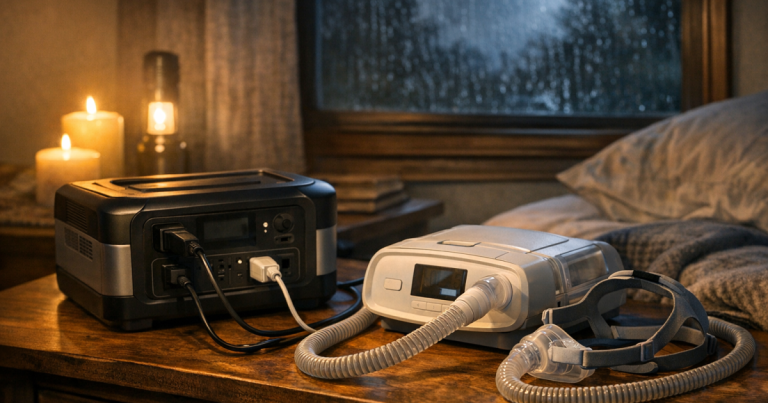
A refrigerator is important, but it may not be the only essential load. Phones, a router, medical equipment, lights, and fans may all compete for the same stored energy. Before the next outage, write down your household’s first-priority loads and decide what gets unplugged if the battery drops faster than expected.
For a broader planning exercise, use this guide on choosing which appliances get backup power first. It is especially useful if you are trying to balance food safety with internet access, work needs, or medical-device backup.
Step 7: Plan for recharging before the battery is low
For a short evening outage, one fully charged power station may be enough. For an overnight or multi-day outage, the recharge plan matters as much as the starting battery size.
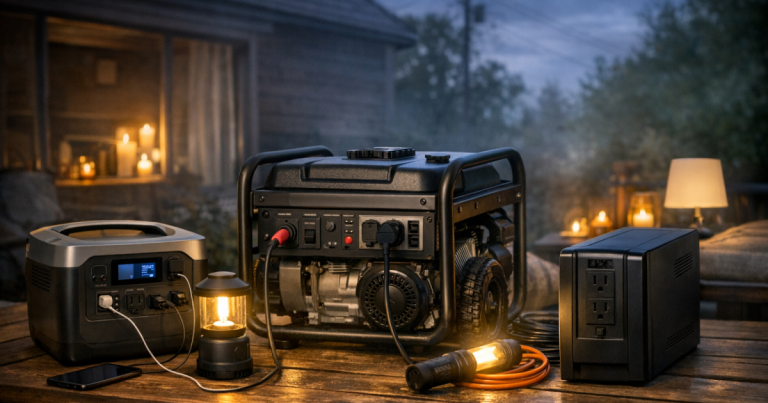
Common recharge paths include wall charging before the storm, solar panels during daylight, vehicle charging, or recharging from a generator used outdoors. Each has limits. Solar output changes with shade, season, and panel angle. Vehicle charging can be slow and should not be your only plan if fuel is limited. A fuel-powered generator must stay outside, away from doors, windows, vents, and garages because of carbon monoxide risk.
If you expect outages that last more than a day, review how to recharge a portable power station during a multi-day outage. That plan should be made before the refrigerator is warming and the battery display is already low.
When a portable station is not the right tool by itself
A portable power station can be an excellent refrigerator backup for apartments, townhomes, and quiet neighborhoods, but it is not magic. A large refrigerator, hot garage freezer, sump pump, well pump, or multiple appliances can overwhelm a single battery setup.
If you are deciding between a battery-first setup and a solar-labeled package, it helps to understand the wording. Many so-called solar generators are portable power stations paired with solar panels; the battery still determines storage, while the panels determine how quickly you can replace energy in good sun. This breakdown of portable power stations versus solar generators for home backup explains the trade-off in plain terms.
Quick pre-outage test
Do not wait for a storm warning to learn whether the setup works. Pick a normal day and run a controlled test while grid power is available.
- Fully charge the power station.
- Cool the refrigerator normally before the test.
- Plug only the refrigerator into the station.
- Confirm the compressor starts without an overload shutdown.
- Record battery percentage after 1 hour, 3 hours, and 6 hours.
- Check refrigerator temperature with a thermometer.
- Recharge the station afterward so it is ready again.
This test gives you a realistic household baseline. It also reveals simple fixes, such as moving the power station to a cooler location, using a better cord, or adjusting your outage routine so the refrigerator is not opened constantly.
FAQ
Can I plug a refrigerator directly into a portable power station?
Yes, if the power station’s AC output and surge rating can handle the refrigerator. Use the AC outlet, keep the station dry and ventilated, and avoid adding heavy loads at the same time.
How many watt-hours do I need for a refrigerator?
It depends on your refrigerator’s average energy use, not just its running wattage. Measure or estimate watt-hours per hour, then divide your usable battery capacity by that number for a rough runtime.
Should I leave the refrigerator plugged in the whole outage?
Not always. In a longer outage, you may choose to power the refrigerator in cooling blocks, then keep the door closed while it coasts. Use a thermometer so temperature, not guesswork, drives the decision.
Can one power station run both a refrigerator and freezer?
Sometimes, but both startup surges may be too much if they start close together. Test them one at a time first, and do not assume a setup is safe or reliable until you have checked the load.
What happens if the power station overloads?
Most units shut off or display an overload warning. Unplug the refrigerator, reset the station according to its manual, and do not keep retrying until you understand whether startup surge is the problem.
What to remember
The cleanest refrigerator backup plan is measured, not guessed. Check the refrigerator label, confirm the power station’s AC and surge ratings, estimate runtime in watt-hours, and test the setup before you need it. During the outage, keep the doors closed, monitor temperature, and protect the battery from unnecessary loads.
A portable power station can buy valuable time for food, medication storage, and household comfort. The best results come from treating it as part of a simple outage routine rather than a last-minute gadget pulled out after the fridge has already started warming.