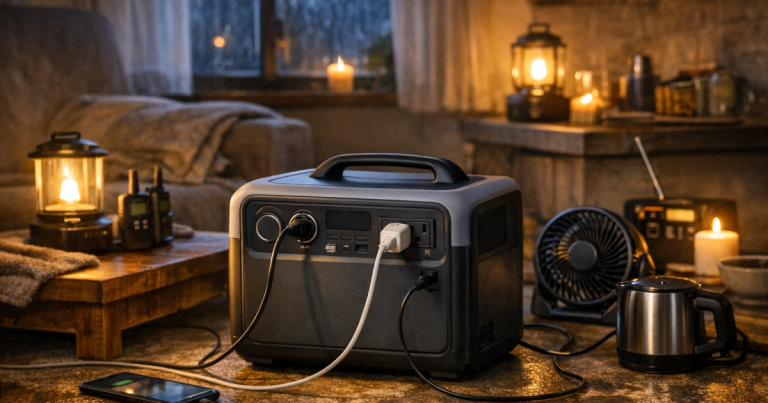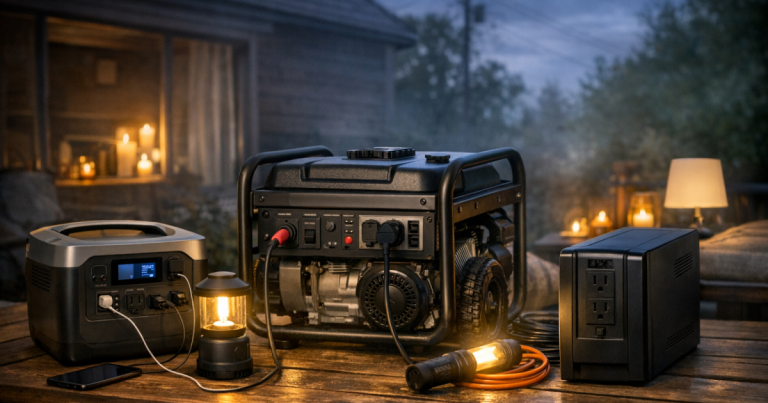
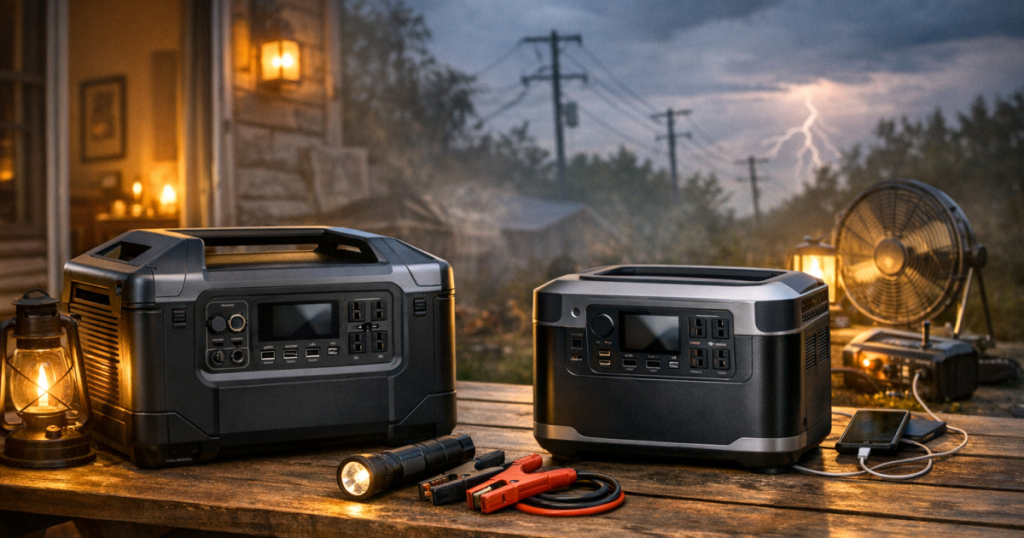
When the lights go out, the battery chemistry inside your power station affects more than a spec sheet. LiFePO4 vs NMC is really a trade-off between long cycle life, weight, storage habits, and how much energy you can carry for phones, routers, CPAP machines, lights, and a refrigerator plan.
Electrical panel connections, transfer-switch installation, and any setup that ties backup power into household wiring should be handled by a qualified electrician to meet local electrical codes, manufacturer instructions, and safety requirements.
What to know first
For most home outage use, LiFePO4 portable power stations are the calmer long-term choice: they usually offer strong cycle life, stable storage behavior, and a good fit for households that expect to recharge and reuse the unit often. NMC portable power stations still make sense when weight and compact size matter more than maximum cycle life, such as evacuation kits, car travel, or occasional short outages.
Neither chemistry automatically tells you whether a power station will run your appliance. The useful questions are simpler: how many watt-hours are available, how many watts the inverter can deliver, whether the outlets match your loads, how the station behaves while charging, and whether the manufacturer clearly states limits for temperature, surge loads, and battery lifespan.
If you are still working out how large your backup system needs to be, start with your actual loads rather than chemistry alone. A small station with the “better” battery chemistry can still disappoint if it cannot cover the wattage or runtime you need. For a practical method, see how to size backup power without overspending.
How the two chemistries differ
LiFePO4 stands for lithium iron phosphate. In portable power stations, it is valued for long service life, good thermal stability, and the ability to handle repeated charge-and-discharge cycles well. The trade-off is that LiFePO4 packs are often heavier for the same amount of stored energy compared with higher-density lithium chemistries.
NMC stands for lithium nickel manganese cobalt oxide. It is widely used where energy density matters, including many battery-powered devices and some portable power stations. In outage terms, NMC can help a power station stay smaller and lighter for a given capacity. The trade-off is that it may not match LiFePO4 for cycle-life expectations, depending on the exact cell quality, battery management system, and how the unit is used.
That last phrase matters. Battery chemistry is important, but it is not the whole story. A well-designed NMC station from a reputable manufacturer can be more useful than a poorly documented LiFePO4 unit with vague output limits. Likewise, a heavy LiFePO4 station may be excellent beside a couch during a storm but frustrating if you need to carry it down apartment stairs.
Where LiFePO4 usually shines during outages
LiFePO4 tends to fit households that treat backup power as a repeat-use tool rather than an emergency item that sits untouched for years. If you live in an area with storm outages, wildfire shutoffs, ice storms, or unreliable local service, a chemistry known for longer cycle life can be reassuring.
- Frequent short outages: Recharging phones, routers, tablets, rechargeable lanterns, and small medical accessories several times a season is exactly the kind of routine cycling where long-life chemistry helps.
- Home-based backup: If the unit mostly stays in a closet, office, bedroom, or garage shelf, extra weight may be less of a problem.
- Solar recharging plans: Households that plan to recharge from panels during multi-day outages may cycle the battery more often, making cycle-life ratings worth checking closely.
- Long ownership window: If you want one station to remain useful for years of storm seasons, LiFePO4 is often the more comfortable direction.
The main downside is portability. A high-capacity LiFePO4 station can be heavy enough that “portable” really means movable around the house, not something everyone can comfortably lift into a car. Check the listed weight, handle design, and whether the people in your household can move it safely before an outage.
Where NMC can still be the sensible pick
NMC should not be dismissed just because many newer outage-focused stations emphasize LiFePO4. The chemistry’s strength is energy density. If you need a compact unit that can ride in a vehicle, fit in a closet, or be carried during a short-notice evacuation, lower weight can be a real safety and convenience advantage.
- Apartment and condo living: Smaller storage spaces and stairwells make weight more important, especially if elevators are out.
- Occasional backup: If you only expect to use the station during rare outages, maximum cycle life may be less important than size, weight, and output fit.
- Travel plus home use: A lighter unit can serve double duty for road trips, camping, remote work, and blackout basics.
- Grab-and-go kits: For households that prioritize evacuation readiness, carrying the unit may matter as much as its chemistry.
The caution with NMC is to look closely at manufacturer-stated cycle life, storage instructions, warranty terms, and temperature limits. Do not assume two NMC units behave the same. The battery management system, cooling design, charger, and inverter quality all affect real-world usefulness.
Runtime is not decided by chemistry alone
A 1,000 watt-hour station and a 1,000 watt-hour station can still perform differently, but the basic math starts the same. Divide watt-hours by your load in watts, then subtract a margin for inverter losses, standby drain, temperature, age, and automatic shutoff behavior. For example, a 50-watt internet and charging setup looks like 20 hours on paper from 1,000 watt-hours, but real runtime will usually be lower.
For outage planning, group loads into tiers. Phones, LED lights, a radio, and a router are low-demand essentials. Laptops, CPAP machines, and small fans are moderate loads. Refrigerators, freezers, microwaves, space heaters, coffee makers, and sump pumps require much more careful wattage and surge planning. Some of those are poor matches for many portable stations unless the station is sized specifically for them.
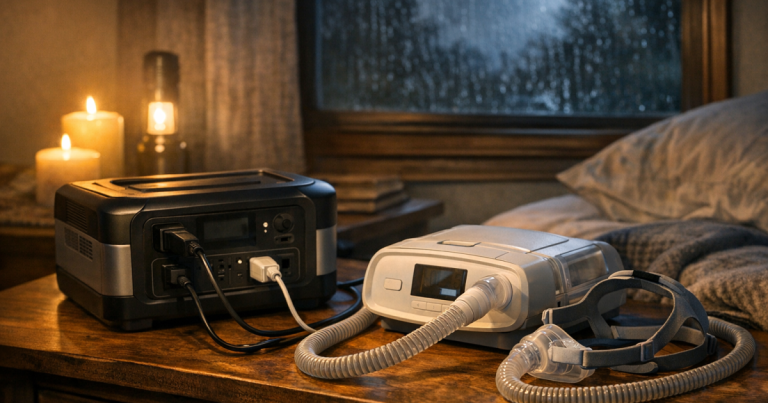
CPAP users should be especially careful because comfort settings can change power draw. Heated humidification and heated tubing can significantly increase energy use compared with basic therapy mode. If this is part of your blackout plan, read the more detailed steps for how to keep a CPAP running on a portable power station.
Storage and charging habits matter
Both LiFePO4 and NMC batteries last longer when they are stored thoughtfully. Keep the power station indoors in a dry, moderate-temperature place. Avoid leaving it in a hot vehicle, a freezing shed, or a damp garage corner. Lithium batteries generally have charging temperature limits, and charging below the manufacturer’s stated range can damage the battery or trigger protection shutoffs.
Check the manual for the recommended storage charge level and maintenance schedule. Some brands suggest storing at a partial state of charge and topping up periodically; others provide specific long-term storage guidance. The right answer is the one printed for your unit, not a rule copied from a different model.
Also think through how you will recharge during a long outage. Wall charging is fastest before the storm. Solar can help during extended events, but it depends on panel wattage, sunlight, weather, cable compatibility, and the station’s solar input limit. Vehicle charging can be useful, but it is usually slower and should be done without draining the vehicle battery needed for transportation.
Safety and compatibility checks before a blackout
Before storm season, test the station with the actual devices you expect to use. Do this on a normal day, not at midnight during a grid failure. Confirm that the station can start each load, that cords reach safely without creating trip hazards, and that the display gives you useful runtime information.
- Output watts: Check both continuous output and surge capacity for motors or compressors.
- Outlet type: Confirm whether you need AC outlets, USB-C, USB-A, 12-volt DC, or a mix.
- Pure sine wave output: Many modern stations provide it, but verify if you are powering sensitive electronics or medical equipment.
- Pass-through behavior: Some units can power devices while charging, but that does not automatically make them a true UPS.
- Certifications and protections: Look for clear documentation on over-temperature, overload, short-circuit, and battery management protections.
- Noise and lighting: Fan noise and bright displays can matter in a bedroom during an overnight outage.
For a broader checklist of the features that affect real blackout use, the guide to portable power station features that matter during outages is a useful next step.
Simple scenarios: which chemistry fits better?
Overnight outage in an apartment
If the plan is phones, router, a lamp, a small fan, and maybe a laptop, either chemistry can work. NMC may be attractive if the station needs to be light and easy to move. LiFePO4 may be better if outages happen regularly and the unit will see frequent use.
Bedroom backup for CPAP and communications
LiFePO4 is often appealing for repeated overnight cycling, but the right capacity and medical-device compatibility matter more than chemistry. Test the CPAP setup, including the exact settings you expect to use, and keep a low-power lighting option nearby so the power station is not doing every job.
Refrigerator support during a day-long outage
Chemistry is secondary to inverter output, surge handling, and capacity. A refrigerator may run intermittently, but startup surge and real-world duty cycle vary. Use a plug-in power meter before an outage if possible, and avoid assuming a small station can protect cold food for a full day.
Multi-day storm plan
LiFePO4 usually has the stronger case when the power station will be cycled repeatedly with solar, vehicle charging, or generator-assisted recharging. Still, capacity, charging speed, and input limits decide whether the plan works in bad weather.
FAQ
Is LiFePO4 safer than NMC for indoor outage use?
LiFePO4 is generally known for strong thermal stability, but indoor safety depends on the full product design. Use any power station according to its manual, keep it dry, avoid blocked vents, and do not overload it.
Does NMC mean a power station is outdated?
No. NMC can still be useful where compact size and lower weight matter. The key is to verify cycle-life claims, warranty coverage, output capacity, and storage instructions for the exact model.
Which chemistry is better for solar recharging?
LiFePO4 is often favored for frequent cycling, but solar performance depends on the station’s input limit, panel compatibility, weather, and charging controls. Chemistry alone does not determine solar recharge speed.
Can either type run a refrigerator?
Possibly, but only if the station can handle the refrigerator’s running watts, startup surge, and total energy use. Test the actual refrigerator before relying on it during an outage.
How often should I check a stored power station?
Follow the manufacturer’s storage schedule. As a practical habit, inspect charge level, cables, vents, and firmware or manual updates before storm season and after any extended use.
What stands out
For a home blackout kit that will be used often, LiFePO4 is usually the easier chemistry to trust for long-term service. For a lighter, more compact station that may need to travel, NMC can still be a reasonable fit. The better choice is the one that matches your actual outage routine: what you need to run, how long it must run, who has to move it, and how you will recharge it safely.
Think of chemistry as one layer of the decision, not the whole decision. A well-sized, well-tested station with clear limits is far more useful than a larger-looking unit chosen from battery chemistry alone.