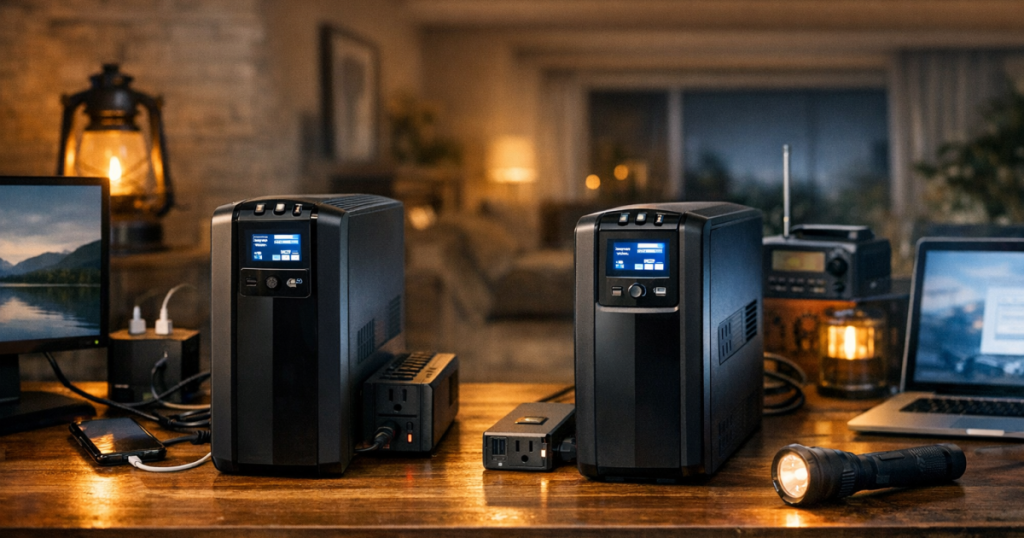
A desktop UPS is not a whole-home backup plan. It is the small, quiet bridge that keeps a router, computer, modem, or home theater stack alive long enough to ride through a blink, save work, or shut down cleanly. For home blackout planning, the APC vs CyberPower UPS decision comes down to watts, outlet layout, transfer time, and how much battery-backed capacity you actually need at the desk or network shelf.
Quick Buying Links
APC by Schneider Electric APC Back-UPS Pro 1500VA UPS
modest electronics loads where a simple stated APC replacement battery path is a priority
CyberPower CP1500PFCLCD PFC Sinewave UPS System
Better for crowded desks or network shelves needing higher stated watt capacity and more total outlets
This comparison treats the APC Back-UPS Pro 1500VA UPS as the current US APC Back-UPS Pro 1500VA/900W Tower 120V BR1500MS2. The CyberPower model is the US CyberPower CP1500PFCLCD PFC Sinewave UPS System. Both are plug-in, line-interactive UPS units for electronics, not refrigerator, sump pump, HVAC, or whole-home backup systems.
In brief
- APC Back-UPS Pro 1500VA BR1500MS2: a 1500VA, 900W, line-interactive tower UPS with sine-wave output, 10 total NEMA 5-15R outlets, and a user-replaceable APCRBC163 battery.
- CyberPower CP1500PFCLCD PFC Sinewave UPS System: a 1500VA, 1000W, line-interactive mini-tower UPS with sine-wave output, 12 total NEMA 5-15R outlets, and user-replaceable batteries identified by serial-number prefix.
- Both provide 6 battery-backed and surge-protected outlets. For outage planning, that number counts more than the total outlet count.
- CyberPower has the higher manufacturer-stated real-power rating: 1000W versus 900W for APC.
- APC lists 3 minutes 12 seconds at its full 900W rated load. CyberPower lists 2.5 minutes at its full 1000W rated load and 10 minutes at half load.
The job these UPS units are built for
A UPS earns its keep during short interruptions and messy power transitions. It can keep a cable modem, Wi-Fi router, desktop PC, monitor, NAS, or home theater electronics from dropping instantly when the lights flicker. It is also useful when the outage lasts longer, because it gives you time to shut down gear in an orderly way instead of yanking power without warning.
That is a very different role from a portable power station or generator. A UPS is usually about continuity for electronics, not hours of appliance runtime. If you are deciding where a UPS fits beside larger backup options, the broader breakdown in portable power station vs generator vs UPS for blackouts is a useful companion.
For the APC vs CyberPower UPS comparison, the cleanest way to think about it is this: both are capable electronics-backup units in the same general class, but CyberPower gives you more stated watt capacity and more total outlets, while APC gives you a slightly wider published high-end input voltage limit and a simple single replacement battery model for this specific BR1500MS2 unit.
Manufacturer-stated side-by-side comparison
- Rated apparent power: APC BR1500MS2 is rated at 1500VA. CyberPower CP1500PFCLCD is also rated at 1500VA.
- Rated real power: APC is rated at 900W. CyberPower is rated at 1000W.
- UPS topology: Both are listed as line-interactive UPS units.
- Output waveform: Both are listed with sine-wave output.
- Outlet layout: APC has 10 total NEMA 5-15R outlets: 6 battery backup and surge, plus 4 surge-only. CyberPower has 12 total NEMA 5-15R outlets: 6 battery and surge protected, plus 6 surge-only protected.
- Input voltage operating range: APC lists 88 to 147V. CyberPower lists 88 to 144VAC.
- Transfer time: APC lists 8 ms typical and 10 ms maximum. CyberPower lists 4 ms typical.
- User-replaceable battery support: APC uses APCRBC163 for BR1500MS2. CyberPower uses RB1290X2 or RB1280X2B depending on serial number.
Power rating: same 1500VA label, different watt ceiling
The shared 1500VA rating makes these look nearly identical at a glance, but watts are the number that should get your attention when you are adding up actual connected loads. APC states 900W for the BR1500MS2. CyberPower states 1000W for the CP1500PFCLCD.
That 100W difference does not turn the CyberPower into an appliance backup unit, and it does not mean every setup should be loaded close to the limit. It does give the CyberPower a higher stated real-power ceiling for desk and electronics loads. For a home office with a PC, monitor, router, modem, and a few low-draw accessories, that extra rated wattage is the clearest technical advantage in CyberPower’s column.
VA alone is a poor way to predict runtime. A 1500VA label does not tell you how long your setup will run. Runtime depends on the connected watt load and the manufacturer’s runtime data for that load. This is where careful load planning beats wishful thinking, which is less exciting than a big number on a box but far more useful when the power drops.
Outlet layout: count the battery-backed outlets first
CyberPower provides 12 total outlets while APC provides 10. On paper, that makes the CyberPower layout more generous. The more important detail is that both units provide 6 battery-backed and surge-protected outlets. Those are the outlets that stay powered from the UPS battery during an outage.
The surge-only outlets still have a role. They can serve gear you want protected from surges but do not need running when utility power fails. A printer, speaker, or secondary accessory might live there. The battery-backed outlets should be reserved for the devices that keep your household functioning during a short outage: modem, router, computer, monitor, network storage, or essential home theater components.
CyberPower’s 6 surge-only outlets versus APC’s 4 surge-only outlets gives it more plug-in room for non-battery loads. The practical gain depends on how crowded your desk or media cabinet is. If you already have a tangle of wall warts, power bricks, and one plug that always blocks its neighbor like it pays rent, the extra total outlets can reduce friction.
Transfer time and voltage range
Both models are line-interactive UPS units, a common topology for home electronics backup. In the manufacturer-stated specifications, APC lists an 8 ms typical transfer time and 10 ms maximum. CyberPower lists a 4 ms typical transfer time. Based strictly on those published figures, CyberPower has the shorter typical transfer time.
Input voltage range leans slightly the other way at the high end. APC lists 88 to 147V, while CyberPower lists 88 to 144VAC. That gives APC the wider published upper limit. For most readers, this is less visible day to day than outlet layout and watt rating, but it is still a real specification difference.
The bigger practical point is that both products are designed for plug-in electronics backup. They are not a safe workaround for powering major appliances from standard household outlets. For broader setup boundaries and safe outage habits, see home backup power safety basics.
Runtime: compare loads, not labels
Runtime numbers deserve careful reading because the two published full-load figures are not measured at the same watt load. APC lists 3 minutes 12 seconds at a 900W load, which is its full rated real-power load. CyberPower lists 2.5 minutes at full load, but its full load is 1000W. CyberPower also lists 10 minutes at half load.
That means the full-load runtime figures are not an equal-load head-to-head. The clean conclusion is narrower: APC publishes 3 minutes 12 seconds at 900W, and CyberPower publishes 2.5 minutes at 1000W. CyberPower’s published half-load runtime gives another useful planning point, but it does not tell you what either unit will do with your exact router, desktop, monitor, and accessories.
For outage planning, the saner approach is to decide which loads truly need battery backup and keep the list short. A modem and router are usually easier to support than a full desktop workstation with a large monitor. A desktop PC and monitor may only need enough time to save files and shut down. A network shelf may be the more valuable target if your household depends on internet access during short blackouts.
Battery replacement and ownership friction
Both units support user-replaceable batteries, which is important for long-term ownership. APC identifies APCRBC163 as the user-replaceable battery for the BR1500MS2. CyberPower lists RB1290X2 or RB1280X2B depending on serial-number prefix.
That difference is not glamorous, but it affects the future version of you standing in a utility closet with a dead UPS battery and limited patience. APC’s replacement path is simpler for this specific BR1500MS2 listing because the battery model is stated as APCRBC163. CyberPower’s replacement support is still user-serviceable, but the cartridge depends on the unit’s serial-number prefix.
For readers already leaning toward CyberPower, the separate CyberPower CP1500PFCLCD review takes a closer look at that model as a standalone electronics-backup choice.
Best fit by household scenario
Choose APC BR1500MS2 for a simpler replacement-battery path
The APC Back-UPS Pro 1500VA/900W BR1500MS2 is the cleaner fit if your priority is a sine-wave 1500VA UPS with 6 battery-backed outlets and a straightforward manufacturer-stated replacement battery model for this specific unit. It also has the slightly wider published upper input voltage limit, 147V versus CyberPower’s 144VAC.
The trade-off is the lower real-power rating at 900W and fewer total outlets. For a tidy home office or network shelf that does not need the extra stated watt headroom, those limits may be acceptable.
Choose CyberPower CP1500PFCLCD for higher stated watt capacity and more total outlets
The CyberPower CP1500PFCLCD is the stronger fit if you want the higher manufacturer-stated real-power rating and a larger overall outlet count. It is rated at 1000W versus APC’s 900W and provides 12 total outlets versus APC’s 10, while still giving you the same 6 battery-backed outlets.
CyberPower also lists a shorter typical transfer time at 4 ms. The main ownership wrinkle is battery replacement identification: the user-replaceable cartridge is RB1290X2 or RB1280X2B depending on serial-number prefix.
Common questions
Can either UPS run a refrigerator during a blackout?
No. This comparison is limited to 120V plug-in UPS backup for electronics such as computers, networking gear, and home theater equipment. Refrigerator backup involves different load behavior, startup surge, runtime planning, and safety considerations.
Is 1500VA enough to estimate runtime?
No. The VA rating describes apparent power capacity, not a simple runtime promise. Use watts and manufacturer runtime data for the connected load. A lightly loaded router setup and a heavily loaded desktop PC will behave very differently.
Are the surge-only outlets useful in an outage?
Surge-only outlets protect connected devices from surges but do not provide battery power during an outage. For blackout planning, reserve the battery-backed outlets for the devices that must stay on or shut down safely.
Which one should you buy?
For most home electronics backup plans, the CyberPower CP1500PFCLCD has the stronger spec-based case. It offers the higher stated real-power rating, 1000W versus 900W, more total outlets, 12 versus 10, and a shorter published typical transfer time. Those advantages are directly useful around a crowded desk, network shelf, or entertainment center.
The APC BR1500MS2 still makes sense when its specific strengths line up with your priorities. It provides the same 1500VA class, the same 6 battery-backed outlet count, sine-wave output, a slightly wider published high-end input voltage limit, and a simpler stated battery replacement model for this unit. If your connected load is modest and you value that cleaner replacement path, it remains a practical choice.
The most useful buying rule is simple: choose CyberPower for the higher watt rating and outlet flexibility; choose APC for a straightforward BR1500MS2 battery replacement path and the slightly wider published upper input voltage limit. Either way, keep the UPS focused on electronics. For refrigerators, medical equipment, sump pumps, and longer outages, plan a separate backup system rather than asking a desk UPS to do a generator’s job.
Quick Buying Links
APC by Schneider Electric APC Back-UPS Pro 1500VA UPS
modest electronics loads where a simple stated APC replacement battery path is a priority
CyberPower CP1500PFCLCD PFC Sinewave UPS System
Better for crowded desks or network shelves needing higher stated watt capacity and more total outlets