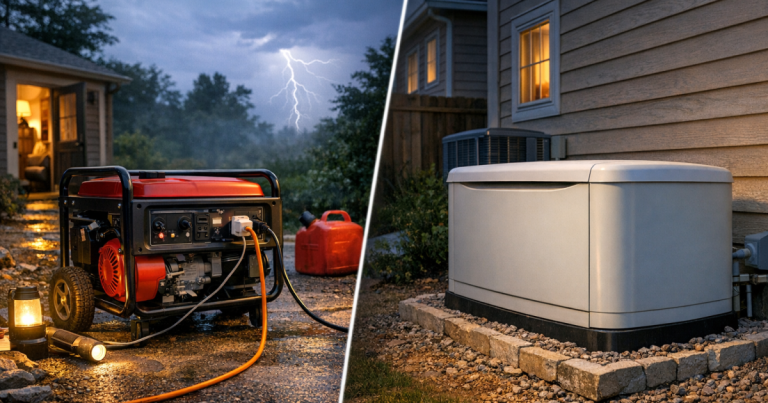
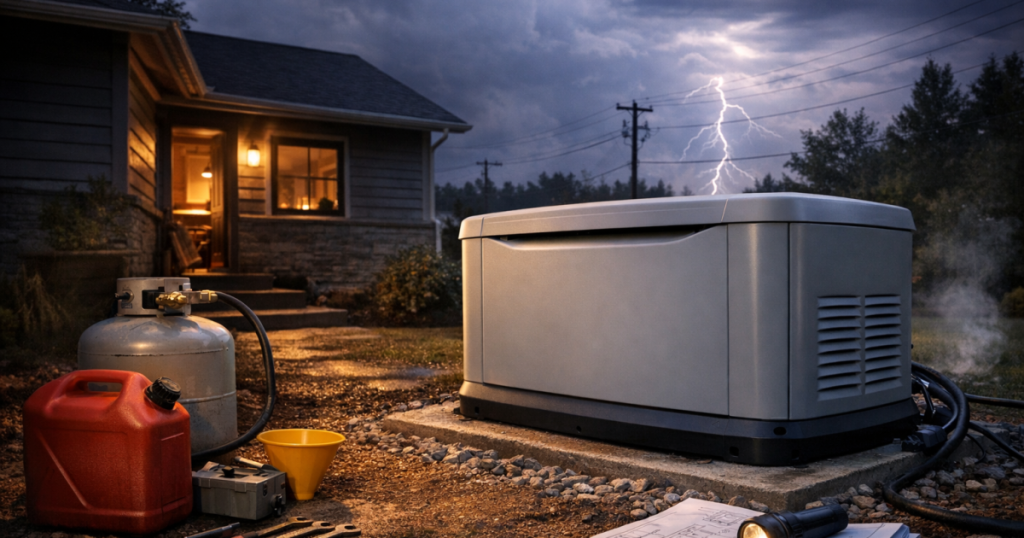
A long outage feels different when the house can switch to backup power without dragging equipment into the rain. For homeowners who want automatic backup, standby generators for blackouts are the permanent, installed option: an outdoor generator connected to a fuel source and an automatic transfer switch.
Electrical service connections, automatic transfer switch installation, and fuel-line work for a standby generator should be handled by qualified electrical and gas professionals so the system complies with local code, utility requirements, and manufacturer safety standards.
At a glance
- A standby generator is permanently installed outdoors and typically starts automatically when utility power fails.
- Sizing should be based on actual loads, not just the square footage of the house.
- Natural gas and propane are the most common residential standby fuels; diesel appears more often in larger or specialized setups.
- The installed cost is usually driven as much by electrical work, fuel supply, permits, and site prep as by the generator itself.
- A standby generator is not automatically a whole-home solution. Some systems back up selected circuits, while others support more of the house with load management.
What a standby generator actually does during an outage
A standby generator is meant to remove the scramble from a power failure. When the utility feed drops, the transfer switch disconnects the home from the grid, the generator starts, and selected circuits receive power. When utility service returns, the switch transfers the home back and the generator shuts down after its cool-down cycle.
That automatic handoff is the big difference from a portable generator or portable power station. You are not running extension cords through a doorway, rolling a generator out of the garage, or deciding what to plug in first. For households with sump pumps, well pumps, refrigeration, medical equipment, or frequent work-from-home needs, that convenience can matter.
The trade-off is commitment. A standby system is a home improvement project, not a simple appliance. It needs a safe outdoor location, the right fuel supply, an approved transfer method, inspections, and ongoing service. If you want the broader picture of how transfer switches, batteries, generators, and circuits fit together, start with how home backup power works during an outage.
When a standby generator makes sense
For many homes, standby generators for blackouts make the most sense when outages are long enough or frequent enough that manual backup becomes stressful. A five-minute flicker does not justify much. A 24-hour winter storm, a multi-day hurricane outage, or repeated wildfire shutoffs can change the math quickly.
A standby system may be worth considering when you need to keep more than phones and a fridge alive. Common reasons include a basement sump pump that must run during storms, a private well pump, home medical equipment, a freezer full of food, remote work that cannot pause, or heating and cooling needs in extreme weather. Older adults, families with young children, and households with mobility limitations may also value not having to set up equipment outside in bad conditions.
It may be less compelling for renters, apartment dwellers, homes with very rare outages, or households that only need phones, internet gear, lights, and a refrigerator for a few hours. In those cases, a UPS, portable power station, or smaller portable generator plan may cover the real need with less installation work.
Sizing starts with the loads you cannot lose
Generator sizing is where many homeowners drift toward either overspending or disappointment. A standby generator is commonly described by kilowatts, but the number that matters is what your house will ask it to run at the same time.
Start with the essential loads before thinking about the whole house:
- Refrigerator and freezer
- Sump pump or well pump
- Furnace blower or boiler controls
- Internet gear and basic electronics
- Several lights and outlets
- Garage door opener, if needed for access
- Medical or mobility equipment, where applicable
Then add the comfort loads that change the size conversation: central air conditioning, electric range, electric water heater, clothes dryer, heat pump, pool equipment, or large workshop loads. These are the items that can push a system from “essential backup” into “larger whole-home backup.”
Motors also create starting loads. A well pump, air conditioner compressor, or sump pump may draw more power for a moment when it starts than it uses once running. A qualified installer can calculate those starting requirements and decide whether load management is needed.
Essential-circuit backup versus whole-home backup
An essential-circuit setup powers a limited group of circuits selected in advance. It can keep the house safe, connected, and functional without pretending every appliance will run as usual. This is often the most sensible planning style for budget-aware households.
A whole-home setup aims to power most or all of the electrical panel. That does not mean every large appliance should run at once. Many larger installations still use load-shedding controls so air conditioning, water heating, cooking appliances, and other high-demand loads do not overload the generator.
The right question is not “What size runs my house?” It is “What do I need to run at the same time during a realistic outage?”
Fuel choices: natural gas, propane, and diesel
Fuel is not just a preference. It affects runtime, installation, storage, maintenance, and how confident you can be during a long outage.
- Natural gas: Convenient where available because there is no on-site tank to refill. The home’s gas meter and service line must be able to support the generator plus other gas appliances, and utility gas service must be operating.
- Propane: Useful for homes without natural gas or for people who want fuel stored on-site. Tank size matters; a small tank may not provide the runtime a homeowner expects during a multi-day outage.
- Diesel: More common in larger or commercial-style systems. It requires proper fuel storage and maintenance and is usually less common for standard residential standby installations.
For households that are not ready for a permanent standby system, portable dual-fuel generators can offer a flexible middle ground. The fuel trade-offs are different, and the setup is manual, so it is worth reading about dual-fuel generators for blackouts before assuming one approach is automatically better.
Realistic cost planning
The generator is only one line item. Installed cost depends on the generator size, transfer switch type, fuel work, electrical panel layout, distance from the meter or propane tank, concrete pad or base requirements, permits, inspections, and any trenching or site prep.
As a rough US planning range, smaller essential-backup standby installations often land in the several-thousand-dollar range, while larger whole-home systems commonly move into five figures. Complex fuel runs, panel upgrades, difficult placement, or higher-capacity systems can push costs higher. Treat any simple online price as incomplete until it includes installation, permitting, and the fuel side of the job.
Budget for these parts of the project:
- The generator unit and weather-rated outdoor enclosure
- Automatic transfer switch or service-rated equipment
- Electrical labor and inspection
- Gas line work, propane tank work, or meter upgrades
- Pad, gravel base, or other placement preparation
- Permits and local inspection fees
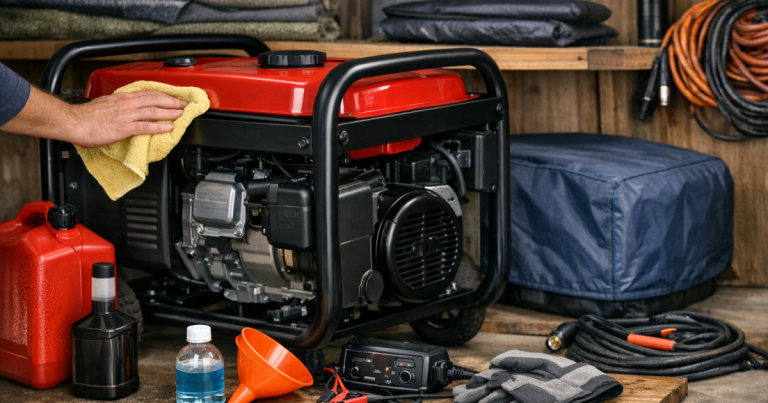
- Annual maintenance, oil, filters, battery checks, and service calls
A lower quote that skips permits, undersizes the fuel supply, or leaves unclear which circuits are backed up is not a bargain. A good proposal should show what the system will power, what it will not power, and what happens when large loads try to start.
Installation decisions that affect everyday reliability
Placement matters. A standby generator needs outdoor clearance from doors, windows, vents, property lines, and combustible materials according to manufacturer instructions and local code. It also needs service access, stable support, and a location where exhaust will not collect near living spaces.
Noise should be part of the conversation before installation day. Standby units exercise automatically, usually on a schedule, and they run continuously during an outage. Think about bedrooms, neighbors, patios, and property lines. Local noise ordinances and HOA rules can also affect placement.
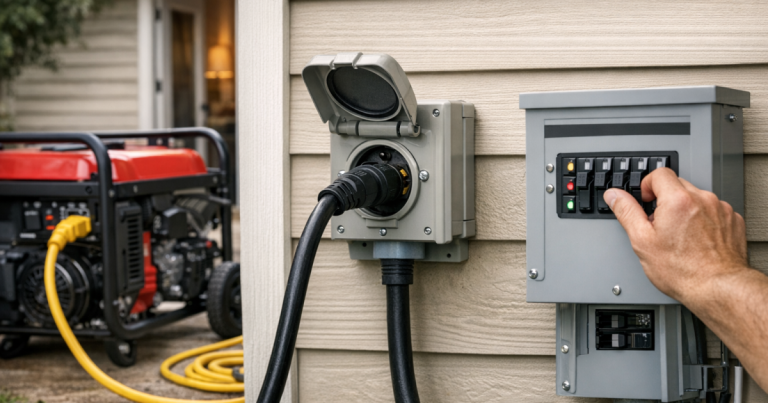
The transfer switch is just as important as the generator. It prevents the generator from backfeeding the utility grid and controls which circuits are supplied. For larger homes, load management modules may pause certain appliances so the generator can handle priority loads without tripping offline.
If your plan also includes portable backup gear, keep the systems clearly separated and safe. Portable generator placement, carbon monoxide risks, cords, and grounding deserve their own attention; the safety basics are covered in this portable generator safety guide.
What the evidence from real outages suggests
After a major outage, the households that are happiest with standby power usually did the unglamorous planning well. They knew which loads were backed up. Their fuel supply matched their expected runtime. The transfer switch was labeled. They had service records. They had already heard the generator exercise and knew what normal operation sounded like.
The disappointed households often expected “whole home” to mean unlimited power. A standby generator can be very capable, but it still has limits. Electric heat, central air, ovens, dryers, and water heaters can consume a lot of capacity. Running them all as if the grid were normal may exceed what the system was designed to do.
There is also a resilience argument for layering. Even with a standby generator, a small UPS for a router, battery lanterns, and charged power banks can smooth over transfer delays, maintenance downtime, or a generator fault. Redundancy does not have to be expensive; it just has to cover the moments when the main plan is not available.
Different views: automatic comfort or expensive overkill?
The case for standby power is simple: it is automatic, weather-resistant, and able to support heavier household loads than most battery-only setups. For homes with critical pumps, frequent outages, or residents who cannot safely manage portable equipment, that convenience is not a luxury. It can be the difference between a controlled outage and a stressful one.
The opposing view is also fair. Standby systems are expensive, permanent, and maintenance-dependent. They burn fuel, make noise, and require professional installation. If your realistic outage need is phones, lights, internet, and refrigeration for a short period, a smaller layered setup can be more practical.
The best answer is household-specific. A rural home with a well pump and repeated winter outages has a different risk profile than a suburban home with underground utilities and rare short interruptions. A medically sensitive household has a different planning threshold than a household that can comfortably relocate for a night.
Common questions
Can a standby generator power my central air conditioner?
Sometimes, but it depends on the generator size, the air conditioner’s starting load, and what else is running. Many homes need load management or a larger system to support central air reliably.
Is natural gas better than propane for a standby generator?
Natural gas is convenient where service is available and properly sized. Propane offers on-site storage, but tank size and refill access matter during long regional outages.
How long can a standby generator run?
Runtime depends on fuel supply, load, maintenance condition, and manufacturer guidance. Natural gas systems depend on utility service; propane systems depend on tank capacity and consumption rate.
Do I still need batteries or a UPS if I have a standby generator?
Often, yes. A UPS can keep internet gear or sensitive electronics running during the transfer delay and gives you a backup layer if the generator is being serviced.
Will a standby generator increase home value?
It can be attractive to some buyers, especially in outage-prone areas, but value depends on installation quality, permits, maintenance records, and whether the system matches the home’s needs.
Final thoughts
A standby generator is most useful when it is designed around a real outage plan, not a vague promise of whole-home comfort. Decide which loads matter, confirm the fuel supply, insist on code-compliant installation, and understand the maintenance before you commit.
For the right home, automatic backup can make storm season calmer and safer. For others, a layered plan with batteries, a portable generator, stored water, lighting, and clear routines may be the better first move. The goal is not to buy the biggest system possible. It is to keep the household safe, comfortable enough, and connected when the grid is down.