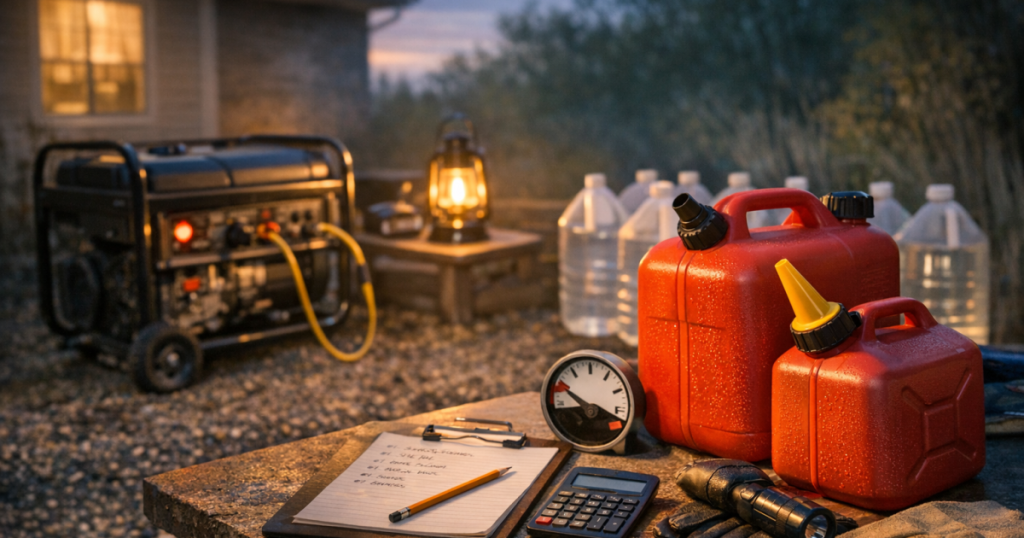
A generator can make a long outage feel manageable, but only if the fuel plan is as realistic as the power plan. Good generator fuel planning starts with deciding what must run, how long it runs each day, and how much fuel you can safely store and replace.
The goal is not to run everything nonstop. It is to keep the household safe, food cold, basic devices charged, and essential needs covered without burning through fuel on day one.
Permanent generator connections, transfer switch installation, and any home wiring used to feed household circuits should be carried out by a qualified electrician to meet local electrical codes, utility requirements, and manufacturer safety instructions.
The short version
For a multi-day outage, plan fuel around run windows, not 24-hour operation. Most households can reduce fuel use by powering essentials in blocks: cooling the refrigerator and freezer, recharging devices, running a furnace blower or well pump when needed, and keeping lights and communications covered with smaller batteries between generator sessions.
- List the loads that truly need generator power.
- Find your generator’s fuel use from the owner’s manual at a load close to your expected use.
- Multiply fuel burn per hour by planned run hours per day.
- Multiply that daily amount by the number of outage days you are planning for.
- Add a reserve for weather, heavier loads, starting surges, and delayed fuel access.
Before choosing run hours, it helps to decide what gets power first. If that list is still fuzzy, start with how to prioritize essential blackout loads so the fuel plan supports the right things.
Step 1: Decide what the generator is actually doing
A fuel plan falls apart when the generator becomes the default power source for everything. Start with the essential jobs, then work backward.
- Food protection: refrigerator and freezer cycles, plus a thermometer check so you are not guessing.
- Heat or cooling support: furnace blower, boiler controls, fans, or limited room cooling where appropriate.
- Water and safety: well pump, sump pump, garage door opener, security basics, or necessary lighting.
- Medical and daily needs: powered medical devices, mobility equipment charging, or refrigerated medications.
- Communication: phones, router, modem, laptop, weather radio, and rechargeable lights.
Some of these loads do not need to run constantly. A freezer may only need periodic generator time if it stays closed and remains at a safe temperature. Phones and lanterns can charge during the day and run from their own batteries overnight. A sump pump, on the other hand, may need more immediate power during heavy rain. Your fuel use should reflect those differences.
Step 2: Estimate fuel use from the generator, not from guesswork
The only useful starting point is the generator’s own fuel consumption information. Look in the manual for fuel use at different loads, often shown as a runtime estimate at a certain percentage of rated output. If the manual only gives a runtime per tank, divide the tank size by that runtime to estimate gallons per hour for that load level.
For example, if a manual says a generator runs a certain number of hours on a full tank at a listed load, that is a controlled estimate, not a guarantee. Real use can change with load, temperature, altitude, maintenance condition, fuel quality, and how often large motors start. Treat the number as a planning baseline and leave room for error.
A simple worksheet looks like this:
- Expected generator load: essential circuits and plug-in loads only.
- Estimated fuel burn: gallons per hour or pounds of propane per hour from the manual.
- Planned run time: hours per day.
- Daily fuel need: fuel burn multiplied by run time.
- Total fuel target: daily fuel need multiplied by outage days, plus reserve.
If your estimated fuel burn is 0.4 gallons per hour under your essential load and you plan to run the generator 8 hours per day, your starting estimate is 3.2 gallons per day. For three days, that is 9.6 gallons before adding reserve. This is only an example; your actual number should come from your generator, loads, and run schedule.
Step 3: Build a daily run schedule
A multi-day fuel plan usually works better when the generator has planned work periods. This reduces waste, keeps noise more predictable, and lets you pair high-demand tasks together.
Morning run
Use the morning window to cool the refrigerator and freezer, charge phones and power stations, make coffee or breakfast if your setup allows it, and run a well pump or furnace blower as needed. Avoid stacking every high-wattage appliance at once.
Afternoon check
If temperatures are high, food safety may drive an additional run. If weather is mild and doors stay closed, the afternoon may only be needed for battery charging, medical equipment, or water.
Evening run
The evening window is useful for topping off batteries, cooling food storage again, running lights, and preparing the house for overnight quiet hours. If a medical device, sump pump, or heat system needs overnight power, plan that separately instead of assuming the same schedule fits every household.
Load rotation matters here. Running the microwave, well pump, fridge, and window air conditioner at the same time can create a surge problem even if each item seems reasonable on its own. For a safer routine, use a generator load rotation plan so fuel savings do not turn into overloads.
Step 4: Match the fuel type to your outage reality
Different generator fuels change the plan. None is perfect, so think in terms of storage, resupply, weather, and how your household will handle the fuel safely.
Gasoline
Gasoline is common for portable generators and usually easy to understand, but it has storage limits and can be hard to find during widespread outages. Store it only in approved containers, keep it away from living spaces and ignition sources, and follow local fire rules. Rotate stored fuel according to the container and stabilizer guidance you use.
Propane
Propane can be convenient for homeowners who already use cylinders for grills or outdoor equipment. It stores differently than gasoline and may be easier to keep ready for longer periods, but cylinder size, regulator setup, cold-weather performance, and generator compatibility all matter. Verify your generator’s propane requirements before counting cylinders as usable backup fuel.
Diesel
Diesel is common in some larger generator setups but is less typical for smaller household portable units. Storage, fuel quality, cold-weather handling, and maintenance needs should be planned carefully.
Natural gas
Some standby and tri-fuel setups can use natural gas, which removes the need to store cans or cylinders on site. That does not mean it is unlimited in every emergency. Utility service, generator sizing, installation quality, and local conditions still matter. If you are still sorting out the basic generator categories, this overview of home backup generator types and safety basics is a useful next step.
Step 5: Plan safe storage before you buy extra fuel
Fuel storage is not just a math problem. It is a household safety problem, a local-code problem, and a practical handling problem.
- Use approved fuel containers designed for the fuel you are storing.
- Label containers clearly and keep them sealed when not in use.
- Store fuel away from living areas, heat, flames, pilot lights, and electrical ignition sources.
- Keep propane cylinders upright and outdoors in a suitable location.
- Do not refuel a hot running generator; shut it down and let it cool according to the manual.
- Keep a fuel log so you know what is fresh, what was used, and what needs rotating.
Never run a generator indoors, in a garage, in a shed, on a porch, or near open windows and doors. Carbon monoxide can build up quickly and without warning. Your fuel plan should include safe outdoor placement, weather protection that does not block ventilation, and working carbon monoxide alarms inside the home.
Step 6: Decide how much reserve is enough
A reserve is the fuel you do not plan to use unless conditions change. It covers a freezer that needs more runtime in hot weather, a longer-than-expected outage, an extra sump pump cycle, or a delayed gas station trip.
For many households, the best reserve is not simply more fuel. It may be lower usage. That could mean switching from whole-room lighting to rechargeable lanterns, charging phones from power banks, keeping the fridge closed longer, or postponing nonessential appliances. The less your generator has to do, the longer your stored fuel lasts.
Also think about resupply. If roads are blocked, stations are without power, or propane refill locations are closed, your plan should still cover the first stretch of the outage. If you live in a storm-prone, wildfire shutoff, or rural service area, plan around the fuel you can safely store at home rather than assuming a quick refill run will be available.
A simple three-day fuel planning example
Here is a realistic way to think through a three-day outage without pretending every house uses the same amount of fuel.
- Daytime essentials: refrigerator, freezer, device charging, router, a few lights, and limited water pumping.
- Comfort load: furnace blower in cold weather or fans in warm weather.
- Run schedule: morning and evening blocks, with an extra afternoon block only if food temperature, weather, or medical needs require it.
- Fuel math: use the generator manual’s burn rate at your expected load and multiply it by the total scheduled hours.
- Reserve: keep extra capacity for weather, starting surges, and the possibility that the outage lasts into another day.
This kind of plan is more dependable than simply filling every can you own. It ties fuel to actual household needs and makes trade-offs visible before the lights go out.
Helpful questions
How many gallons of gas do I need for a three-day outage?
There is no universal number. Use your generator manual’s fuel burn estimate, multiply by planned daily run hours, then multiply by three days and add a reserve. A lightly loaded generator running in scheduled blocks will use far less than one running continuously.
Should I run a generator overnight?
Only if an essential load truly needs it and the generator can be operated safely outdoors with proper carbon monoxide protection. Many households save fuel by charging batteries and cooling food storage before bedtime, then shutting the generator down overnight.
Is propane better than gasoline for multi-day outages?
It depends on your generator, storage space, climate, and resupply options. Propane can be convenient to store, while gasoline is widely used in portable generators. Verify fuel compatibility, expected consumption, and safe storage rules before relying on either one.
Can I store generator fuel in my garage?
Follow local fire rules and the fuel container instructions. Fuel should be kept away from living spaces, ignition sources, heat, and appliances with pilot lights. Propane cylinders should be stored upright outdoors in an appropriate location.
What if I cannot safely store enough fuel?
Reduce generator demand. Prioritize food safety, medical needs, communications, and basic comfort, then use batteries, lanterns, cooler discipline, and shorter run windows to stretch the fuel you can safely keep on hand.
The big picture
A strong fuel plan is calm, specific, and flexible. Know your essential loads, estimate fuel use from the generator manual, schedule run windows, store fuel safely, and build in a reserve for the messy parts of real outages.
You do not need to power your normal life for several days. You need a safe, repeatable routine that keeps the important things running while using fuel carefully. That is what makes a generator useful when a blackout lasts longer than expected.