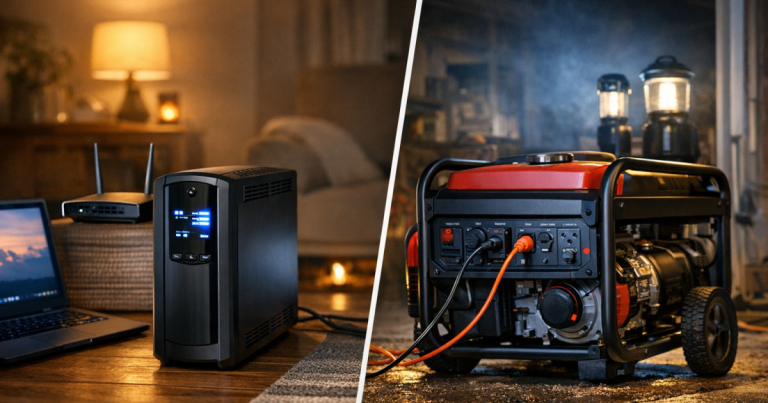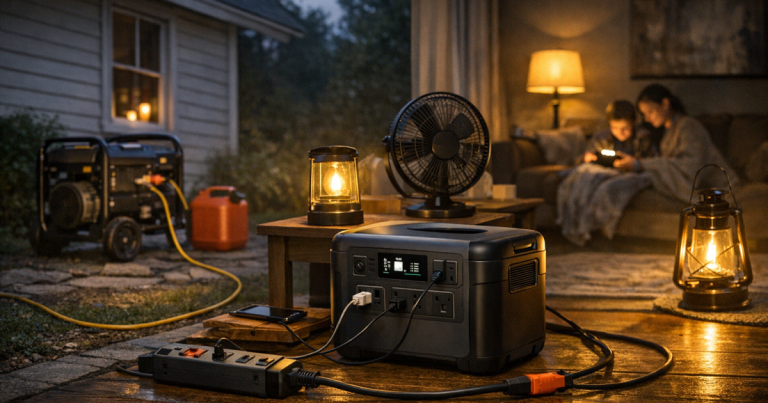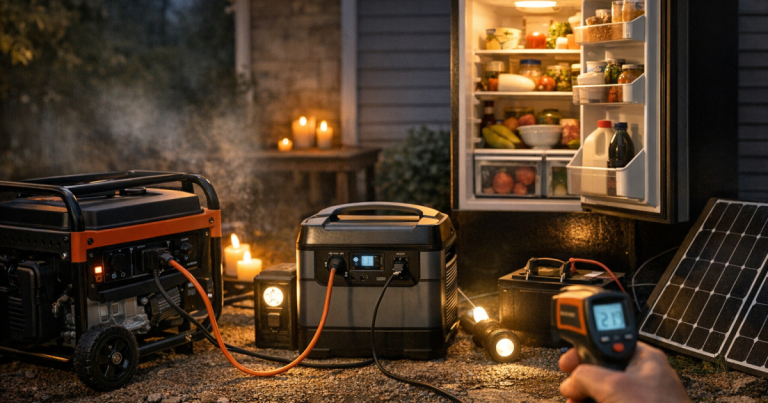
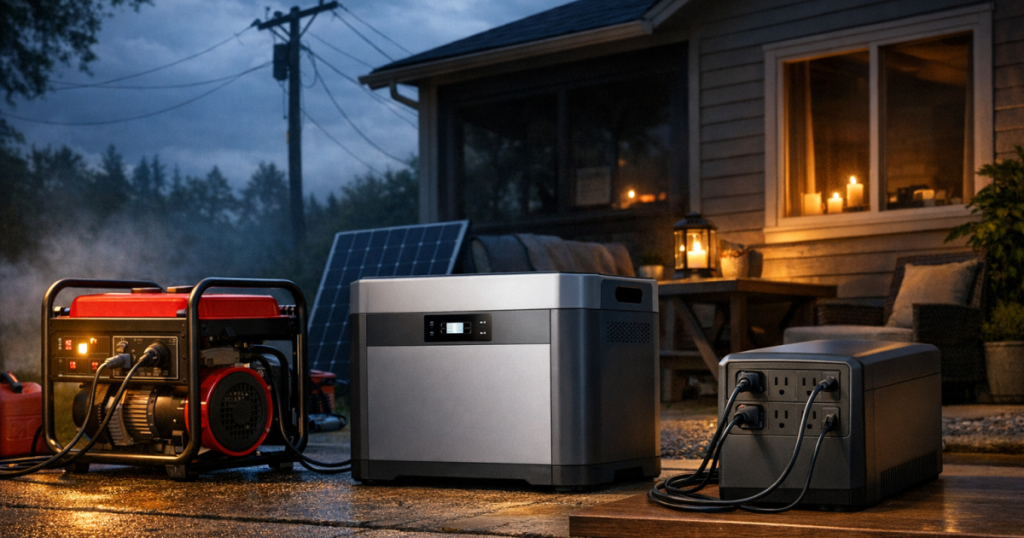
A sensible home outage backup plan starts with the jobs you need power to do, not with the biggest machine you can find. A fridge, phone, router, medical device, sump pump and a few lights all behave differently during a blackout. Generators, battery backups and UPS units can all help, but they solve different parts of the problem.
Transfer switch installation, interlock wiring and any connection between backup equipment and household circuits should be carried out by a qualified electrician in compliance with local electrical codes, the National Electrical Code and applicable safety requirements.
The short version
If you want a quick way to think about the three options, use this hierarchy:
- Generator: best for longer outages, heavier loads and homes that need to run essentials for many hours or days, provided it can be used safely outdoors with fuel on hand.
- Battery backup: best for quiet indoor power, apartments, night-time use, electronics, lights and short-to-medium essential loads, with runtime limited by battery capacity and recharge options.
- UPS: best for instant backup for a router, modem, desktop computer, network gear or other sensitive electronics, usually for minutes to a few hours rather than whole-home support.
The right answer is often a layered setup: a UPS for internet and electronics, a battery backup for quiet indoor essentials, and a generator for longer outages where outdoor operation is practical.
Why the difference matters during a real blackout
A two-hour outage on a mild afternoon is mostly inconvenient. A 24-hour storm outage with a fridge full of food, a remote worker in the house and a cold night forecast is different. A three-day grid failure after a hurricane, ice storm or wildfire shutoff is different again.
backup power choices matter because every system has limits. A generator can keep going as long as it is maintained, fuelled and operated safely, but it brings noise, exhaust, storage and setup considerations. A battery backup is quiet and simple indoors, but once the stored energy is used, it needs recharging. A UPS reacts almost instantly, but it is designed to bridge interruptions and protect electronics, not to carry a household through a long outage.
For wider planning by household scenario, the Outage Essentials blog is a useful next step once you know which power category fits your situation.
Generators: strong output, real safety rules
A portable generator is the traditional choice for running higher-demand essentials during extended outages. It can be useful for refrigerators, freezers, some heating or cooling equipment, well pumps, sump pumps and selected household circuits when sized and connected correctly.
The big advantage is endurance. Unlike a battery, a generator does not depend on stored electrical capacity alone. If you have safe fuel storage, routine maintenance and suitable weather protection for outdoor operation, it can support a home for much longer than most portable battery systems.
The trade-off is that generators are not casual indoor appliances. They must run outdoors, away from doors, windows, vents and garages because carbon monoxide can build up quickly and invisibly. A practical spacing rule is to keep the generator at least 6 metres from openings, with exhaust directed away from the home, while also following the manufacturer’s instructions and local rules.
Connection method matters too. Plugging appliances directly into a generator with properly rated outdoor extension cords is different from powering household circuits. Feeding a panel requires a transfer switch or approved interlock setup so the generator cannot backfeed utility lines. Manual transfer switch kits such as the Reliance Controls 306CRK Pro/Tran 2 30A 6-Circuit Transfer Switch Kit show the type of equipment households may discuss with an electrician, but compatibility, circuit selection and installation requirements need to be verified for the home.
Where a generator makes sense
- You own a detached home or have a safe outdoor operating area.
- You expect outages lasting 12 hours, 24 hours or several days.
- You need to run motor loads such as a fridge, freezer, sump pump or well pump.
- You can store fuel safely and rotate it according to local fire rules and manufacturer guidance.
- You are prepared to test, maintain and operate the generator before storm season.
Battery backup: quiet indoor power with a capacity ceiling
Battery backup can mean a portable power station, a larger home battery system or a battery paired with solar panels. For many renters, apartment households and neighbourhoods with strict noise expectations, this is the more comfortable option because it produces no exhaust at the point of use and can run indoors.
Portable battery systems are especially helpful for phones, tablets, laptops, LED lights, routers, small fans and some medical or comfort devices, provided the device’s power needs are within the unit’s rating. Larger battery systems can support more, but the same basic rule applies: stored energy is finite.
Runtime depends on three things: the battery’s usable capacity, the wattage of the devices connected, and efficiency losses. A small LED lamp may run for a long time. A heater, kettle, microwave or large appliance can drain capacity quickly or exceed the output limit entirely. For outage planning, it is safer to build around modest essentials than to assume a battery can behave like the grid.
Some portable power stations, such as the EcoFlow DELTA 3 Plus Portable Power Station, help readers understand the category: rechargeable, indoor-friendly backup power with multiple output options. Before relying on any model, verify its continuous output rating, surge handling, usable capacity, recharge time, supported solar input and whether it is suitable for the specific device you plan to power.
Where battery backup fits best
- Apartments, condos and homes where a generator is not practical.
- Quiet overnight power for phones, lights, a router or a small fan.
- Short outages where you mainly need comfort, communication and basic electronics.
- Homes that want a clean indoor layer alongside a generator used outdoors during longer outages.
- Households that can recharge from the wall before storms, a vehicle where appropriate, solar panels or a generator during extended events.
UPS units: instant protection, not whole-home backup
A UPS, or uninterruptible power supply, is the small but important piece people often overlook. It sits between the wall outlet and sensitive electronics, switching to battery power when utility power drops or flickers. That instant handover is the point.
For remote workers, a UPS can keep a modem, router, network switch or desktop computer alive long enough to save work, stay on a call briefly or shut down safely. It can also reduce the frustration of repeated momentary outages that reset equipment even when the blackout only lasts seconds.
A UPS is not designed to run a fridge, space heater, coffee maker or a room full of appliances. Its capacity is usually modest, and runtime falls fast as load increases. For outage use, it is most effective when connected only to the devices that truly need instant continuity.
Units such as the CyberPower CP1500PFCLCD are examples of consumer UPS equipment used for computers and networking gear. Before choosing one, check the equipment wattage, outlet layout, battery replacement guidance, waveform requirements and expected runtime at the load you intend to connect.
Where a UPS earns its place
- Keeping internet equipment running during brief outages or generator changeovers.
- Protecting a desktop computer from sudden shutdowns.
- Giving a home office a few minutes to save work and shut down cleanly.
- Bridging the gap while a larger battery system or generator is being started.
- Reducing nuisance resets from flickers and brownouts.
How the three options compare in household use
There is no single winner because each option has a different role. The better question is which loads you need to support, for how long, and under what living conditions.
- For a fridge and freezer: a generator is often the practical long-outage choice, while a sufficiently rated battery may help for shorter periods. A UPS is generally the wrong tool for this job.
- For internet and phones: a UPS or battery backup is usually cleaner and quieter than starting a generator for a small load.
- For apartments: battery backup and UPS units are usually more realistic than generators because indoor generator use is unsafe and outdoor placement may not be available.
- For medical devices: check the device’s wattage, start-up needs, runtime requirements and manufacturer guidance. Keep a written backup plan and discuss critical power needs with the relevant healthcare provider or equipment supplier.
- For pumps and hardwired circuits: a generator connected through approved equipment is usually the more capable route, but circuit selection and installation need professional handling.
- For quiet night-time use: a battery backup can carry lights, phones and small electronics without engine noise, fuel handling or exhaust concerns.
The layered approach most homes should consider
A resilient home outage backup setup does not have to be oversized. It should be organised. Start with the devices that protect safety, food, communication and basic comfort, then decide which power source matches each job.
A practical layered plan might look like this:
- Layer 1: a UPS for modem, router and one work computer or network setup.
- Layer 2: a portable battery backup for phones, LED lights, a laptop, rechargeable radio and small comfort items.
- Layer 3: a generator for longer outages, fridge or freezer cycling, pumps, selected circuits and battery recharging when conditions allow safe outdoor use.
This approach avoids two common mistakes. The first is expecting a UPS to do too much. The second is firing up a generator for tiny loads that a quiet battery could handle more comfortably indoors.
Two competing views: simple kit or full backup system?
Some households want the simplest possible setup: a charged battery station, a UPS on the router and a few rechargeable lights. For renters, older adults, apartment dwellers and people dealing mostly with short outages, that can be a sensible and low-maintenance plan.
Other households need a more robust system. Rural homes with well pumps, frequent storm outages or a freezer full of food may find that a generator and professionally installed transfer equipment are more realistic than relying on batteries alone. In wildfire shutoff areas, fuel access, air quality, neighbourhood noise and solar recharge options all become part of the decision.
The important point is not to copy someone else’s setup. A suburban family with a safe generator pad has different options than an apartment renter on the fifth floor. A remote worker needs different protection than a household mainly worried about refrigerated medication. Your backup plan should follow your loads, building type, outage pattern and safety constraints.
Questions people ask
Can a UPS run my refrigerator?
Usually, no. Most consumer UPS units are meant for electronics, not motor-driven appliances. Refrigerators can have start-up surges, and runtime would usually be poor even if the UPS could handle the load.
Is a battery backup safer than a generator?
Battery backups avoid exhaust at the point of use and can run indoors, which makes them easier for many households. They still have capacity, charging and placement limits, so use them according to the manufacturer’s instructions.
Do I need a transfer switch for a generator?
You need proper transfer equipment if the generator will power household circuits through the electrical panel. Direct appliance connection with rated cords is a different setup, but backfeeding a home circuit is unsafe.
What should remote workers prioritise?
Put the modem, router and key work device on a UPS, then keep a charged battery backup for longer runtime. That gives you instant protection plus a quieter extended layer.
Can solar panels replace a generator?
Sometimes they can help, but solar recharge depends on panel size, weather, placement and battery capacity. For multi-day outages with heavy loads, solar alone may not cover everything.
Why it matters
Generators, battery backups and UPS units are not rivals as much as they are tools with different strengths. A generator handles sustained work when used safely outdoors. A battery backup keeps indoor essentials quiet and manageable. A UPS protects the few electronics that cannot tolerate even a brief power drop.
If you are building a household plan from scratch, write down your must-run devices, their power needs and the outage length you are preparing for. Then choose the smallest safe combination that covers those needs without pretending every appliance can run as normal.
For questions about the site’s editorial approach and affiliate links, see the Affiliate Disclosure. If you have a scenario you would like us to cover in a future planning guide, you can also contact Outage Essentials.