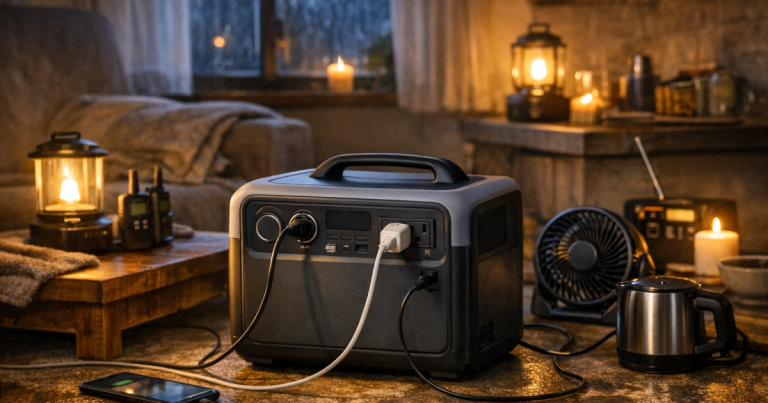
A blackout feels more manageable when the essentials keep working: phones, routers, a few lights, maybe a fridge or CPAP. For many households, portable power stations are the simplest indoor backup option because they store electricity in a rechargeable battery instead of burning fuel. The catch is that they are not miniature whole-home generators. They are best when you ask them to cover specific jobs, for a specific window of time, and with a clear charging plan.
Hardwired connections to household circuits, transfer equipment, or electrical panels should be carried out by a qualified electrician to comply with local electrical codes, manufacturer instructions, and safety requirements.
What to know first
A battery backup unit can be a very good blackout tool when the goal is comfort, communication, refrigeration support, or medical-device runtime. It is usually a poor fit when the goal is electric heating, central air conditioning, electric cooking, well-pump starting loads, or running a whole house as if the grid never failed.
The practical question is not “How big is the battery?” by itself. The better question is: “Which devices must run, how many watts do they use, and how long do they need to stay on?” Once you answer that, portable power stations become much easier to understand. A compact unit may handle phones, lamps, and a router for many hours. A larger unit may support a refrigerator in cycles, a laptop workday, or overnight medical equipment. None of that means it can run every appliance at once.
Think of battery backup as a controlled essentials system. It works best when you decide in advance what matters most: keeping internet gear online, preserving food, powering a bedside medical device, charging phones, or keeping one room usable with lights and fans.
What they can do well during a home outage
The strongest use case is low-to-moderate power for devices that matter a lot but do not draw huge wattage. These loads are usually quiet, indoor-safe, and easy to plug in directly.
- Phones, tablets, and small electronics: These are easy wins. A battery unit can usually recharge multiple devices many times, depending on capacity and what else is plugged in.
- Wi-Fi router and modem: Internet equipment often uses modest power, making it a good match if your service line remains active. For setup details, see how to keep internet gear online with a portable power station.
- LED lamps and rechargeable lights: Efficient lighting gives a strong comfort boost without draining the battery quickly.
- Laptops and work gear: Remote workers can often stretch runtime by charging only when needed and lowering screen brightness.
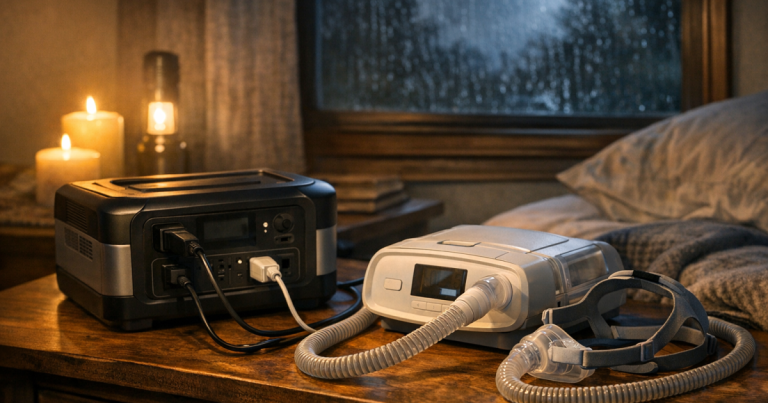
- CPAP machines and similar bedside devices: These can be good candidates, but users should verify the device wattage, humidifier draw, battery compatibility, and required runtime before relying on any setup.
- Small fans: In a summer outage, a fan can make one room much more tolerable for far less energy than air conditioning.
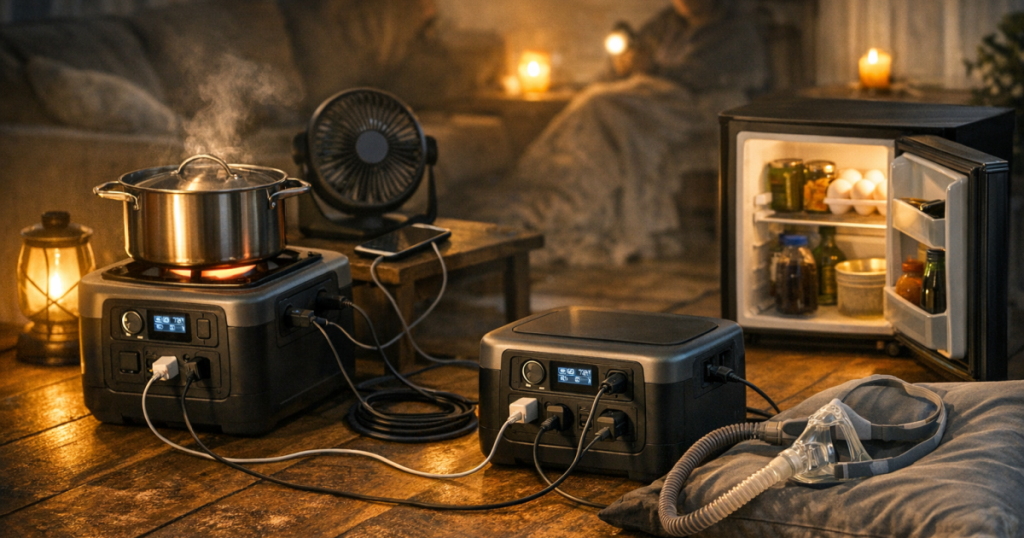
Some batteries can also help with refrigerator or freezer management, but expectations matter. A fridge does not draw the same power every minute; it cycles on and off. The compressor startup surge, room temperature, door openings, appliance age, and battery inverter rating all affect real runtime. A battery may help bridge a short outage or rotate power to a fridge for part of the day, but it is not a guaranteed multi-day food safety solution without enough capacity and a recharge plan.
What they usually cannot do
The limit is not just capacity. It is also output. A battery may have plenty of stored energy on paper but still fail if an appliance needs more watts than the inverter can provide, especially during startup.
- Central air conditioning: Whole-home cooling typically demands far more power than a plug-in battery station is meant to supply.
- Electric space heaters: Resistance heat uses a lot of energy. Even if a battery can start a small heater, runtime is usually disappointing and can drain the unit quickly.
- Electric ranges, ovens, and clothes dryers: These are high-draw appliances and are generally not realistic loads for simple battery backup.
- Electric water heaters: Heating water electrically is energy-intensive and not a good use of limited stored power.
- Hardwired furnaces and HVAC equipment: These are not plug-and-play loads. Any connection to household wiring needs proper transfer equipment and professional installation.
- Well pumps and sump pumps: Some pumps have high starting surges. Compatibility must be verified from the pump label, starting requirements, and the battery’s output ratings.
There are larger home battery systems designed for critical circuits or whole-home integration, but that is a different category from a movable battery box with outlets. It involves electrical design, code-compliant installation, and usually a much larger budget.
Runtime is an estimate, not a promise
Battery capacity is usually shown in watt-hours. A simplified way to estimate runtime is to divide usable watt-hours by the watts your devices draw. For example, if a setup has roughly 800 usable watt-hours and the connected load averages 80 watts, the simple estimate is about 10 hours.
Real life is messier. Inverter losses, temperature, battery age, device cycling, surge loads, and manufacturer reserve settings all change the result. That is why the best planning method is to test your actual gear before storm season, not rely only on a chart.
A useful approach is to create three load groups:
- Always-on essentials: Router, modem, medical device, or one safety light.
- Rotating loads: Refrigerator, freezer, laptop charging, small fan, or phone charging hub.
- Skip during outage: Anything heat-producing, decorative, inefficient, or nonessential.
If overnight power is the priority, trimming loads matters more than squeezing every outlet full. For a practical load-shedding routine, use this step-by-step guide to make a portable power station last overnight.
Charging plans matter as much as battery size
A battery backup is only as useful as its next recharge. For a short evening outage, wall charging before the storm may be enough. For a longer outage, you need a plan for the second day.
Common recharge paths include a wall outlet before the outage, a vehicle outlet during limited use, compatible solar panels, or a generator used outdoors and away from windows, doors, vents, and attached garages. Solar can help, but it is weather-dependent and slower than many people expect once clouds, shade, panel angle, and short winter days are considered.
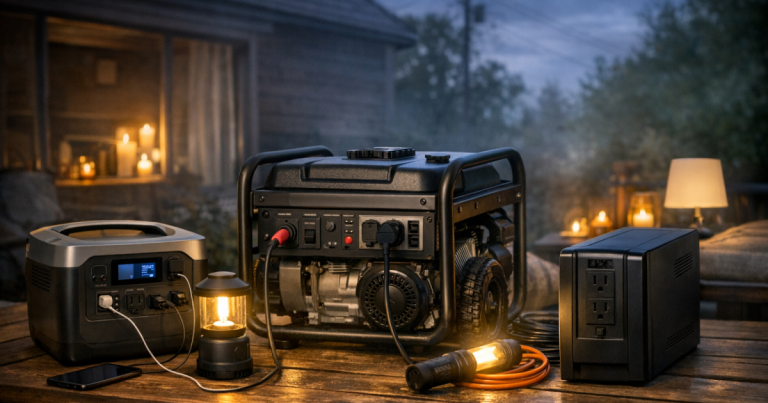
Generator charging can make sense for some homes because the generator can run outdoors for a limited window while the battery stores power for quiet indoor overnight use. That can reduce noise at night and avoid running extension cords constantly through the living space. It does not remove generator safety rules: fuel-burning generators stay outside, never in a garage or enclosed area, and refueling should be done only when the generator is off and cooled according to the manual.
How to decide what belongs on the battery
Start with your outage priorities, not the outlets on the unit. A simple home plan might look like this:
- Apartment renter: Phones, router, LED lamp, laptop, fan, and a weather radio. The battery stays indoors and avoids fuel storage issues.
- Suburban family: Router, phones, fridge rotation, a few lights, and device charging. Cooking and heating are handled separately with safe non-electric plans.
- Remote worker: Modem, router, laptop, monitor only if needed, phone, and one task light. The goal is work continuity, not running the whole room normally.
- Medication-focused household: Medical device needs, refrigeration monitoring, phone access, and a clear backup plan if runtime is shorter than expected.
For a real-world example of how a modern battery performs within limits, the EcoFlow DELTA 3 Plus review is useful because it looks at blackout practicality instead of pretending one box solves every outage problem.
Checks to make before you rely on one
Before the next storm warning or planned shutoff, do a short household audit. It does not need to be complicated, but it should be specific.
- Read the appliance labels: Look for watts, amps, and voltage. If only amps are listed, watts are roughly amps multiplied by volts.
- Check startup surge: Refrigerators, freezers, pumps, and some tools can need extra power at startup.
- Match outlets and cables: Confirm whether your devices need AC outlets, USB-C, USB-A, DC barrel ports, or a car-style 12-volt socket.
- Test before the outage: Run the actual devices for a few hours and record battery percentage drop.
- Store it ready: Follow the manufacturer’s guidance for charge level, temperature, and maintenance charging.
- Keep cords simple: Avoid overloaded power strips and long daisy chains. Use properly rated cords and keep walkways clear.
- Plan for heat and cold separately: Batteries are not a substitute for safe heating, cooling centers, insulation, shade, or checking on vulnerable household members.
Also be honest about noise and neighborhood constraints. Battery units are quiet indoors, which is one reason they work well for apartments, townhomes, and overnight use. If your outage plan depends on a generator for recharging or heavier loads, compare the broader trade-offs in portable vs standby backup power for home outages.
Where they fit in a whole-home resilience plan
Portable power stations are not a complete outage plan by themselves. They are one layer. The rest of the plan includes food safety, lighting, communication, heat or cooling strategy, medical needs, water access, and a way to receive local alerts.
For many households, the sweet spot is simple: use a battery for quiet indoor essentials, avoid wasting energy on high-draw appliances, and have a separate plan for cooking, warmth, and extended outages. That might mean a cooler and thermometer for fridge management, shelf-stable meals, rechargeable lanterns, a NOAA weather radio, and a written list of what gets plugged in first.
The biggest mistake is buying capacity without changing behavior. A large battery will still drain quickly if it is used like a wall outlet during normal life. The households that get the most value usually pre-decide the loads, label the cords, test the setup, and know what to turn off.
Questions people ask
Can a portable power station run a refrigerator?
Sometimes, but it depends on the refrigerator’s running watts, startup surge, door openings, room temperature, and battery capacity. Test your actual fridge before relying on it for food safety.
Is it safe to use one indoors?
Battery power stations are designed for indoor use because they do not burn fuel while operating. Follow the manual, keep vents clear, avoid wet locations, and do not overload the outlets.
Can I plug my whole house into one?
Not directly. Plug-in battery units are meant for connected devices, not backfeeding a panel. Any home-circuit connection requires proper transfer equipment installed by a qualified electrician.
How much battery capacity do I need for overnight use?
Add up the watts of the devices that must run, estimate the hours needed, then allow extra for losses and startup loads. Testing your real setup is the most reliable method.
Can solar panels keep it charged indefinitely?
Solar can extend runtime, but it depends on sun, panel size, weather, shade, and how much power you use. Treat solar as a helpful recharge source, not a guaranteed endless supply.
Key takeaways
A battery backup can make a blackout calmer by keeping communication, lighting, medical support, and selected appliances going. It cannot replace the grid for high-draw heating, cooling, cooking, or whole-home service without a larger installed system.
The best results come from planning modestly: pick the loads that truly matter, estimate runtime conservatively, test the setup, and decide how you will recharge if the outage lasts longer than one night. Used that way, portable power stations are one of the most practical tools for ordinary home outage planning.