A generator can make a long blackout far easier to manage, but only when it is planned around real household priorities. A home backup generator should support essentials first: refrigeration, medical equipment, heat controls, internet, phones, lights, and a few comfort items that genuinely matter during an outage. The goal is not to recreate normal grid power; it is to keep people safe and the house functional until utility power returns.
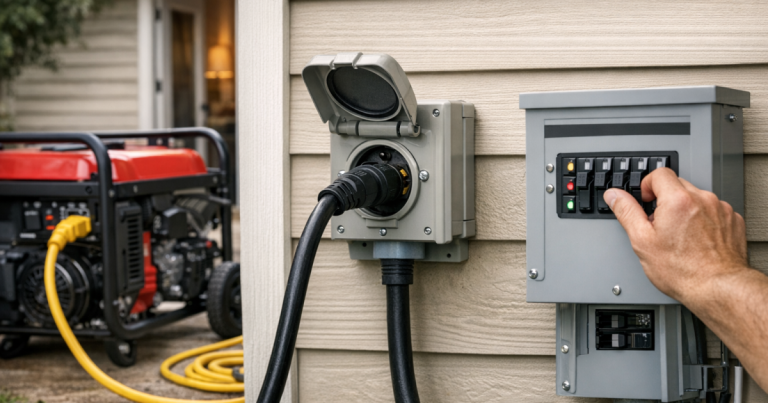
Generator transfer switches, interlock kits, inlet boxes, and any wiring that connects a generator to household circuits should be installed by a qualified electrician to comply with the National Electrical Code, local regulations, and safety requirements.
Main points
- Start with loads, not generator size. Decide what must run, what can wait, and what only needs short bursts of power.
- Portable generators and standby generators solve different problems. One is flexible and manual; the other is installed, automatic, and more involved.
- Fuel planning is as important as wattage. A powerful generator is not useful if fuel storage, refuelling, or availability breaks down during a storm.
- Connection method matters. Extension cords, transfer switches, and interlocks have different safety limits and convenience levels.
- Carbon monoxide risk is non-negotiable. Generators must run outdoors, away from doors, windows, vents, garages, and enclosed spaces.
What a generator is really for during a blackout
Most households do not need every circuit energised during an outage. They need a reliable way to cover the loads that protect food, health, communication, and basic comfort. That usually means a refrigerator or freezer, a few lights, device charging, internet equipment if service is still working, a furnace blower or boiler controls where applicable, and any essential medical equipment.
The mistake is sizing around the house on a normal day. Electric ovens, clothes dryers, central air conditioning, large well pumps, and whole-home heating loads can push requirements far beyond what many portable setups can handle. Some homes can support selected larger loads with the right equipment, but that is a planning decision, not something to assume because a generator has a large number printed on the box.
A useful first step is to decide which devices matter most before looking at generator output. A short essentials list prevents overspending and makes the eventual setup safer and easier to operate under stress.
The main generator types for homes
Portable open-frame generators
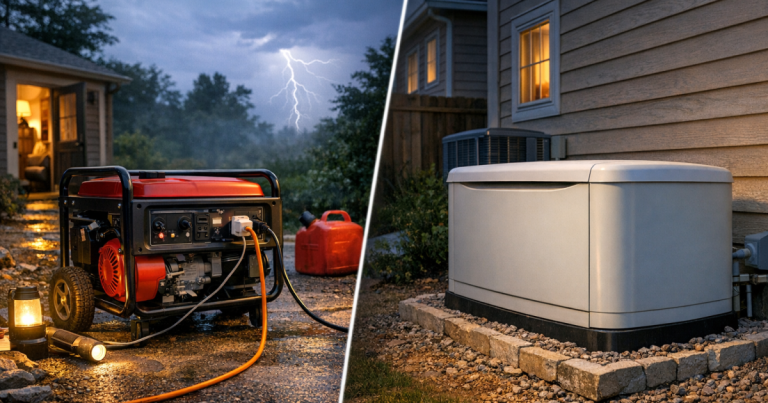
Open-frame portable generators are the familiar wheeled units used for job sites, storm backup, and temporary outdoor power. They can provide substantial output for the cost and can run selected household essentials when connected correctly. Their trade-offs are noise, fuel handling, manual setup, and the need to store them securely when not in use.
These units are often used with heavy-duty outdoor-rated extension cords for individual appliances, or with a professionally installed inlet and transfer equipment for selected circuits. They are not indoor appliances, and they should never be connected directly to a wall outlet or improvised house wiring.
Portable inverter generators
Inverter generators are usually quieter and more fuel-efficient at lighter loads than many traditional open-frame units. They are commonly used when neighbourhood noise, overnight operation, camping-style portability, or sensitive electronics are concerns. Output varies widely, so the important question is not whether it is an inverter generator, but whether it has enough continuous and starting capacity for the loads you plan to run.
For many homes, a midsize inverter generator can cover a refrigerator, lights, phones, internet gear, and a few small appliances if loads are managed carefully. It may not be enough for central air conditioning, large electric heating, or multiple high-demand appliances at once.
Dual-fuel and tri-fuel generators
Dual-fuel generators typically run on gasoline and propane. Tri-fuel generators add natural gas capability on models designed for it. The appeal is flexibility: if one fuel is hard to find, another may be available. The trade-off is that output can vary by fuel type, and connection requirements differ.
Propane stores more cleanly than gasoline for many households, but cylinders still need safe outdoor storage and refill planning. Natural gas avoids stored fuel but depends on the local gas supply remaining available and on a correctly sized, code-compliant connection. Do not assume a barbecue outlet, small hose, or casual adapter is suitable for a generator.
Installed standby generators
Standby generators are permanently installed outside the home and connected through automatic transfer equipment. They are designed to start when utility power fails and can support selected circuits or, in some cases, a broader household load. They are more convenient than portable setups but involve installation, permitting, fuel connection, maintenance, and a larger overall project.
Standby systems make the most sense when outages are frequent, household needs are high, or manual setup is unrealistic for the people living there. They are not a reason to skip load planning. Even installed systems have capacity limits, maintenance requirements, and fuel assumptions that should be clearly understood.
Sizing without getting lost in watts
A well-matched home backup generator starts with two numbers: running watts and starting watts. Running watts are what a device uses once it is operating. Starting watts are the brief surge some motors and compressors need when they start. Refrigerators, freezers, sump pumps, furnace blowers, and well pumps can all have starting loads that are higher than their running loads.
Rather than relying on generic appliance averages, check the nameplate, manual, or manufacturer information for your actual equipment. Older appliances, unusual HVAC setups, and pump systems can behave differently from typical examples. If the load is critical, verify it before an outage rather than discovering the mismatch during one.
A practical sizing process looks like this:
- List the devices that must run continuously, such as medical equipment, a refrigerator, or essential heating controls.
- Add devices that can run in rotation, such as a freezer, microwave, coffee maker, or small room fan.
- Note motor loads that may have a higher startup surge.
- Separate comfort loads from safety loads so you can shed non-essentials if the generator struggles.
- Leave headroom rather than planning to run at the generator’s maximum output for long periods.
For example, a household might plan for a refrigerator, a freezer, a few LED lights, phone charging, a modem and router, and occasional use of a microwave. That is very different from trying to run central air conditioning, an electric range, a dryer, and the rest of the home at the same time. The first scenario is realistic for many portable setups; the second often requires a larger installed solution and careful electrical planning.
Runtime is about load and fuel, not just tank size
Runtime claims are easy to misunderstand. A generator may run for many hours at a light load and much less time at a heavier load. Weather, elevation, maintenance condition, fuel type, and cycling loads can all change the result. Treat published runtime figures as a reference point, then plan conservatively.
It helps to think in outage blocks. For a 12-hour outage, you may only need refrigeration, lights, phones, and a short cooking window. For a 24-hour outage, fuel storage, freezer management, and overnight noise become more important. For a 3-day outage, refuelling, oil checks, safe storage, neighbourhood impact, and rest breaks become part of the plan.
If you want to estimate how long batteries, UPS units, or generator-supported devices might last, use the same load-first thinking you would use to calculate backup power runtime for essential devices. The exact maths changes by system, but the habit is the same: watts multiplied by hours tells you far more than a vague promise of “all-day power”.
Fuel choices and what they mean in real life
Gasoline is widely available and common for portable generators, but it requires safe storage, rotation, and careful refuelling. Store it only in approved containers, follow local limits, and keep it away from living areas, ignition sources, and children. During major storms, petrol stations may be closed, crowded, or unable to pump fuel if they have no power.
Propane is popular because cylinders store neatly outdoors and the fuel does not degrade in the same way gasoline can. It is useful for households that already use propane for grilling or heating, but generator output may differ on propane, and cold weather can affect cylinder performance. Check the generator manual rather than assuming identical behaviour across fuels.
Natural gas can be convenient for installed or tri-fuel systems because it avoids stored cans and cylinders. The limitation is dependency: the gas utility, pipe sizing, regulator setup, and generator requirements all have to line up. Any permanent gas connection belongs in the hands of qualified professionals and must meet local code.
Diesel appears in some larger home and commercial systems. It can be efficient and durable in the right application, but it brings its own storage, maintenance, noise, and emissions considerations. For many ordinary households, gasoline, propane, natural gas, or a battery-supported plan will be more common.
Safe ways to connect a generator
Extension cords for individual loads
The simplest portable setup is to run outdoor-rated, appropriately sized extension cords from the generator to individual appliances or power strips rated for the load. This can work for a refrigerator, freezer, lamp, phone charger, or small electronics setup. Keep cords routed to avoid trip hazards, water exposure, pinching under doors, or overheating.
This method does not energise built-in circuits, so it will not run hardwired equipment such as many furnace systems, well pumps, or built-in lighting circuits. It is simple, but it has limits.
Manual transfer switches and interlocks
A manual transfer switch or interlock allows selected household circuits to be powered from a generator while preventing dangerous backfeed into utility lines. This is the cleaner route for hardwired loads, but it requires proper equipment, correct installation, and clear labelling so the household knows which circuits are supported.
Backfeeding through a dryer outlet, range outlet, or any improvised cord is dangerous. It can injure utility workers, damage equipment, and create fire or shock hazards. A safe generator plan never depends on a workaround that bypasses transfer protection.
Automatic transfer equipment
Installed standby generators use automatic transfer equipment to separate the home from utility power and start the generator when an outage is detected. This is convenient, but it still needs maintenance, testing, clear load management, and a fuel plan. Automatic does not mean maintenance-free.
Carbon monoxide, placement, and refuelling
Carbon monoxide is one of the most serious generator hazards because it is invisible and can build up quickly. Run generators outdoors only, at least 6 metres from doors, windows, vents, crawlspace openings, and attached garages. Point exhaust away from the home and neighbouring homes, and use working carbon monoxide alarms on every level of the house.
Never run a generator in a garage, basement, shed, porch, sunroom, carport, or near an open window. Opening a door or using a fan does not make an enclosed or semi-enclosed space safe. If wind direction changes, reposition the unit so exhaust still moves away from occupied areas.
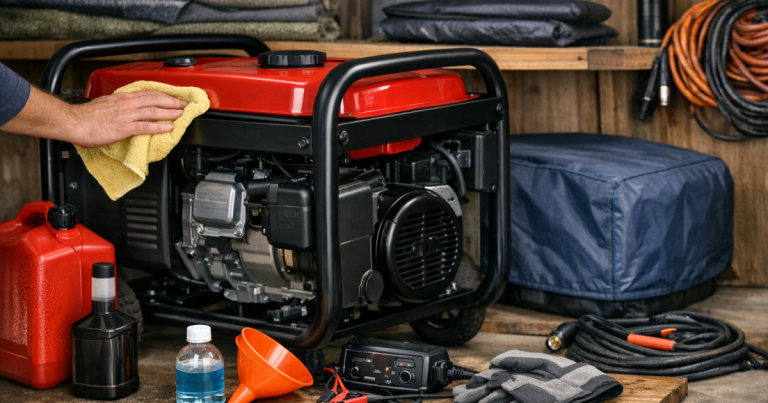
Refuelling also deserves discipline. Turn the generator off and let it cool before adding fuel. Keep fuel containers away from the hot engine and exhaust. At night, use a headlamp or lantern rather than rushing with a can in the dark. A calm refuelling routine is safer than trying to stretch one more hour from a hot, running machine.
Where batteries and UPS units fit
A generator is not always the best answer for every load. Small electronics, routers, medical devices with modest draw, and overnight quiet hours may be better served by a UPS or portable power station. Batteries are silent indoors and do not create exhaust, but they have finite stored energy and need a way to recharge during longer outages.
Many resilient households use a layered plan: a UPS for the router and computer, a portable power station for phones and small essentials, and a generator for refrigeration, longer outages, or higher loads. If you are weighing a generator, battery backup, and UPS setup, the right answer often depends on outage length, noise tolerance, fuel access, and whether you live in an apartment, suburb, or rural area.
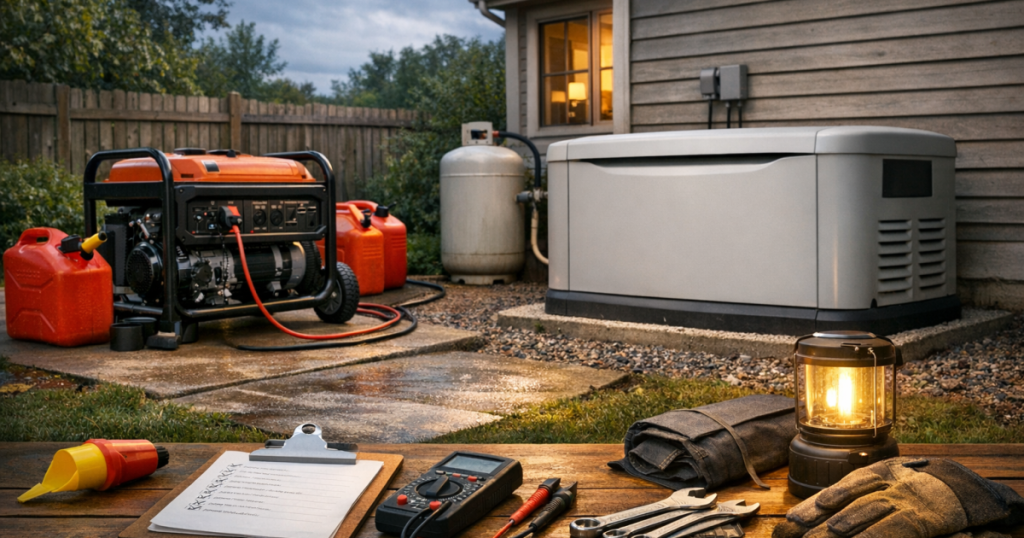
A simple planning checklist
- Write down the top five loads that matter in a blackout.
- Check running and starting watt information for those loads.
- Decide whether you will use extension cords, selected circuits, or an installed standby system.
- Plan where the generator will sit outdoors with safe exhaust clearance.
- Confirm how much fuel you can store safely and legally.
- Keep carbon monoxide alarms working and replace ageing units as required by their manufacturer.
- Test the setup before storm season, not during the outage.
- Label cords, circuits, and shutoff steps so another adult can operate the plan.
FAQ
Can a portable generator run my whole house?
Usually not in the way people imagine. A portable generator can run selected essentials when sized and connected correctly, but whole-house loads such as central air conditioning, electric heating, ovens, and dryers can exceed many portable setups.
How far should a generator be from the house?
Use at least 6 metres of outdoor clearance from doors, windows, vents, crawlspace openings, and attached garages, and point the exhaust away from occupied spaces. More distance is better when your cord setup and property layout allow it.
Do I need a transfer switch?
You need proper transfer equipment if you want to power household circuits from a generator. If you only power individual plug-in appliances with suitable extension cords, a transfer switch is not used for those loads.
Is propane better than gasoline for outages?
Neither is automatically better. Propane stores cleanly and is convenient for cylinders, while gasoline is widely available and common for portable units. Compare safe storage, local availability, generator output on each fuel, and your likely outage length.
Can I run a generator overnight?
Only if it is outdoors, positioned safely for exhaust, fuelled appropriately, and operated within local noise rules and the manufacturer’s instructions. For quiet overnight electronics, a battery or UPS may be a better fit.
Why it matters
A good generator plan feels almost boring when the power goes out: the fridge stays cold, phones stay charged, the house has light, and everyone knows what happens next. That level of calm comes from making a few decisions ahead of time: what to power, how to connect it safely, where the fuel comes from, and when to shut loads off.
The strongest home backup plans are not built around the biggest generator on the shelf. They are built around realistic needs, safe installation, sensible fuel habits, and enough practice that the first storm is not the first test.