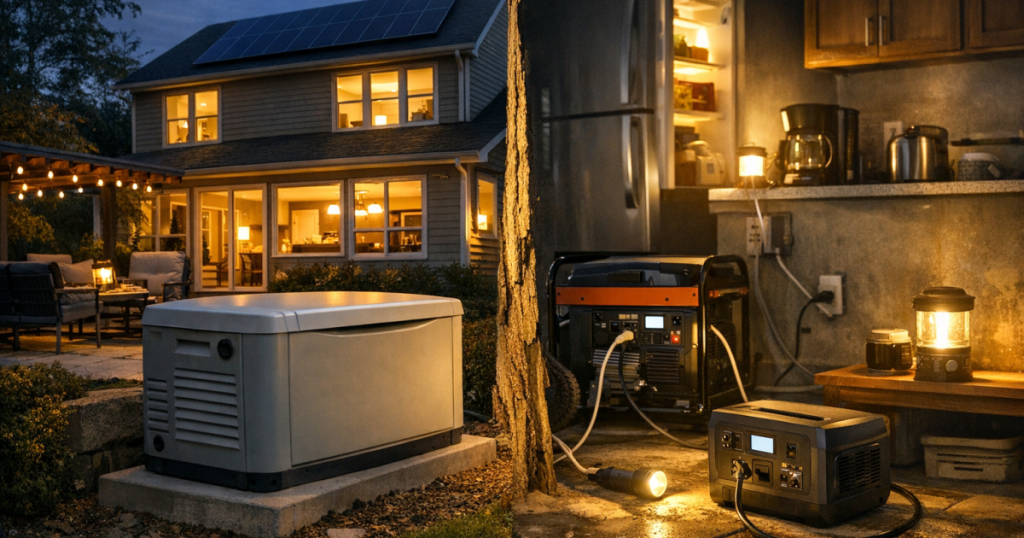
A blackout plan gets easier once you stop thinking in terms of “powering the house” and start thinking about what life needs to keep moving. For many households, essential-load backup power covers the refrigerator, internet gear, a few lights, medical or comfort equipment, and phone charging without trying to run every appliance at once. Whole-home backup is broader, but it also brings larger equipment, more fuel or battery capacity, and more planning.
Transfer-switch installation, interlock setup, and any hardwired panel connections should be carried out by a qualified electrician to meet local electrical codes, manufacturer instructions, and safety requirements.
Main points
- Whole-home backup aims to keep most or all household circuits available, often through a standby generator, large portable generator with proper connection equipment, or a larger battery system.
- Essential-load planning focuses on the circuits and devices that protect food, communication, health needs, basic lighting, and comfort.
- The right answer depends less on house size and more on load priorities, starting watts, runtime expectations, fuel storage, noise limits, and how long outages usually last in your area.
- Many homes are better served by a reliable essentials plan than by an oversized system that is expensive, hard to fuel, or poorly matched to real outage needs.
What “whole-home” really means
Whole-home backup sounds simple: the grid goes down, backup power starts, and the house continues as normal. In practice, there are limits. A true whole-home setup must account for high-demand loads like central air conditioning, electric heat, well pumps, electric water heaters, ovens, clothes dryers, and multiple refrigerators or freezers. Some systems can handle these loads; others require load management so they do not all start at once.
That distinction matters because the label “whole-home” can create false confidence. A system may be connected to the whole panel but still have rules about which appliances can run together. A large generator may be able to power many circuits, but only if fuel is available, exhaust is managed safely outdoors, and the connection is code-compliant. A battery system may be quiet and convenient, but runtime depends heavily on how many watts the home is drawing hour after hour.
Whole-home backup tends to make the most sense when the house has critical hardwired systems, frequent long outages, medical or accessibility needs, a well pump, sump pump risk, or household members who cannot easily adapt to a lower-power routine. It can also be the right fit for homeowners who want automatic operation and are prepared for the cost, installation work, maintenance, and space requirements that come with a larger setup.
What an essentials plan looks like day to day
An essentials plan starts from a different question: what needs power for the household to stay safe, informed, fed, and reasonably comfortable? That usually means refrigeration, phones, a router or modem if internet service is still available, a few lamps or LED lanterns, a furnace blower or boiler controls where compatible, medical devices such as a CPAP machine, and possibly a sump pump or well pump depending on the home.
This approach is practical because blackouts are not normal days. You are not trying to bake, do laundry, run every TV, charge every tool battery, and cool the whole house at once. You are trying to keep food from spoiling, keep communication open, avoid unsafe extension cord habits, and make the next 12 to 72 hours manageable.
The best starting point is a room-by-room circuit list. Identify which breaker controls the refrigerator, freezer, internet gear, garage door opener, furnace controls, sump pump, bedroom outlets, and lighting zones. If you have not done this yet, use a simple circuit map and label the panel clearly; mapping essential circuits for backup power is one of the most useful steps before you choose any equipment.
The trade-offs that decide the plan
The whole-home versus essentials decision is really a set of trade-offs. More coverage feels convenient, but every added load increases capacity requirements and can shorten runtime. A smaller, focused plan may require more discipline, but it is often easier to fuel, test, store, and operate safely.
- Capacity: Add up running watts and starting watts for the loads that matter. Motors, compressors, and pumps can need a surge of power when they start, even if their running load is lower.
- Runtime: A backup source that can technically power a device may not power it long enough to solve the problem. Runtime estimates should be treated as planning tools, not guarantees.
- Fuel or recharging: Generators need safe outdoor placement and fuel planning. Battery systems need charging time and may need solar, generator, or grid recharging between outage cycles.
- Noise and neighbors: A quiet inverter generator or battery setup may be easier to live with overnight than a louder open-frame generator, especially in dense neighborhoods.
- Installation complexity: Hardwired connections, transfer switches, and interlocks change what is possible, but they also require proper installation and clear operating steps.
- Budget discipline: Bigger systems can solve more problems, but oversizing for rare conveniences can crowd out basics like safe cords, lighting, fuel storage, food thermometers, and communication gear.
If the numbers feel fuzzy, work backward from your actual outage routine. Estimate the loads you would run during breakfast, overnight, and the hottest or coldest part of the day. The planning method in how much backup power your outage plan needs can help turn a wish list into a realistic load plan.
Three realistic household scenarios
Apartment or townhouse with short outages
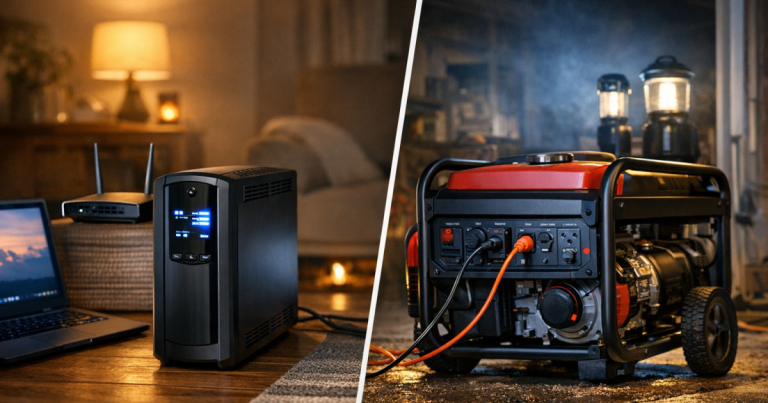
For renters and townhouse residents, whole-home backup is usually not realistic because generator placement, fuel storage, exhaust clearance, and panel access are limited. A focused essentials setup often works better: a UPS for modem and router, charged power banks for phones, rechargeable lanterns, and possibly a portable power station for a laptop, small fan, or medical device after verifying wattage and runtime needs.
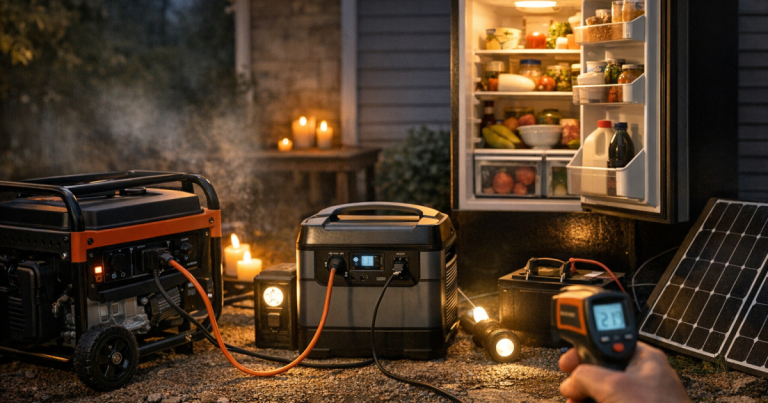
The priority here is quiet, indoor-safe power from batteries, not running large appliances. Food safety becomes more about keeping the refrigerator and freezer closed, using thermometers, and having a cooler plan if the outage runs long.
Suburban home with fridge, heat controls, and internet needs
A suburban household may be a good candidate for a small generator, portable power station, or hybrid plan. Instead of energizing every circuit, the household might prioritize the refrigerator, furnace blower or controls where compatible, modem and router, phone charging, several lights, and one cooking alternative that does not depend on the main electric range.
This is where essential-load backup power often hits the sweet spot. The family gets comfort and stability without assuming that every appliance can run normally. If central air conditioning, an electric water heater, or an electric dryer is part of the wish list, the system size and connection method need a more careful review.
Rural home with well pump or longer outage history
Rural homes often have different stakes. A well pump, pressure tank, septic components, chest freezer, or longer utility restoration times can push the plan toward a larger generator or more robust battery-plus-generator strategy. Even then, it may still be an essentials plan rather than a true whole-home plan. The difference is that the essential list is larger and may include hardwired loads that cannot be handled safely with casual extension cords.
For rural homes, fuel logistics matter as much as wattage. A generator that looks adequate on paper becomes less useful if fuel cannot be stored safely, transported during storms, or managed during a multi-day outage.
Transfer switches, cords, and safe operation
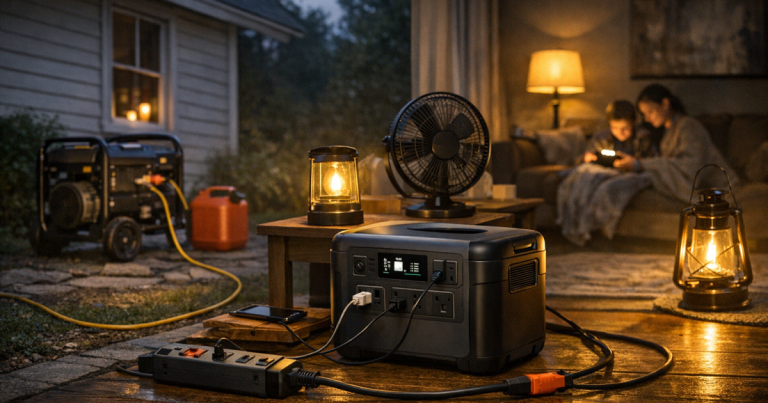
Essential circuits can be powered in more than one way. Small plug-in loads may run from a UPS, portable power station, or properly rated extension cord from an outdoor generator. Hardwired circuits require a transfer switch, interlock, or other approved connection method so backup power does not backfeed the utility lines or energize the home in an unsafe way.
A manual transfer switch can make an essentials plan cleaner because selected circuits are clearly assigned and switched during an outage. It also forces useful decisions before the storm: which six, eight, or ten circuits actually matter? For operating steps and limitations, read how to use a manual transfer switch during an outage before you need it in the dark.
Portable generators must run outdoors, away from doors, windows, vents, garages, crawl spaces, and enclosed porches, with exhaust directed away from the home. Refuel only after the generator is shut down and cooled according to the manual. Carbon monoxide alarms with fresh batteries belong on every level of the home, regardless of which backup strategy you choose.
Why advice on this topic can sound conflicting
One contractor may recommend a large standby generator. A neighbor may say a small inverter generator is enough. A battery installer may focus on silent backup and solar charging. None of those views is automatically wrong; they are solving different problems.
Whole-home systems prioritize convenience and continuity. They can reduce the number of decisions a household has to make during an outage, especially when automatic start and load management are part of the setup. The trade-off is cost, maintenance, fuel or battery sizing, and more complex installation.
Essentials-based systems prioritize resilience with limits. They ask the household to live smaller for a while, but they can be easier to understand and maintain. They also encourage better load discipline, which is useful no matter how much equipment you eventually add.
The mistake is treating “whole-home” as automatically better or “essentials” as automatically bare minimum. A well-planned essentials setup can outperform a larger but poorly understood system. A whole-home setup can be worthwhile when it is sized honestly, installed correctly, and matched to the household’s outage history.
How to make the choice
Choose whole-home backup when the household genuinely needs broad circuit coverage, has frequent or long outages, relies on hardwired systems, and is ready for professional installation, maintenance, and fuel or battery planning. It is strongest when convenience, automatic operation, and continuity are worth the added complexity.
Choose an essentials plan when the goal is to stay safe, connected, and reasonably comfortable without powering normal life at full scale. This is often the better first step for renters, budget-conscious homeowners, remote workers, and families who mainly need refrigeration, communication, lighting, and a few comfort loads.
A sensible path is to map circuits first, estimate loads second, and decide on equipment third. That order prevents overspending and also prevents the opposite problem: buying something too small for the loads that actually matter. If the plan starts with real circuits and real outage routines, the choice becomes much clearer.
Straight answers
Can a portable generator power a whole house?
Some large portable generators can power many household circuits through approved connection equipment, but that does not mean every appliance can run at once. Starting watts, fuel use, transfer equipment, and load management still set the limits.
Is an essentials-only plan enough for a refrigerator and freezer?
Often, yes, if the backup source can handle the starting surge and has enough runtime or fuel. Confirm the appliance wattage, avoid adding too many loads at the same time, and use thermometers to track food safety.
Should I include central air conditioning in my backup plan?
Central air usually requires much more capacity than lights, internet gear, and refrigeration. Some homes plan for a smaller window unit or one cooled room instead, but compatibility and load limits must be checked carefully.
What is the first circuit most homes should identify?
Start with the refrigerator, then identify any medical, heating, sump pump, well pump, internet, and lighting circuits that affect safety or basic comfort. Labeling these before an outage saves time and reduces guesswork.
Can I start with essentials and expand later?
Yes. Many strong outage plans begin with batteries, lighting, communication, and refrigerator support, then expand to a transfer switch, generator, or larger system after the household understands its real loads.
Why it matters
Backup power is not about recreating a normal day. It is about keeping the household steady when the grid is unavailable. Whole-home backup can be the right answer for some homes, but essential-load planning is often the clearer, safer, and more affordable foundation. Once you know what must stay on, what can wait, and what each load really demands, the right backup plan becomes a practical household decision instead of a guessing game.